







West Azarbaijan balances heritage preservation with expanding tourism
During the first six months of this year, more than 225,000 tourists visited the museums of West Azarbaijan Province, said the director general of the province’s Cultural Heritage, Tourism, and Handicrafts Organization.
Morteza Safari told IRNA that Takht-e Soleyman in Takab, Qareh Kelisa (Saint Thaddeus Cathedral ) in Chaldoran, and Baqcheh Jooq Palace Museum, located between Maku and Bazargan, attracted the most visitors during this period.
He noted that all museums in the province are open and ready to welcome tourists.
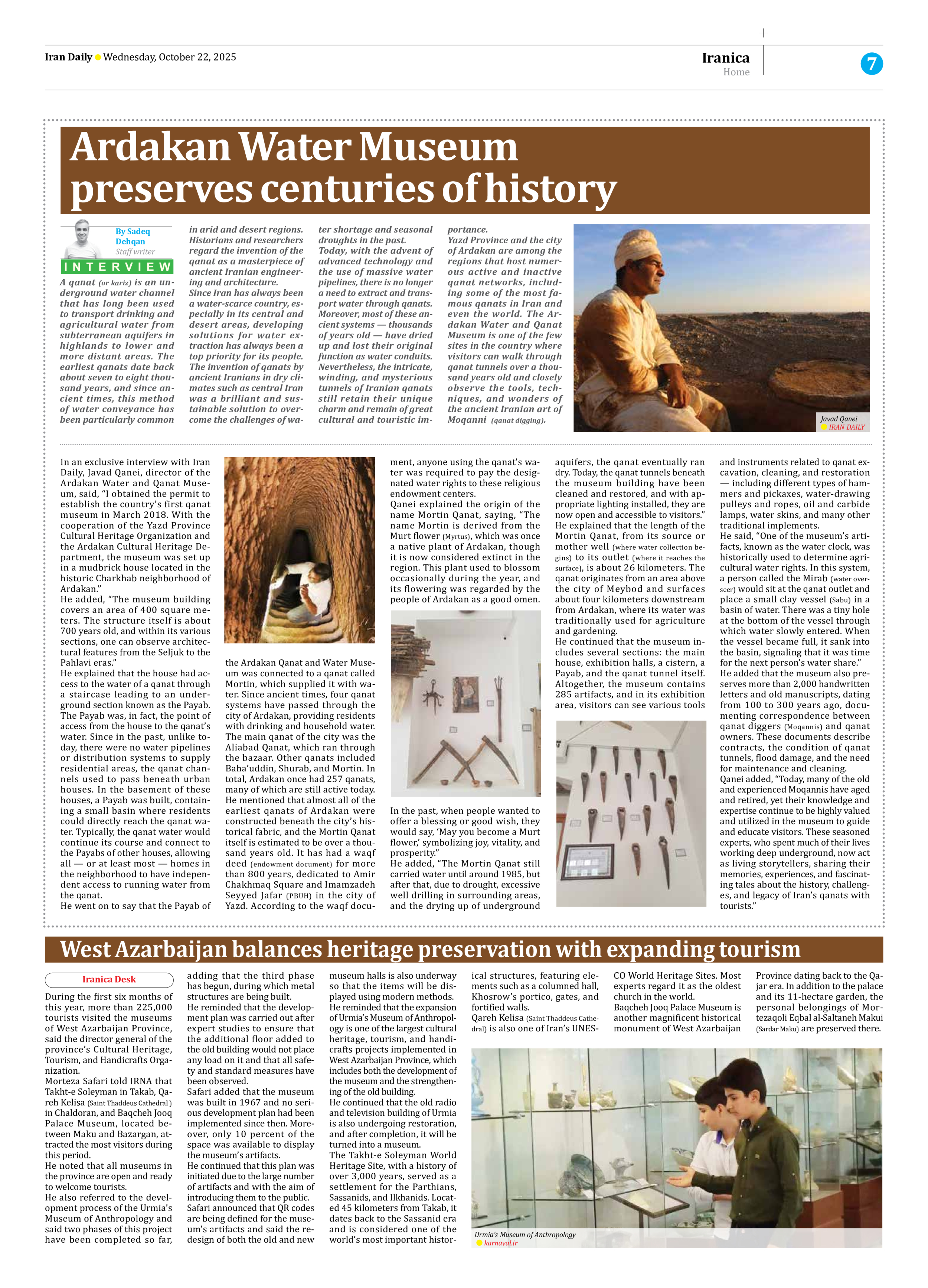
He also referred to the development process of the Urmia’s Museum of Anthropology and said two phases of this project have been completed so far, adding that the third phase has begun, during which metal structures are being built.
He reminded that the development plan was carried out after expert studies to ensure that the additional floor added to the old building would not place any load on it and that all safety and standard measures have been observed.
Safari added that the museum was built in 1967 and no serious development plan had been implemented since then. Moreover, only 10 percent of the space was available to display the museum’s artifacts.
He continued that this plan was initiated due to the large number of artifacts and with the aim of introducing them to the public.
Safari announced that QR codes are being defined for the museum’s artifacts and said the redesign of both the old and new museum halls is also underway so that the items will be displayed using modern methods.
He reminded that the expansion of Urmia’s Museum of Anthropology is one of the largest cultural heritage, tourism, and handicrafts projects implemented in West Azarbaijan Province, which includes both the development of the museum and the strengthening of the old building.
He continued that the old radio and television building of Urmia is also undergoing restoration, and after completion, it will be turned into a museum.
The Takht-e Soleyman World Heritage Site, with a history of over 3,000 years, served as a settlement for the Parthians, Sassanids, and Ilkhanids. Located 45 kilometers from Takab, it dates back to the Sassanid era and is considered one of the world’s most important historical structures, featuring elements such as a columned hall, Khosrow’s portico, gates, and fortified walls.
Qareh Kelisa (Saint Thaddeus Cathedral) is also one of Iran’s UNESCO World Heritage Sites. Most experts regard it as the oldest church in the world.
Baqcheh Jooq Palace Museum is another magnificent historical monument of West Azarbaijan Province dating back to the Qajar era. In addition to the palace and its 11-hectare garden, the personal belongings of Mortezaqoli Eqbal al-Saltaneh Makui (Sardar Maku) are preserved there.