







Ardakan Water Museum preserves centuries of history
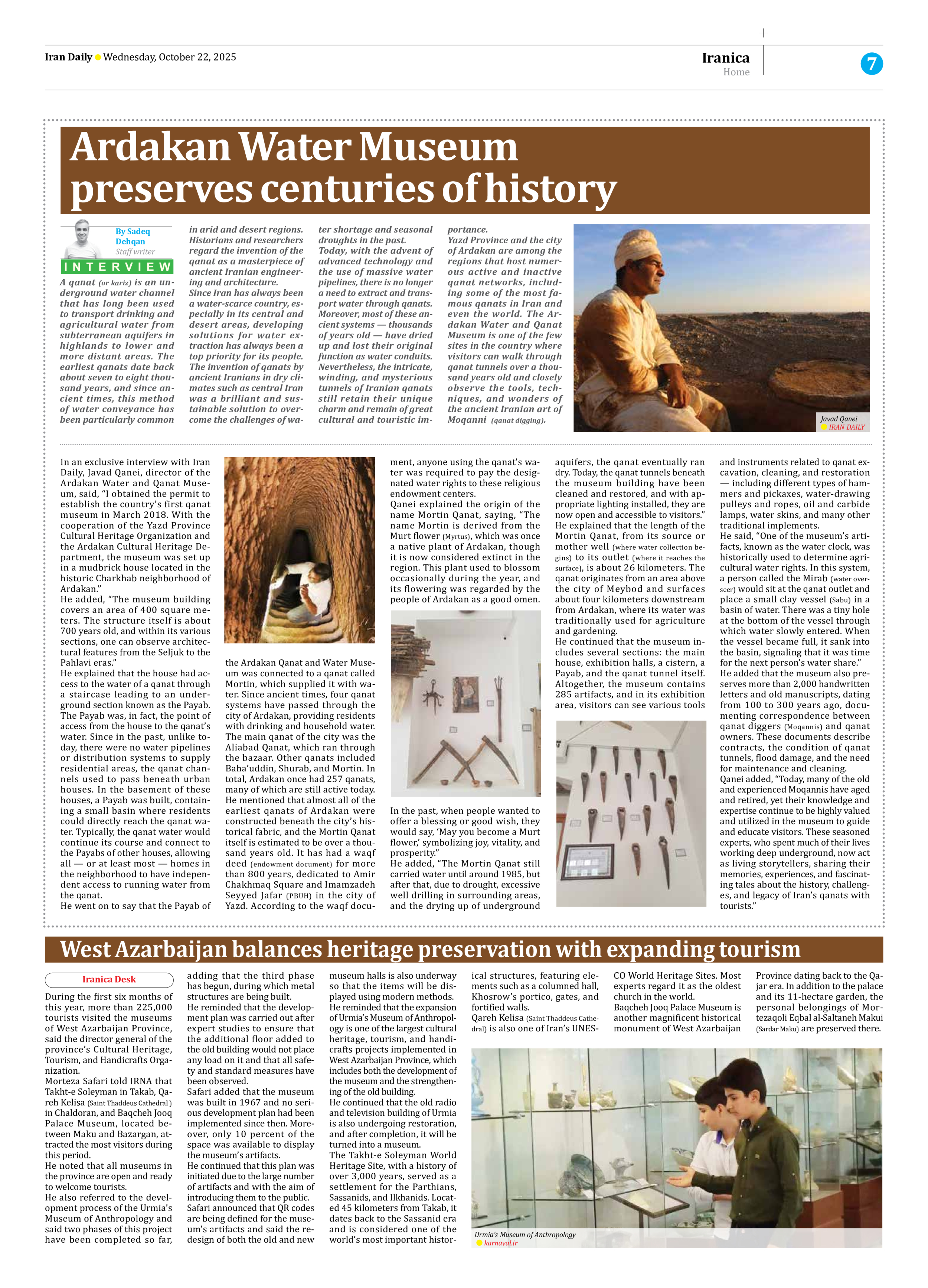
A qanat (or kariz) is an underground water channel that has long been used to transport drinking and agricultural water from subterranean aquifers in highlands to lower and more distant areas. The earliest qanats date back about seven to eight thousand years, and since ancient times, this method of water conveyance has been particularly common in arid and desert regions. Historians and researchers regard the invention of the qanat as a masterpiece of ancient Iranian engineering and architecture. Since Iran has always been a water-scarce country, especially in its central and desert areas, developing solutions for water extraction has always been a top priority for its people. The invention of qanats by ancient Iranians in dry climates such as central Iran was a brilliant and sustainable solution to overcome the challenges of water shortage and seasonal droughts in the past. Today, with the advent of advanced technology and the use of massive water pipelines, there is no longer a need to extract and transport water through qanats. Moreover, most of these ancient systems — thousands of years old — have dried up and lost their original function as water conduits. Nevertheless, the intricate, winding, and mysterious tunnels of Iranian qanats still retain their unique charm and remain of great cultural and touristic importance. Yazd Province and the city of Ardakan are among the regions that host numerous active and inactive qanat networks, including some of the most famous qanats in Iran and even the world. The Ardakan Water and Qanat Museum is one of the few sites in the country where visitors can walk through qanat tunnels over a thousand years old and closely observe the tools, techniques, and wonders of the ancient Iranian art of Moqanni (qanat digging).
By Sadeq Dehqan
Staff writer
In an exclusive interview with Iran Daily, Javad Qanei, director of the Ardakan Water and Qanat Museum, said, “I obtained the permit to establish the country’s first qanat museum in March 2018. With the cooperation of the Yazd Province Cultural Heritage Organization and the Ardakan Cultural Heritage Department, the museum was set up in a mudbrick house located in the historic Charkhab neighborhood of Ardakan.”
He added, “The museum building covers an area of 400 square meters. The structure itself is about 700 years old, and within its various sections, one can observe architectural features from the Seljuk to the Pahlavi eras.”
He explained that the house had access to the water of a qanat through a staircase leading to an underground section known as the Payab. The Payab was, in fact, the point of access from the house to the qanat’s water. Since in the past, unlike today, there were no water pipelines or distribution systems to supply residential areas, the qanat channels used to pass beneath urban houses. In the basement of these houses, a Payab was built, containing a small basin where residents could directly reach the qanat water. Typically, the qanat water would continue its course and connect to the Payabs of other houses, allowing all — or at least most — homes in the neighborhood to have independent access to running water from the qanat.
He went on to say that the Payab of the Ardakan Qanat and Water Museum was connected to a qanat called Mortin, which supplied it with water. Since ancient times, four qanat systems have passed through the city of Ardakan, providing residents with drinking and household water. The main qanat of the city was the Aliabad Qanat, which ran through the bazaar. Other qanats included Baha’uddin, Shurab, and Mortin. In total, Ardakan once had 257 qanats, many of which are still active today.
He mentioned that almost all of the earliest qanats of Ardakan were constructed beneath the city’s historical fabric, and the Mortin Qanat itself is estimated to be over a thousand years old. It has had a waqf deed (endowment document) for more than 800 years, dedicated to Amir Chakhmaq Square and Imamzadeh Seyyed Jafar (PBUH) in the city of Yazd. According to the waqf document, anyone using the qanat’s water was required to pay the designated water rights to these religious endowment centers.
Qanei explained the origin of the name Mortin Qanat, saying, “The name Mortin is derived from the Murt flower (Myrtus), which was once a native plant of Ardakan, though it is now considered extinct in the region. This plant used to blossom occasionally during the year, and its flowering was regarded by the people of Ardakan as a good omen. In the past, when people wanted to offer a blessing or good wish, they would say, ‘May you become a Murt flower,’ symbolizing joy, vitality, and prosperity.”
He added, “The Mortin Qanat still carried water until around 1985, but after that, due to drought, excessive well drilling in surrounding areas, and the drying up of underground aquifers, the qanat eventually ran dry. Today, the qanat tunnels beneath the museum building have been cleaned and restored, and with appropriate lighting installed, they are now open and accessible to visitors.”
He explained that the length of the Mortin Qanat, from its source or mother well (where water collection begins) to its outlet (where it reaches the surface), is about 26 kilometers. The qanat originates from an area above the city of Meybod and surfaces about four kilometers downstream from Ardakan, where its water was traditionally used for agriculture and gardening.
He continued that the museum includes several sections: the main house, exhibition halls, a cistern, a Payab, and the qanat tunnel itself. Altogether, the museum contains 285 artifacts, and in its exhibition area, visitors can see various tools and instruments related to qanat excavation, cleaning, and restoration — including different types of hammers and pickaxes, water-drawing pulleys and ropes, oil and carbide lamps, water skins, and many other traditional implements.
He said, “One of the museum’s artifacts, known as the water clock, was historically used to determine agricultural water rights. In this system, a person called the Mirab (water overseer) would sit at the qanat outlet and place a small clay vessel (Sabu) in a basin of water. There was a tiny hole at the bottom of the vessel through which water slowly entered. When the vessel became full, it sank into the basin, signaling that it was time for the next person’s water share.”
He added that the museum also preserves more than 2,000 handwritten letters and old manuscripts, dating from 100 to 300 years ago, documenting correspondence between qanat diggers (Moqannis) and qanat owners. These documents describe contracts, the condition of qanat tunnels, flood damage, and the need for maintenance and cleaning.
Qanei added, “Today, many of the old and experienced Moqannis have aged and retired, yet their knowledge and expertise continue to be highly valued and utilized in the museum to guide and educate visitors. These seasoned experts, who spent much of their lives working deep underground, now act as living storytellers, sharing their memories, experiences, and fascinating tales about the history, challenges, and legacy of Iran’s qanats with tourists.”