







Calls grow for a broader view of modern sculpture
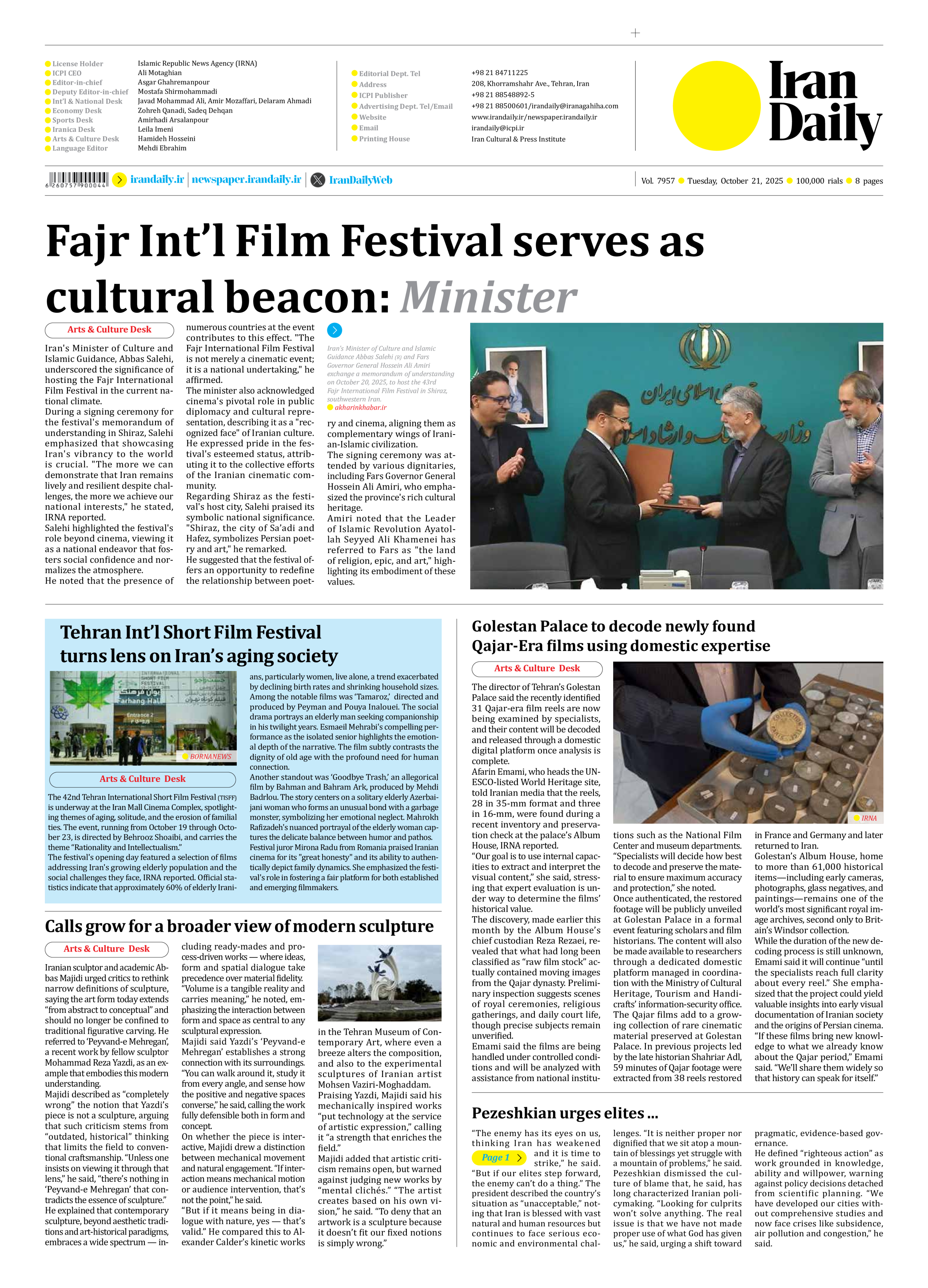
Iranian sculptor and academic Abbas Majidi urged critics to rethink narrow definitions of sculpture, saying the art form today extends “from abstract to conceptual” and should no longer be confined to traditional figurative carving. He referred to ‘Peyvand-e Mehregan’, a recent work by fellow sculptor Mohammad Reza Yazdi, as an example that embodies this modern understanding.
Majidi described as “completely wrong” the notion that Yazdi’s piece is not a sculpture, arguing that such criticism stems from “outdated, historical” thinking that limits the field to conventional craftsmanship. “Unless one insists on viewing it through that lens,” he said, “there’s nothing in ‘Peyvand-e Mehregan’ that contradicts the essence of sculpture.”
He explained that contemporary sculpture, beyond aesthetic traditions and art-historical paradigms, embraces a wide spectrum — including ready-mades and process-driven works — where ideas, form and spatial dialogue take precedence over material fidelity.
“Volume is a tangible reality and carries meaning,” he noted, emphasizing the interaction between form and space as central to any sculptural expression.
Majidi said Yazdi’s ‘Peyvand-e Mehregan’ establishes a strong connection with its surroundings. “You can walk around it, study it from every angle, and sense how the positive and negative spaces converse,” he said, calling the work fully defensible both in form and concept.
On whether the piece is interactive, Majidi drew a distinction between mechanical movement and natural engagement. “If interaction means mechanical motion or audience intervention, that’s not the point,” he said.
“But if it means being in dialogue with nature, yes — that’s valid.” He compared this to Alexander Calder’s kinetic works in the Tehran Museum of Contemporary Art, where even a breeze alters the composition, and also to the experimental sculptures of Iranian artist Mohsen Vaziri-Moghaddam.
Praising Yazdi, Majidi said his mechanically inspired works “put technology at the service of artistic expression,” calling it “a strength that enriches the field.”
Majidi added that artistic criticism remains open, but warned against judging new works by “mental clichés.” “The artist creates based on his own vision,” he said. “To deny that an artwork is a sculpture because it doesn’t fit our fixed notions is simply wrong.”