







Copy in clipboard...
Golestan Palace to decode newly found Qajar-Era films using domestic expertise
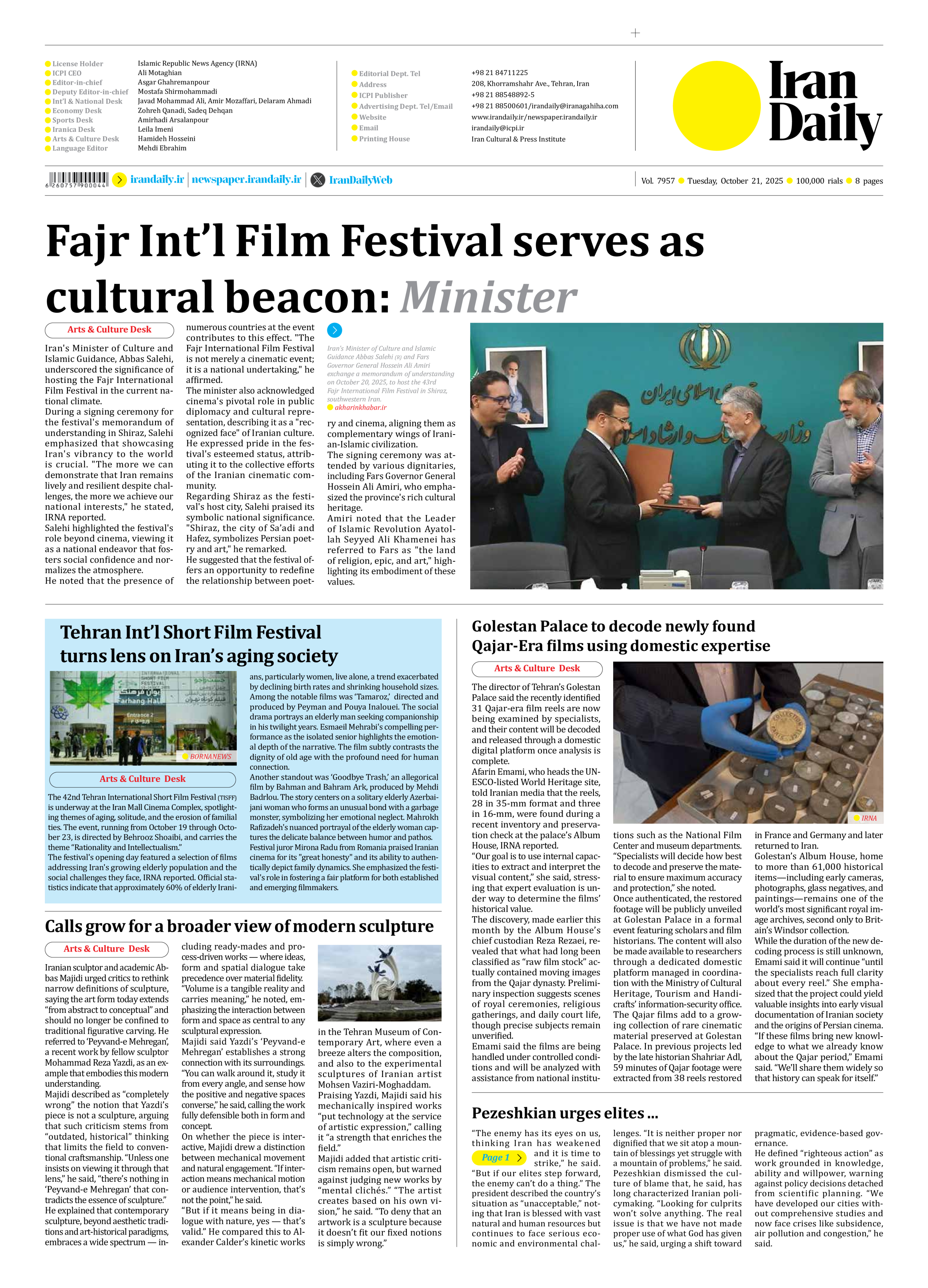
The director of Tehran’s Golestan Palace said the recently identified 31 Qajar-era film reels are now being examined by specialists, and their content will be decoded and released through a domestic digital platform once analysis is complete.
Afarin Emami, who heads the UNESCO-listed World Heritage site, told Iranian media that the reels, 28 in 35-mm format and three in 16-mm, were found during a recent inventory and preservation check at the palace’s Album House, IRNA reported.
“Our goal is to use internal capacities to extract and interpret the visual content,” she said, stressing that expert evaluation is under way to determine the films’ historical value.
The discovery, made earlier this month by the Album House’s chief custodian Reza Rezaei, revealed that what had long been classified as “raw film stock” actually contained moving images from the Qajar dynasty. Preliminary inspection suggests scenes of royal ceremonies, religious gatherings, and daily court life, though precise subjects remain unverified.
Emami said the films are being handled under controlled conditions and will be analyzed with assistance from national institutions such as the National Film Center and museum departments.
“Specialists will decide how best to decode and preserve the material to ensure maximum accuracy and protection,” she noted.
Once authenticated, the restored footage will be publicly unveiled at Golestan Palace in a formal event featuring scholars and film historians. The content will also be made available to researchers through a dedicated domestic platform managed in coordination with the Ministry of Cultural Heritage, Tourism and Handicrafts’ information-security office.
The Qajar films add to a growing collection of rare cinematic material preserved at Golestan Palace. In previous projects led by the late historian Shahriar Adl, 59 minutes of Qajar footage were extracted from 38 reels restored in France and Germany and later returned to Iran.
Golestan’s Album House, home to more than 61,000 historical items—including early cameras, photographs, glass negatives, and paintings—remains one of the world’s most significant royal image archives, second only to Britain’s Windsor collection.
While the duration of the new decoding process is still unknown, Emami said it will continue “until the specialists reach full clarity about every reel.” She emphasized that the project could yield valuable insights into early visual documentation of Iranian society and the origins of Persian cinema.
“If these films bring new knowledge to what we already know about the Qajar period,” Emami said. “We'll share them widely so that history can speak for itself.”