







Urban planners value cemeteries, encourage community engagement
Over the past century, particularly between the 1930s and 1990s, many historic cemeteries across Iran were removed from city maps under the pretext of urban development or labeled as “incompatible land use.”
In urban planning schemes, cemeteries were often classified alongside markets and slaughterhouses, gradually being excluded from the list of recognized cultural and spiritual spaces. However, over the past two decades, the perspective of Tehran’s urban managers toward historic cemeteries has gradually shifted toward preservation and cultural recognition, according to Mehr News Agency.
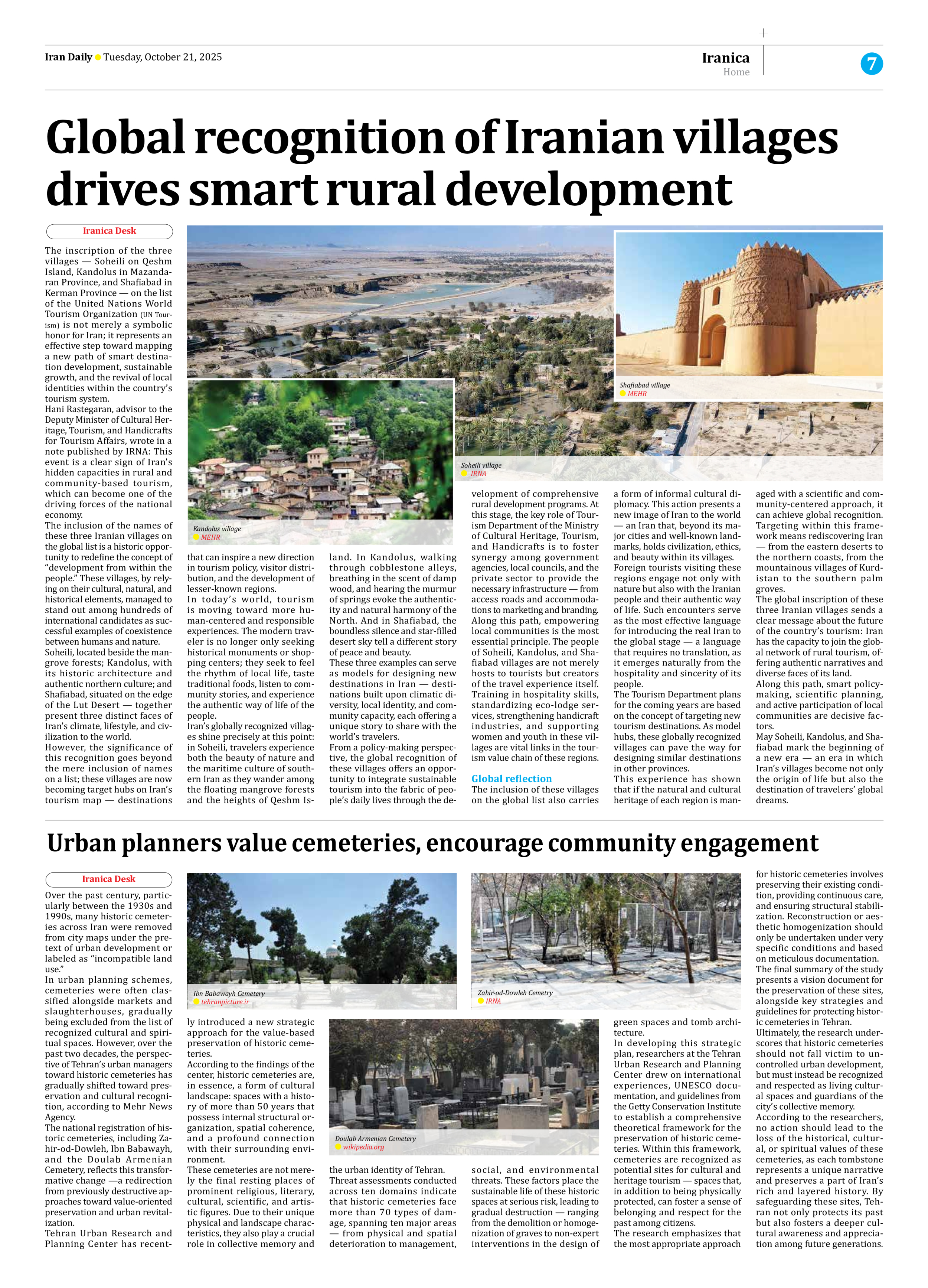
The national registration of historic cemeteries, including Zahir-od-Dowleh, Ibn Babawayh, and the Doulab Armenian Cemetery, reflects this transformative change —a redirection from previously destructive approaches toward value-oriented preservation and urban revitalization.
Tehran Urban Research and Planning Center has recently introduced a new strategic approach for the value-based preservation of historic cemeteries.
According to the findings of the center, historic cemeteries are, in essence, a form of cultural landscape: spaces with a history of more than 50 years that possess internal structural organization, spatial coherence, and a profound connection with their surrounding environment.
These cemeteries are not merely the final resting places of prominent religious, literary, cultural, scientific, and artistic figures. Due to their unique physical and landscape characteristics, they also play a crucial role in collective memory and the urban identity of Tehran.
Threat assessments conducted across ten domains indicate that historic cemeteries face more than 70 types of damage, spanning ten major areas — from physical and spatial deterioration to management, social, and environmental threats. These factors place the sustainable life of these historic spaces at serious risk, leading to gradual destruction — ranging from the demolition or homogenization of graves to non-expert interventions in the design of green spaces and tomb architecture.
In developing this strategic plan, researchers at the Tehran Urban Research and Planning Center drew on international experiences, UNESCO documentation, and guidelines from the Getty Conservation Institute to establish a comprehensive theoretical framework for the preservation of historic cemeteries. Within this framework, cemeteries are recognized as potential sites for cultural and heritage tourism — spaces that, in addition to being physically protected, can foster a sense of belonging and respect for the past among citizens.
The research emphasizes that the most appropriate approach for historic cemeteries involves preserving their existing condition, providing continuous care, and ensuring structural stabilization. Reconstruction or aesthetic homogenization should only be undertaken under very specific conditions and based on meticulous documentation.
The final summary of the study presents a vision document for the preservation of these sites, alongside key strategies and guidelines for protecting historic cemeteries in Tehran.
Ultimately, the research underscores that historic cemeteries should not fall victim to uncontrolled urban development, but must instead be recognized and respected as living cultural spaces and guardians of the city’s collective memory.
According to the researchers, no action should lead to the loss of the historical, cultural, or spiritual values of these cemeteries, as each tombstone represents a unique narrative and preserves a part of Iran’s rich and layered history. By safeguarding these sites, Tehran not only protects its past but also fosters a deeper cultural awareness and appreciation among future generations.