







Copy in clipboard...
Vienna pays tribute to Farshchian, architect of modern Persian miniature
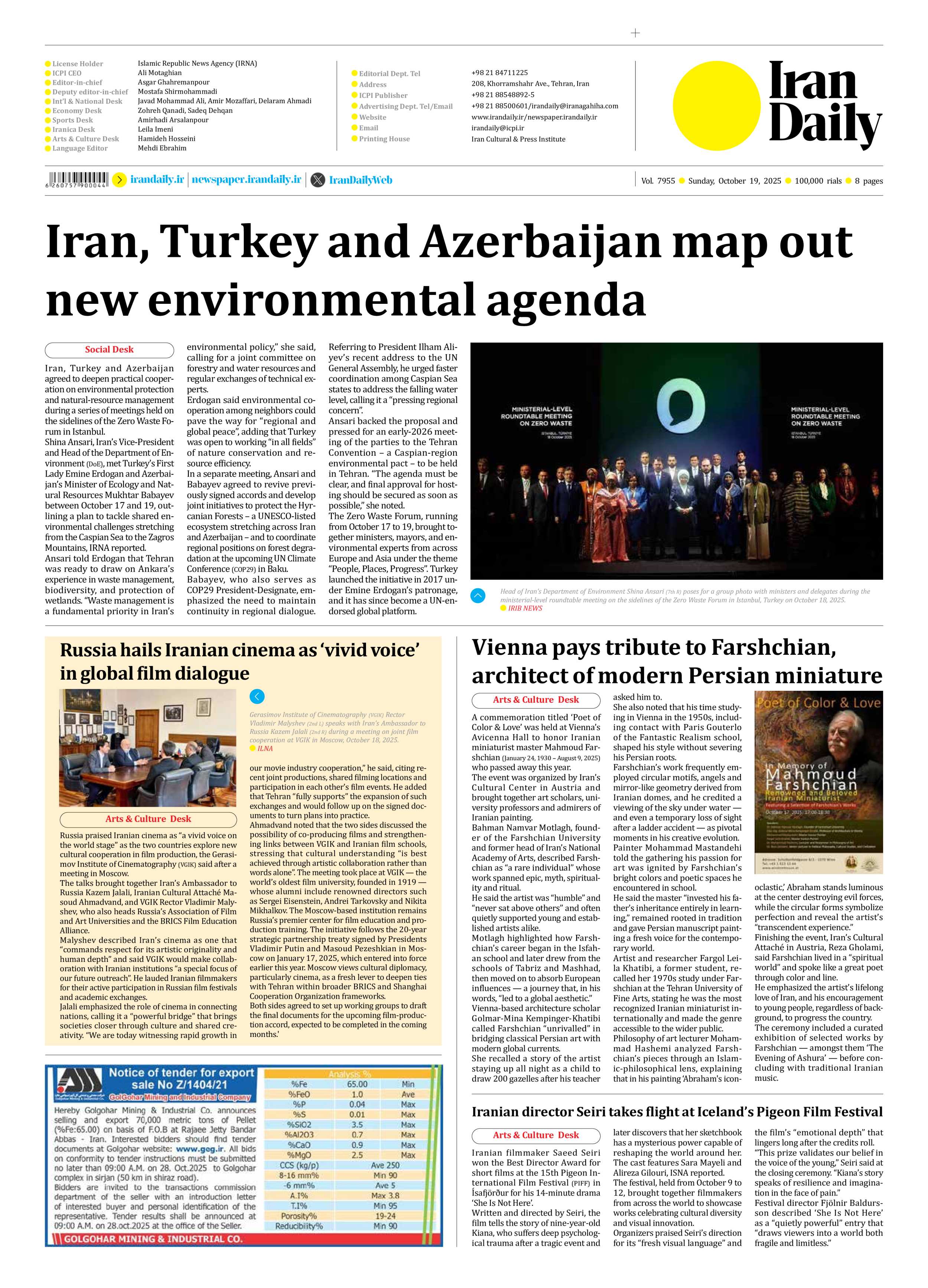
A commemoration titled ‘Poet of Color & Love’ was held at Vienna’s Avicenna Hall to honor Iranian miniaturist master Mahmoud Farshchian (January 24, 1930 – August 9, 2025) who passed away this year.
The event was organized by Iran’s Cultural Center in Austria and brought together art scholars, university professors and admirers of Iranian painting.
Bahman Namvar Motlagh, founder of the Farshchian University and former head of Iran’s National Academy of Arts, described Farshchian as “a rare individual” whose work spanned epic, myth, spirituality and ritual.
He said the artist was “humble” and “never sat above others” and often quietly supported young and established artists alike.
Motlagh highlighted how Farshchian’s career began in the Isfahan school and later drew from the schools of Tabriz and Mashhad, then moved on to absorb European influences — a journey that, in his words, “led to a global aesthetic.”
Vienna-based architecture scholar Golmar-Mina Kempinger-Khatibi called Farshchian “unrivalled” in bridging classical Persian art with modern global currents.
She recalled a story of the artist staying up all night as a child to draw 200 gazelles after his teacher asked him to.
She also noted that his time studying in Vienna in the 1950s, including contact with Paris Gouterlo of the Fantastic Realism school, shaped his style without severing his Persian roots.
Farshchian’s work frequently employed circular motifs, angels and mirror-like geometry derived from Iranian domes, and he credited a viewing of the sky under water — and even a temporary loss of sight after a ladder accident — as pivotal moments in his creative evolution.
Painter Mohammad Mastandehi told the gathering his passion for art was ignited by Farshchian’s bright colors and poetic spaces he encountered in school.
He said the master “invested his father’s inheritance entirely in learning,” remained rooted in tradition and gave Persian manuscript painting a fresh voice for the contemporary world.
Artist and researcher Fargol Leila Khatibi, a former student, recalled her 1970s study under Farshchian at the Tehran University of Fine Arts, stating he was the most recognized Iranian miniaturist internationally and made the genre accessible to the wider public.
Philosophy of art lecturer Mohammad Hashemi analyzed Farshchian’s pieces through an Islamic-philosophical lens, explaining that in his painting ‘Abraham's iconoclastic,’ Abraham stands luminous at the center destroying evil forces, while the circular forms symbolize perfection and reveal the artist’s “transcendent experience.”
Finishing the event, Iran’s Cultural Attaché in Austria, Reza Gholami, said Farshchian lived in a “spiritual world” and spoke like a great poet through color and line.
He emphasized the artist’s lifelong love of Iran, and his encouragement to young people, regardless of background, to progress the country.
The ceremony included a curated exhibition of selected works by Farshchian — amongst them ‘The Evening of Ashura’ — before concluding with traditional Iranian music.