





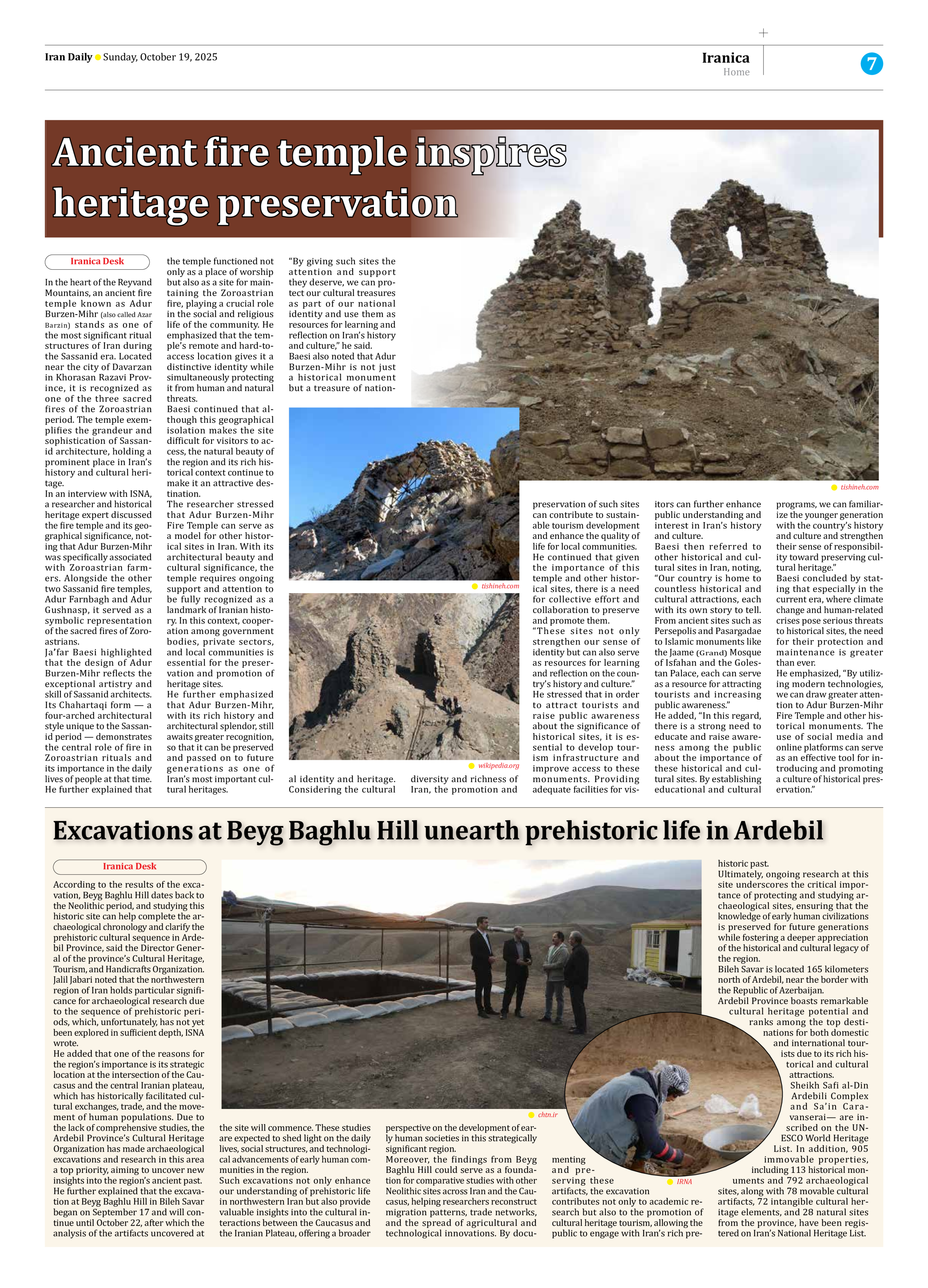


Excavations at Beyg Baghlu Hill unearth prehistoric life in Ardebil
According to the results of the excavation, Beyg Baghlu Hill dates back to the Neolithic period, and studying this historic site can help complete the archaeological chronology and clarify the prehistoric cultural sequence in Ardebil Province, said the Director General of the province’s Cultural Heritage, Tourism, and Handicrafts Organization.
Jalil Jabari noted that the northwestern region of Iran holds particular significance for archaeological research due to the sequence of prehistoric periods, which, unfortunately, has not yet been explored in sufficient depth, ISNA wrote.
He added that one of the reasons for the region’s importance is its strategic location at the intersection of the Caucasus and the central Iranian plateau, which has historically facilitated cultural exchanges, trade, and the movement of human populations. Due to the lack of comprehensive studies, the Ardebil Province’s Cultural Heritage Organization has made archaeological excavations and research in this area a top priority, aiming to uncover new insights into the region’s ancient past.
He further explained that the excavation at Beyg Baghlu Hill in Bileh Savar began on September 17 and will continue until October 22, after which the analysis of the artifacts uncovered at the site will commence. These studies are expected to shed light on the daily lives, social structures, and technological advancements of early human communities in the region.
Such excavations not only enhance our understanding of prehistoric life in northwestern Iran but also provide valuable insights into the cultural interactions between the Caucasus and the Iranian Plateau, offering a broader perspective on the development of early human societies in this strategically significant region.
Moreover, the findings from Beyg Baghlu Hill could serve as a foundation for comparative studies with other Neolithic sites across Iran and the Caucasus, helping researchers reconstruct migration patterns, trade networks, and the spread of agricultural and technological innovations. By documenting and preserving these artifacts, the excavation contributes not only to academic research but also to the promotion of cultural heritage tourism, allowing the public to engage with Iran’s rich prehistoric past.
Ultimately, ongoing research at this site underscores the critical importance of protecting and studying archaeological sites, ensuring that the knowledge of early human civilizations is preserved for future generations while fostering a deeper appreciation of the historical and cultural legacy of the region.
Bileh Savar is located 165 kilometers north of Ardebil, near the border with the Republic of Azerbaijan.
Ardebil Province boasts remarkable cultural heritage potential and ranks among the top destinations for both domestic and international tourists due to its rich historical and cultural attractions.
Sheikh Safi al-Din Ardebili Complex and Sa’in Caravanserai— are inscribed on the UNESCO World Heritage List. In addition, 905 immovable properties, including 113 historical monuments and 792 archaeological sites, along with 78 movable cultural artifacts, 72 intangible cultural heritage elements, and 28 natural sites from the province, have been registered on Iran’s National Heritage List.