







Agricultural irradiation center opens in Ardebil to boost crop yields
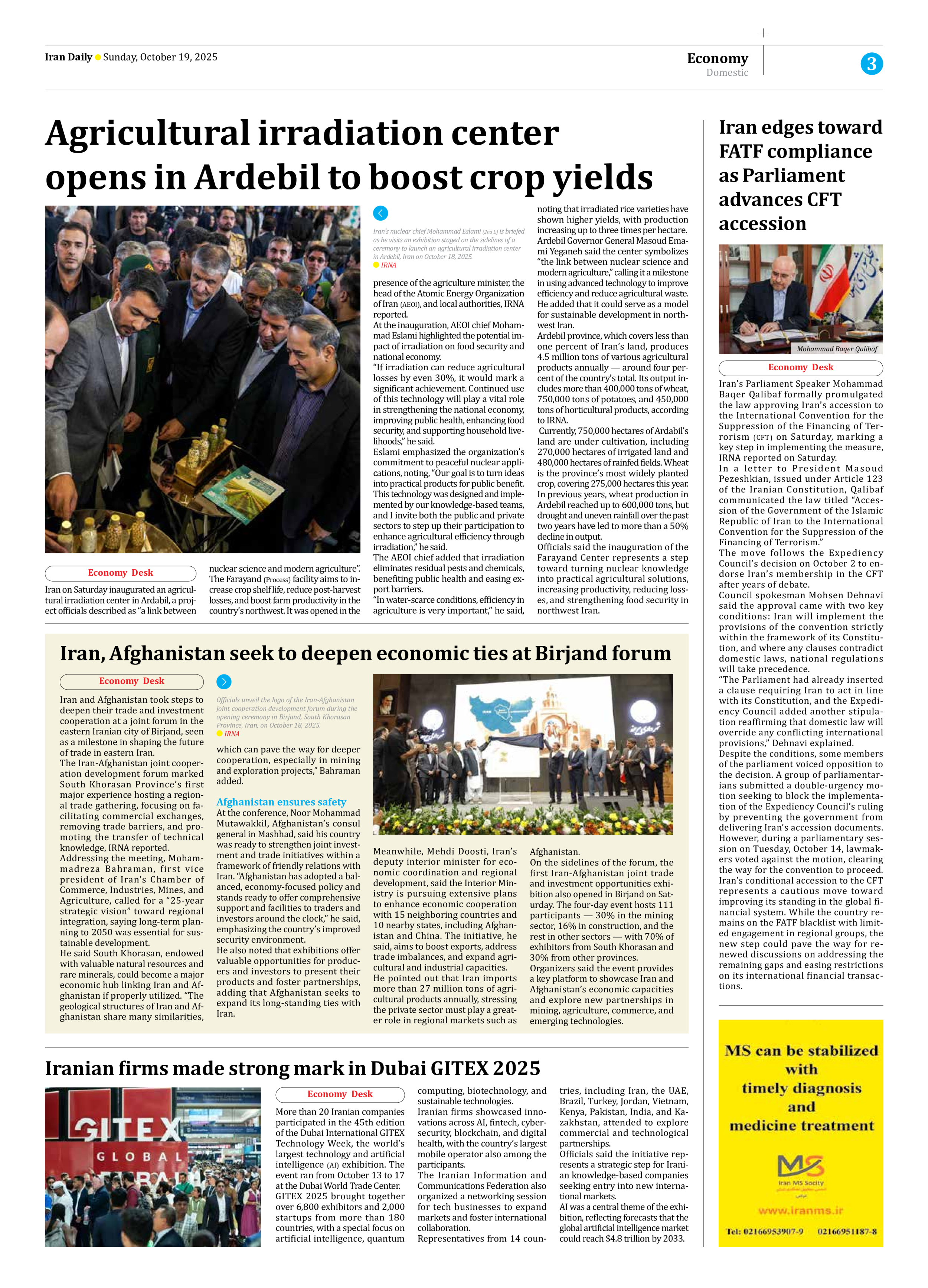
Iran on Saturday inaugurated an agricultural irradiation center in Ardabil, a project officials described as “a link between nuclear science and modern agriculture”.
The Farayand (Process) facility aims to increase crop shelf life, reduce post-harvest losses, and boost farm productivity in the country’s northwest. It was opened in the presence of the agriculture minister, the head of the Atomic Energy Organization of Iran (AEOI), and local authorities, IRNA reported.
At the inauguration, AEOI chief Mohammad Eslami highlighted the potential impact of irradiation on food security and national economy.
“If irradiation can reduce agricultural losses by even 30%, it would mark a significant achievement. Continued use of this technology will play a vital role in strengthening the national economy, improving public health, enhancing food security, and supporting household livelihoods,” he said.
Eslami emphasized the organization’s commitment to peaceful nuclear applications, noting, “Our goal is to turn ideas into practical products for public benefit. This technology was designed and implemented by our knowledge-based teams, and I invite both the public and private sectors to step up their participation to enhance agricultural efficiency through irradiation,” he said.
The AEOI chief added that irradiation eliminates residual pests and chemicals, benefiting public health and easing export barriers.
“In water-scarce conditions, efficiency in agriculture is very important,” he said, noting that irradiated rice varieties have shown higher yields, with production increasing up to three times per hectare.
Ardebil Governor General Masoud Emami Yeganeh said the center symbolizes “the link between nuclear science and modern agriculture,” calling it a milestone in using advanced technology to improve efficiency and reduce agricultural waste. He added that it could serve as a model for sustainable development in northwest Iran.
Ardebil province, which covers less than one percent of Iran’s land, produces 4.5 million tons of various agricultural products annually — around four percent of the country’s total. Its output includes more than 400,000 tons of wheat, 750,000 tons of potatoes, and 450,000 tons of horticultural products, according to IRNA.
Currently, 750,000 hectares of Ardabil’s land are under cultivation, including 270,000 hectares of irrigated land and 480,000 hectares of rainfed fields. Wheat is the province’s most widely planted crop, covering 275,000 hectares this year.
In previous years, wheat production in Ardebil reached up to 600,000 tons, but drought and uneven rainfall over the past two years have led to more than a 50% decline in output.
Officials said the inauguration of the Farayand Center represents a step toward turning nuclear knowledge into practical agricultural solutions, increasing productivity, reducing losses, and strengthening food security in northwest Iran.