







Chogha Ahovan sheds light on prehistoric civilization in western Iran
The ancient mound of Chogha Ahovan, situated north of Mehran and dating from the seventh to the third millennium BCE, is regarded as one of the most significant historical settlements in western Iran, according to Habibollah Mahmoudian, a professor of prehistoric archaeology.
He explained that this archaeological site lies approximately five kilometers north of the border city of Mehran in Ilam Province, near the Iran–Iraq frontier. The most prominent permanent river in the region is the Kanjan Cham River, which originates from the western slopes of the Kabir Kuh Mountains and flows through the entrance of the Mehran Plain, forming a natural boundary between Iran and Iraq, according to ISNA.
Mahmoudian noted that the river’s presence in the warm, lowland areas of western Iran has long rendered the region suitable as a winter settlement for nomadic communities. Consequently, archaeological sites within this geographical zone — including Chogha Ahovan — have retained their historical importance for millennia owing to these favorable environmental conditions.
Highlighting the site’s cultural characteristics, the archaeologist pointed out that the quantity and variety of cultural materials, particularly the numerous forms and styles of pottery, confirm multiple phases of occupation at the site.
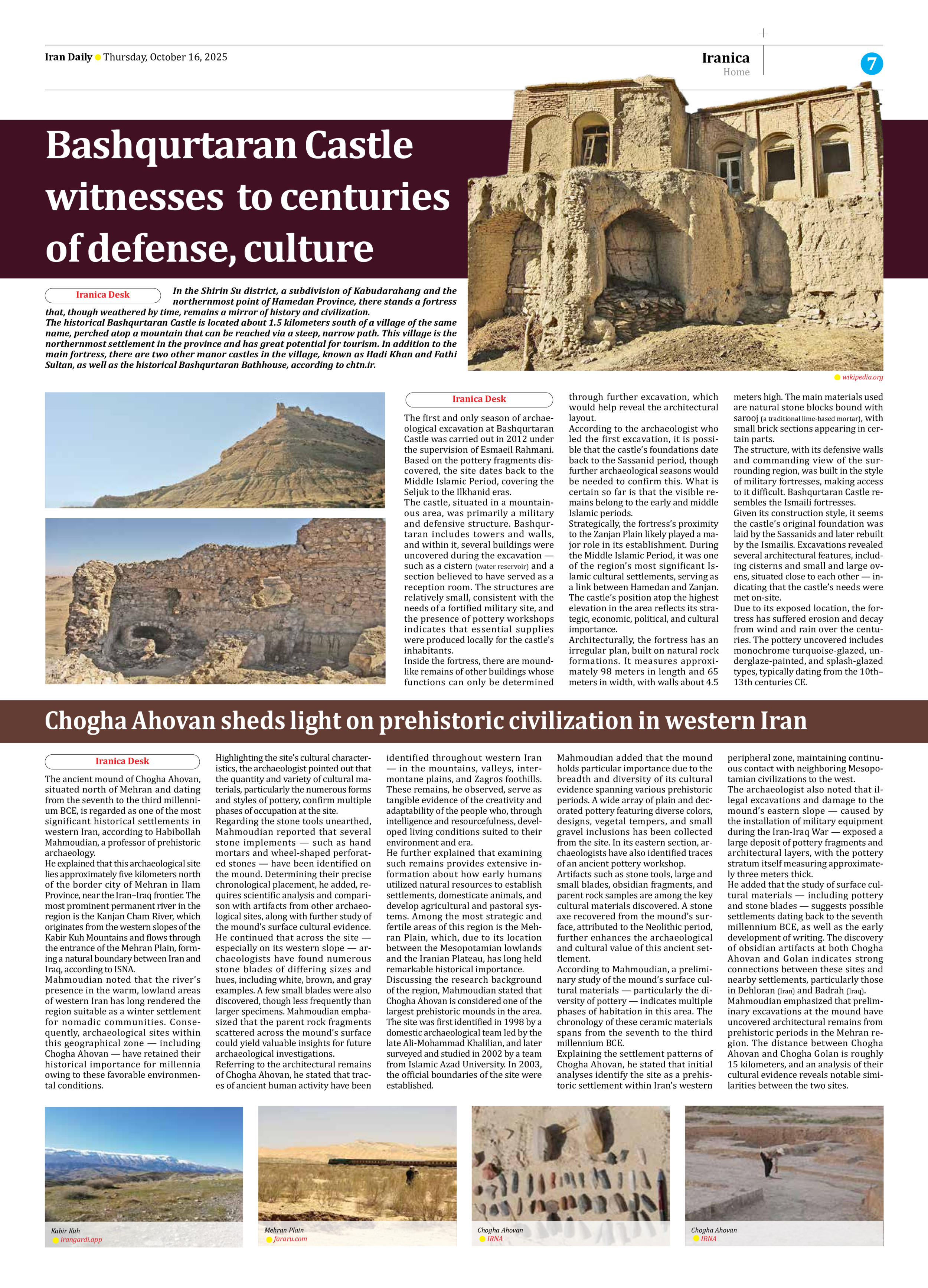
Regarding the stone tools unearthed, Mahmoudian reported that several stone implements — such as hand mortars and wheel-shaped perforated stones — have been identified on the mound. Determining their precise chronological placement, he added, requires scientific analysis and comparison with artifacts from other archaeological sites, along with further study of the mound’s surface cultural evidence.
He continued that across the site — especially on its western slope — archaeologists have found numerous stone blades of differing sizes and hues, including white, brown, and gray examples. A few small blades were also discovered, though less frequently than larger specimens. Mahmoudian emphasized that the parent rock fragments scattered across the mound’s surface could yield valuable insights for future archaeological investigations.
Referring to the architectural remains of Chogha Ahovan, he stated that traces of ancient human activity have been identified throughout western Iran — in the mountains, valleys, intermontane plains, and Zagros foothills. These remains, he observed, serve as tangible evidence of the creativity and adaptability of the people who, through intelligence and resourcefulness, developed living conditions suited to their environment and era.
He further explained that examining such remains provides extensive information about how early humans utilized natural resources to establish settlements, domesticate animals, and develop agricultural and pastoral systems. Among the most strategic and fertile areas of this region is the Mehran Plain, which, due to its location between the Mesopotamian lowlands and the Iranian Plateau, has long held remarkable historical importance.
Discussing the research background of the region, Mahmoudian stated that Chogha Ahovan is considered one of the largest prehistoric mounds in the area. The site was first identified in 1998 by a domestic archaeological team led by the late Ali-Mohammad Khalilian, and later surveyed and studied in 2002 by a team from Islamic Azad University. In 2003, the official boundaries of the site were established.
Mahmoudian added that the mound holds particular importance due to the breadth and diversity of its cultural evidence spanning various prehistoric periods. A wide array of plain and decorated pottery featuring diverse colors, designs, vegetal tempers, and small gravel inclusions has been collected from the site. In its eastern section, archaeologists have also identified traces of an ancient pottery workshop.
Artifacts such as stone tools, large and small blades, obsidian fragments, and parent rock samples are among the key cultural materials discovered. A stone axe recovered from the mound’s surface, attributed to the Neolithic period, further enhances the archaeological and cultural value of this ancient settlement.
According to Mahmoudian, a preliminary study of the mound’s surface cultural materials — particularly the diversity of pottery — indicates multiple phases of habitation in this area. The chronology of these ceramic materials spans from the seventh to the third millennium BCE.
Explaining the settlement patterns of Chogha Ahovan, he stated that initial analyses identify the site as a prehistoric settlement within Iran’s western peripheral zone, maintaining continuous contact with neighboring Mesopotamian civilizations to the west.
The archaeologist also noted that illegal excavations and damage to the mound’s eastern slope — caused by the installation of military equipment during the Iran-Iraq War — exposed a large deposit of pottery fragments and architectural layers, with the pottery stratum itself measuring approximately three meters thick.
He added that the study of surface cultural materials — including pottery and stone blades — suggests possible settlements dating back to the seventh millennium BCE, as well as the early development of writing. The discovery of obsidian artifacts at both Chogha Ahovan and Golan indicates strong connections between these sites and nearby settlements, particularly those in Dehloran (Iran) and Badrah (Iraq).
Mahmoudian emphasized that preliminary excavations at the mound have uncovered architectural remains from prehistoric periods in the Mehran region. The distance between Chogha Ahovan and Chogha Golan is roughly 15 kilometers, and an analysis of their cultural evidence reveals notable similarities between the two sites.