





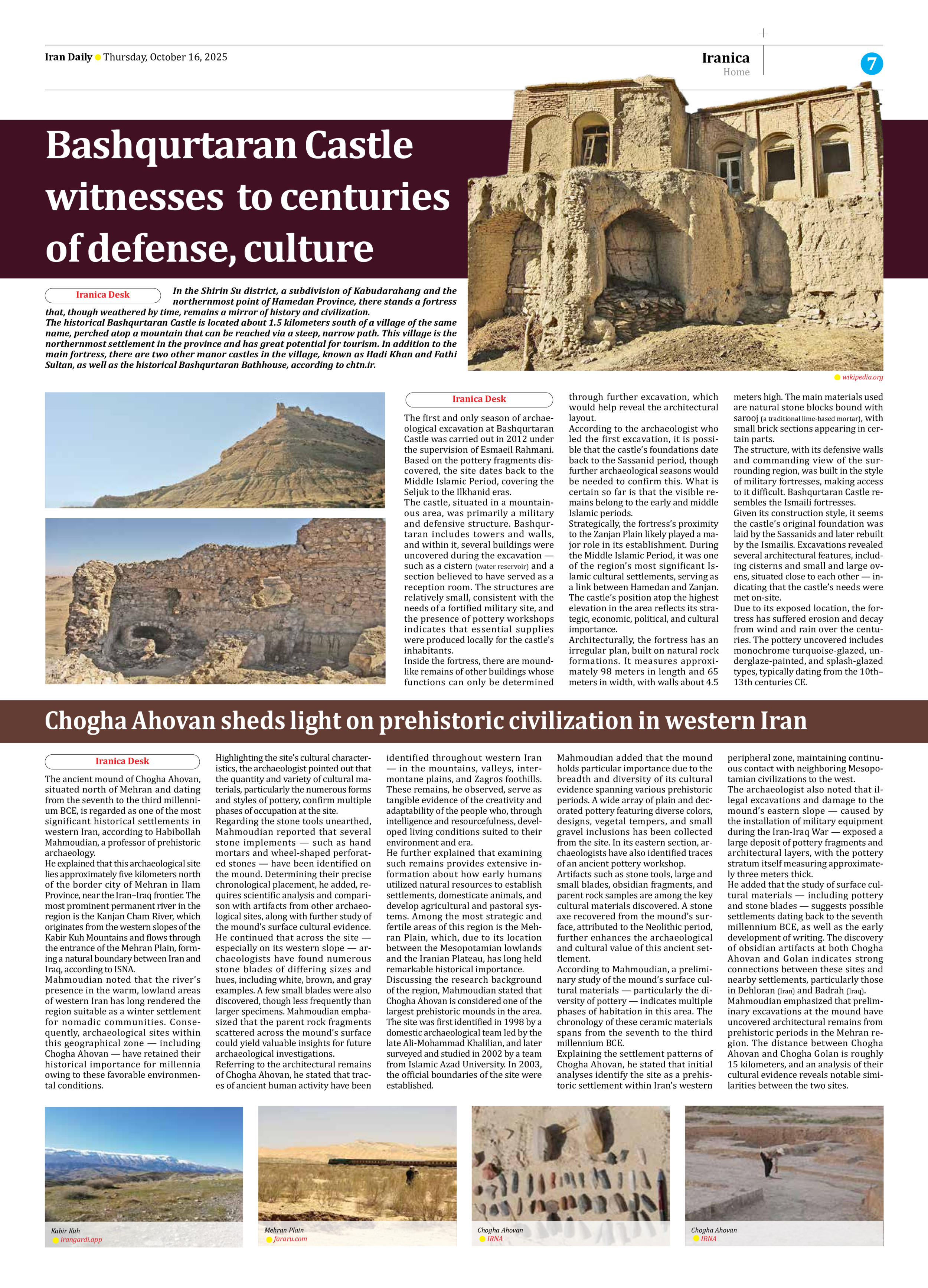


Bashqurtaran Castle witnesses to centuries of defense, culture
In the Shirin Su district, a subdivision of Kabudarahang and the northernmost point of Hamedan Province, there stands a fortress that, though weathered by time, remains a mirror of history and civilization. The historical Bashqurtaran Castle is located about 1.5 kilometers south of a village of the same name, perched atop a mountain that can be reached via a steep, narrow path. This village is the northernmost settlement in the province and has great potential for tourism. In addition to the main fortress, there are two other manor castles in the village, known as Hadi Khan and Fathi Sultan, as well as the historical Bashqurtaran Bathhouse, according to chtn.ir.
The first and only season of archaeological excavation at Bashqurtaran Castle was carried out in 2012 under the supervision of Esmaeil Rahmani. Based on the pottery fragments discovered, the site dates back to the Middle Islamic Period, covering the Seljuk to the Ilkhanid eras.
The castle, situated in a mountainous area, was primarily a military and defensive structure. Bashqurtaran includes towers and walls, and within it, several buildings were uncovered during the excavation — such as a cistern (water reservoir) and a section believed to have served as a reception room. The structures are relatively small, consistent with the needs of a fortified military site, and the presence of pottery workshops indicates that essential supplies were produced locally for the castle’s inhabitants.
Inside the fortress, there are mound-like remains of other buildings whose functions can only be determined through further excavation, which would help reveal the architectural layout.
According to the archaeologist who led the first excavation, it is possible that the castle’s foundations date back to the Sassanid period, though further archaeological seasons would be needed to confirm this. What is certain so far is that the visible remains belong to the early and middle Islamic periods.
Strategically, the fortress’s proximity to the Zanjan Plain likely played a major role in its establishment. During the Middle Islamic Period, it was one of the region’s most significant Islamic cultural settlements, serving as a link between Hamedan and Zanjan. The castle’s position atop the highest elevation in the area reflects its strategic, economic, political, and cultural importance.
Architecturally, the fortress has an irregular plan, built on natural rock formations. It measures approximately 98 meters in length and 65 meters in width, with walls about 4.5 meters high. The main materials used are natural stone blocks bound with sarooj (a traditional lime-based mortar), with small brick sections appearing in certain parts.
The structure, with its defensive walls and commanding view of the surrounding region, was built in the style of military fortresses, making access to it difficult. Bashqurtaran Castle resembles the Ismaili fortresses.
Given its construction style, it seems the castle’s original foundation was laid by the Sassanids and later rebuilt by the Ismailis. Excavations revealed several architectural features, including cisterns and small and large ovens, situated close to each other — indicating that the castle’s needs were met on-site.
Due to its exposed location, the fortress has suffered erosion and decay from wind and rain over the centuries. The pottery uncovered includes monochrome turquoise-glazed, underglaze-painted, and splash-glazed types, typically dating from the 10th–13th centuries CE.