







Tehran Museum of Contemporary Art to establish permanent exhibition hall
TMoCA ranks among world’s top 10 modern art collections
By Sadeq Dehqan
Staff writer
The Tehran Museum of Contemporary Art (TMoCA) is set to establish a permanent exhibition hall dedicated to displaying some of its most celebrated and valuable works, the museum’s director announced, calling the initiative a milestone in the institution’s decades-long mission to make its treasures more accessible to the public.
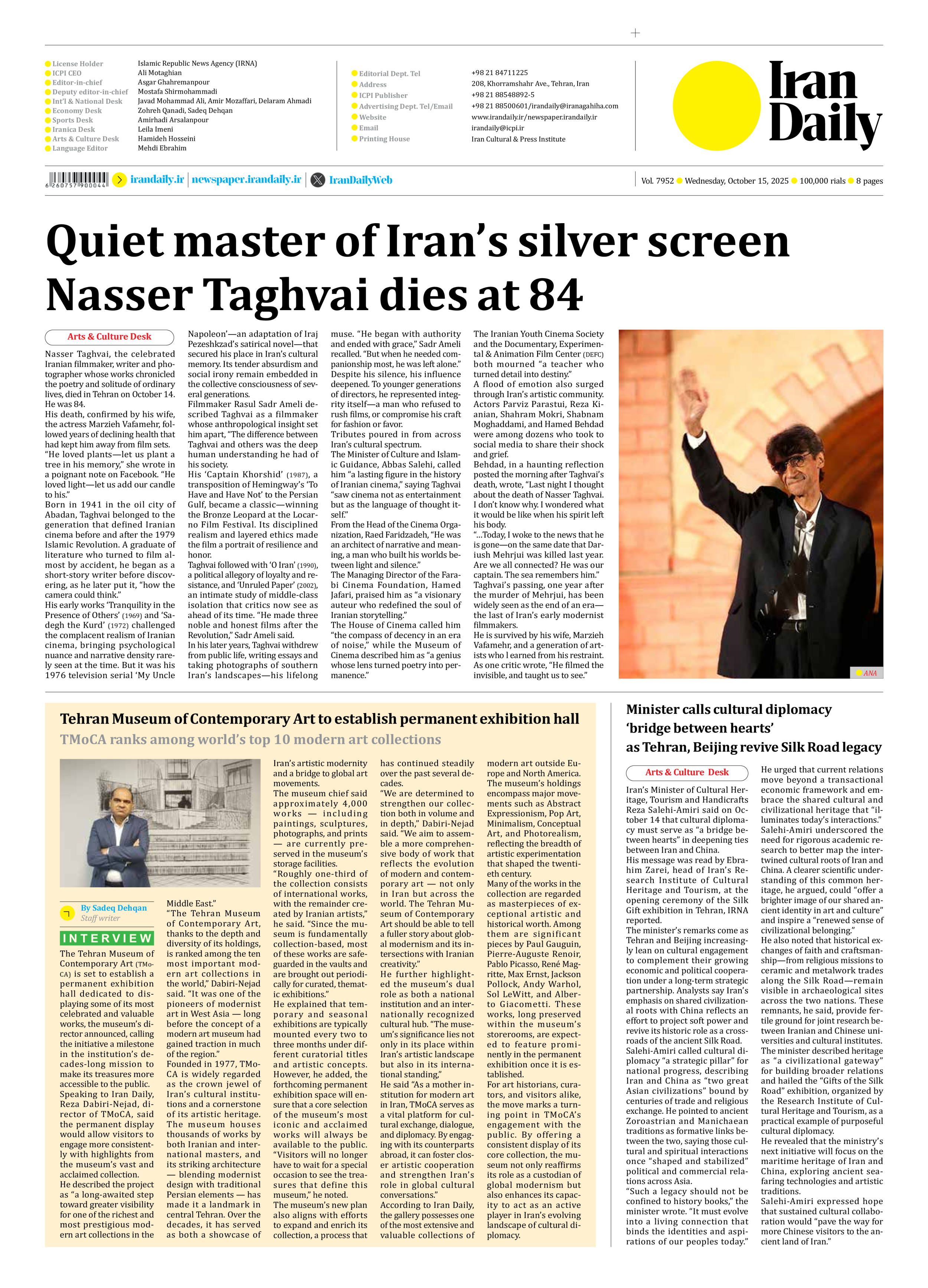
Speaking to Iran Daily, Reza Dabiri-Nejad, director of TMoCA, said the permanent display would allow visitors to engage more consistently with highlights from the museum’s vast and acclaimed collection.
He described the project as “a long-awaited step toward greater visibility for one of the richest and most prestigious modern art collections in the Middle East.”
“The Tehran Museum of Contemporary Art, thanks to the depth and diversity of its holdings, is ranked among the ten most important modern art collections in the world,” Dabiri-Nejad said. “It was one of the pioneers of modernist art in West Asia — long before the concept of a modern art museum had gained traction in much of the region.”
Founded in 1977, TMoCA is widely regarded as the crown jewel of Iran’s cultural institutions and a cornerstone of its artistic heritage. The museum houses thousands of works by both Iranian and international masters, and its striking architecture — blending modernist design with traditional Persian elements — has made it a landmark in central Tehran. Over the decades, it has served as both a showcase of Iran’s artistic modernity and a bridge to global art movements.
The museum chief said approximately 4,000 works — including paintings, sculptures, photographs, and prints — are currently preserved in the museum’s storage facilities.
“Roughly one-third of the collection consists of international works, with the remainder created by Iranian artists,” he said. “Since the museum is fundamentally collection-based, most of these works are safeguarded in the vaults and are brought out periodically for curated, thematic exhibitions.”
He explained that temporary and seasonal exhibitions are typically mounted every two to three months under different curatorial titles and artistic concepts. However, he added, the forthcoming permanent exhibition space will ensure that a core selection of the museum’s most iconic and acclaimed works will always be available to the public. “Visitors will no longer have to wait for a special occasion to see the treasures that define this museum,” he noted.
The museum’s new plan also aligns with efforts to expand and enrich its collection, a process that has continued steadily over the past several decades.
“We are determined to strengthen our collection both in volume and in depth,” Dabiri-Nejad said. “We aim to assemble a more comprehensive body of work that reflects the evolution of modern and contemporary art — not only in Iran but across the world. The Tehran Museum of Contemporary Art should be able to tell a fuller story about global modernism and its intersections with Iranian creativity.”
He further highlighted the museum’s dual role as both a national institution and an internationally recognized cultural hub. “The museum’s significance lies not only in its place within Iran’s artistic landscape but also in its international standing,”
He said “As a mother institution for modern art in Iran, TMoCA serves as a vital platform for cultural exchange, dialogue, and diplomacy. By engaging with its counterparts abroad, it can foster closer artistic cooperation and strengthen Iran’s role in global cultural conversations.”
According to Iran Daily, the gallery possesses one of the most extensive and valuable collections of modern art outside Europe and North America. The museum’s holdings encompass major movements such as Abstract Expressionism, Pop Art, Minimalism, Conceptual Art, and Photorealism, reflecting the breadth of artistic experimentation that shaped the twentieth century.
Many of the works in the collection are regarded as masterpieces of exceptional artistic and historical worth. Among them are significant pieces by Paul Gauguin, Pierre-Auguste Renoir, Pablo Picasso, René Magritte, Max Ernst, Jackson Pollock, Andy Warhol, Sol LeWitt, and Alberto Giacometti. These works, long preserved within the museum’s storerooms, are expected to feature prominently in the permanent exhibition once it is established.
For art historians, curators, and visitors alike, the move marks a turning point in TMoCA’s engagement with the public. By offering a consistent display of its core collection, the museum not only reaffirms its role as a custodian of global modernism but also enhances its capacity to act as an active player in Iran’s evolving landscape of cultural diplomacy.