





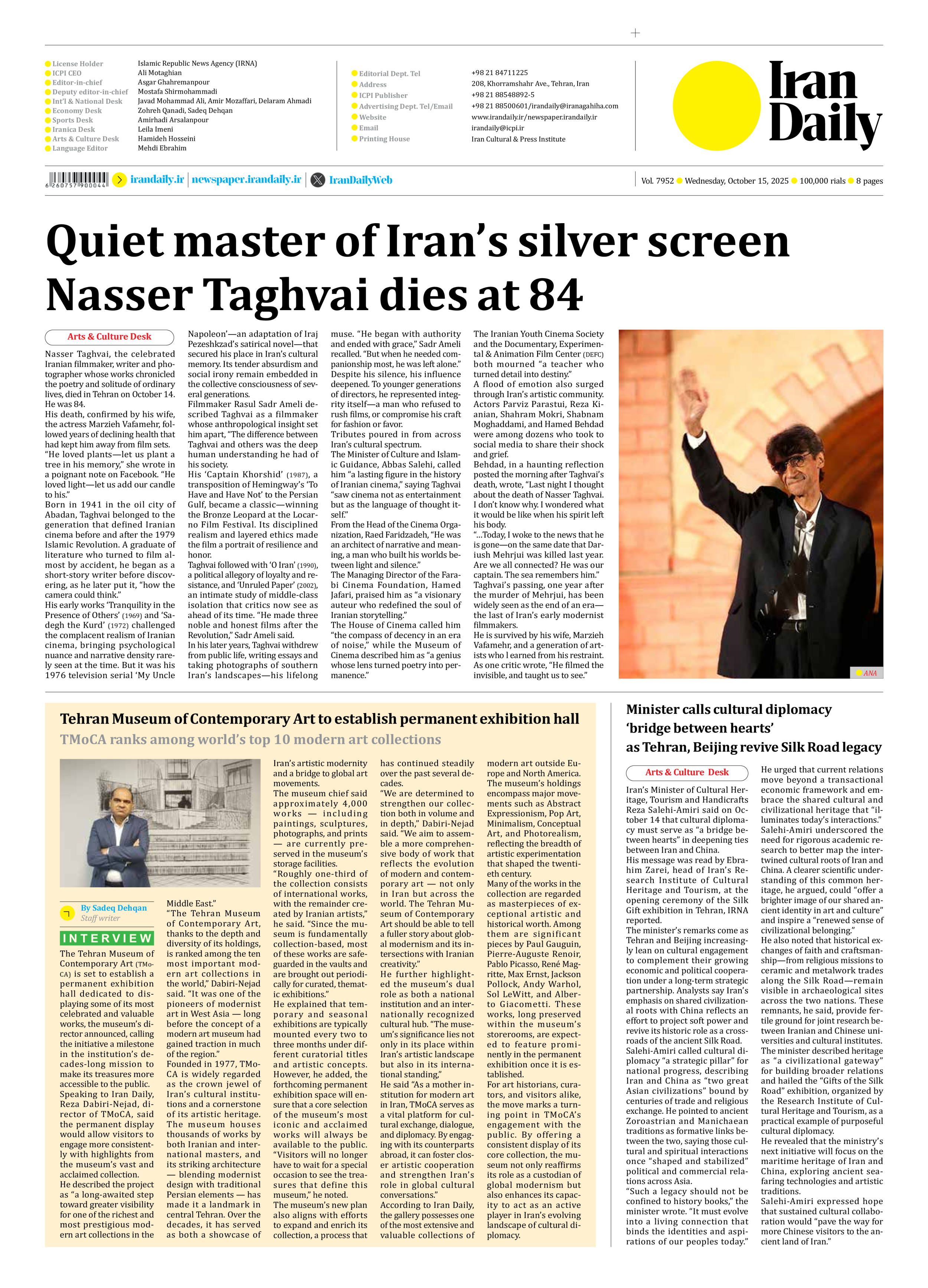


Quiet master of Iran’s silver screen Nasser Taghvai dies at 84
Nasser Taghvai, the celebrated Iranian filmmaker, writer and photographer whose works chronicled the poetry and solitude of ordinary lives, died in Tehran on October 14. He was 84.
His death, confirmed by his wife, the actress Marzieh Vafamehr, followed years of declining health that had kept him away from film sets.
“He loved plants—let us plant a tree in his memory,” she wrote in a poignant note on Facebook. “He loved light—let us add our candle to his.”
Born in 1941 in the oil city of Abadan, Taghvai belonged to the generation that defined Iranian cinema before and after the 1979 Islamic Revolution. A graduate of literature who turned to film almost by accident, he began as a short-story writer before discovering, as he later put it, “how the camera could think.”
His early works ‘Tranquility in the Presence of Others’ (1969) and ‘Sadegh the Kurd’ (1972) challenged the complacent realism of Iranian cinema, bringing psychological nuance and narrative density rarely seen at the time. But it was his 1976 television serial ‘My Uncle Napoleon’—an adaptation of Iraj Pezeshkzad’s satirical novel—that secured his place in Iran’s cultural memory. Its tender absurdism and social irony remain embedded in the collective consciousness of several generations.
Filmmaker Rasul Sadr Ameli described Taghvai as a filmmaker whose anthropological insight set him apart, “The difference between Taghvai and others was the deep human understanding he had of his society.
His ‘Captain Khorshid’ (1987), a transposition of Hemingway’s ‘To Have and Have Not’ to the Persian Gulf, became a classic—winning the Bronze Leopard at the Locarno Film Festival. Its disciplined realism and layered ethics made the film a portrait of resilience and honor.
Taghvai followed with ‘O Iran’ (1990), a political allegory of loyalty and resistance, and ‘Unruled Paper’ (2002), an intimate study of middle-class isolation that critics now see as ahead of its time. “He made three noble and honest films after the Revolution,” Sadr Ameli said.
In his later years, Taghvai withdrew from public life, writing essays and taking photographs of southern Iran’s landscapes—his lifelong muse. “He began with authority and ended with grace,” Sadr Ameli recalled. “But when he needed companionship most, he was left alone.”
Despite his silence, his influence deepened. To younger generations of directors, he represented integrity itself—a man who refused to rush films, or compromise his craft for fashion or favor.
Tributes poured in from across Iran’s cultural spectrum.
The Minister of Culture and Islamic Guidance, Abbas Salehi, called him “a lasting figure in the history of Iranian cinema,” saying Taghvai “saw cinema not as entertainment but as the language of thought itself.”
From the Head of the Cinema Organization, Raed Faridzadeh, “He was an architect of narrative and meaning, a man who built his worlds between light and silence.”
The Managing Director of the Farabi Cinema Foundation, Hamed Jafari, praised him as “a visionary auteur who redefined the soul of Iranian storytelling.”
The House of Cinema called him “the compass of decency in an era of noise,” while the Museum of Cinema described him as “a genius whose lens turned poetry into permanence.”
The Iranian Youth Cinema Society and the Documentary, Experimental & Animation Film Center (DEFC) both mourned “a teacher who turned detail into destiny.”
A flood of emotion also surged through Iran’s artistic community. Actors Parviz Parastui, Reza Kianian, Shahram Mokri, Shabnam Moghaddami, and Hamed Behdad were among dozens who took to social media to share their shock and grief.
Behdad, in a haunting reflection posted the morning after Taghvai’s death, wrote, “Last night I thought about the death of Nasser Taghvai. I don’t know why. I wondered what it would be like when his spirit left his body.
“…Today, I woke to the news that he is gone—on the same date that Dariush Mehrjui was killed last year. Are we all connected? He was our captain. The sea remembers him.”
Taghvai’s passing, one year after the murder of Mehrjui, has been widely seen as the end of an era—the last of Iran’s early modernist filmmakers.
He is survived by his wife, Marzieh Vafamehr, and a generation of artists who l earned from his restraint.
As one critic wrote, “He filmed the invisible, and taught us to see.”