





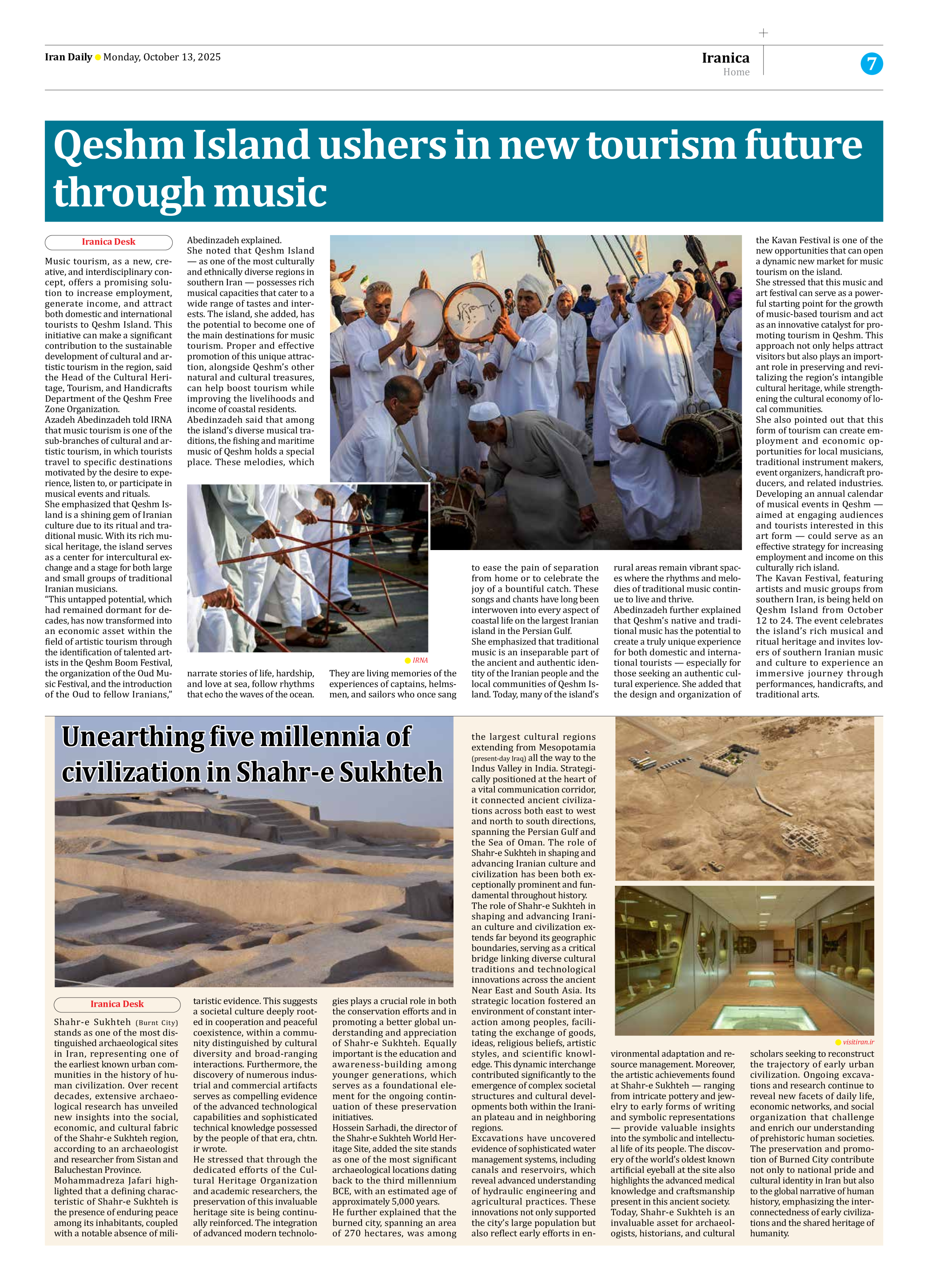


Unearthing five millennia of civilization in Shahr-e Sukhteh
Shahr-e Sukhteh (Burnt City) stands as one of the most distinguished archaeological sites in Iran, representing one of the earliest known urban communities in the history of human civilization. Over recent decades, extensive archaeological research has unveiled new insights into the social, economic, and cultural fabric of the Shahr-e Sukhteh region, according to an archaeologist and researcher from Sistan and Baluchestan Province.
Mohammadreza Jafari highlighted that a defining characteristic of Shahr-e Sukhteh is the presence of enduring peace among its inhabitants, coupled with a notable absence of militaristic evidence. This suggests a societal culture deeply rooted in cooperation and peaceful coexistence, within a community distinguished by cultural diversity and broad-ranging interactions. Furthermore, the discovery of numerous industrial and commercial artifacts serves as compelling evidence of the advanced technological capabilities and sophisticated technical knowledge possessed by the people of that era, chtn.ir wrote.
He stressed that through the dedicated efforts of the Cultural Heritage Organization and academic researchers, the preservation of this invaluable heritage site is being continually reinforced. The integration of advanced modern technologies plays a crucial role in both the conservation efforts and in promoting a better global understanding and appreciation of Shahr-e Sukhteh. Equally important is the education and awareness-building among younger generations, which serves as a foundational element for the ongoing continuation of these preservation initiatives.
Hossein Sarhadi, the director of the Shahr-e Sukhteh World Heritage Site, added the site stands as one of the most significant archaeological locations dating back to the third millennium BCE, with an estimated age of approximately 5,000 years.
He further explained that the burned city, spanning an area of 270 hectares, was among the largest cultural regions extending from Mesopotamia (present-day Iraq) all the way to the Indus Valley in India. Strategically positioned at the heart of a vital communication corridor, it connected ancient civilizations across both east to west and north to south directions, spanning the Persian Gulf and the Sea of Oman. The role of Shahr-e Sukhteh in shaping and advancing Iranian culture and civilization has been both exceptionally prominent and fundamental throughout history.
The role of Shahr-e Sukhteh in shaping and advancing Iranian culture and civilization extends far beyond its geographic boundaries, serving as a critical bridge linking diverse cultural traditions and technological innovations across the ancient Near East and South Asia. Its strategic location fostered an environment of constant interaction among peoples, facilitating the exchange of goods, ideas, religious beliefs, artistic styles, and scientific knowledge. This dynamic interchange contributed significantly to the emergence of complex societal structures and cultural developments both within the Iranian plateau and in neighboring regions.
Excavations have uncovered evidence of sophisticated water management systems, including canals and reservoirs, which reveal advanced understanding of hydraulic engineering and agricultural practices. These innovations not only supported the city’s large population but also reflect early efforts in environmental adaptation and resource management. Moreover, the artistic achievements found at Shahr-e Sukhteh — ranging from intricate pottery and jewelry to early forms of writing and symbolic representations — provide valuable insights into the symbolic and intellectual life of its people. The discovery of the world’s oldest known artificial eyeball at the site also highlights the advanced medical knowledge and craftsmanship present in this ancient society.
Today, Shahr-e Sukhteh is an invaluable asset for archaeologists, historians, and cultural scholars seeking to reconstruct the trajectory of early urban civilization. Ongoing excavations and research continue to reveal new facets of daily life, economic networks, and social organization that challenge and enrich our understanding of prehistoric human societies. The preservation and promotion of Burned City contribute not only to national pride and cultural identity in Iran but also to the global narrative of human history, emphasizing the interconnectedness of early civilizations and the shared heritage of humanity.