





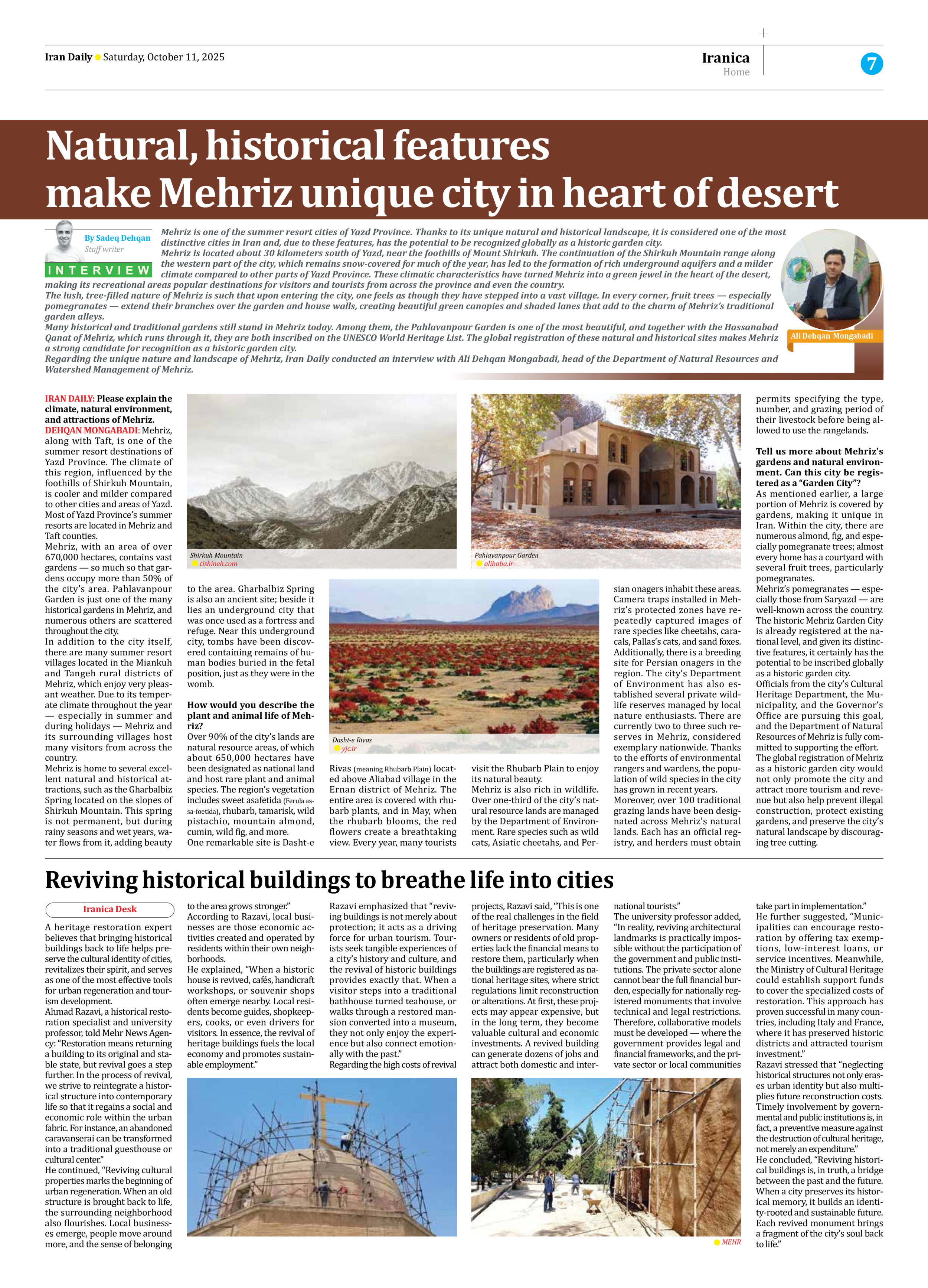


Reviving historical buildings to breathe life into cities
A heritage restoration expert believes that bringing historical buildings back to life helps preserve the cultural identity of cities, revitalizes their spirit, and serves as one of the most effective tools for urban regeneration and tourism development.
Ahmad Razavi, a historical restoration specialist and university professor, told Mehr News Agency: “Restoration means returning a building to its original and stable state, but revival goes a step further. In the process of revival, we strive to reintegrate a historical structure into contemporary life so that it regains a social and economic role within the urban fabric. For instance, an abandoned caravanserai can be transformed into a traditional guesthouse or cultural center.”
He continued, “Reviving cultural properties marks the beginning of urban regeneration. When an old structure is brought back to life, the surrounding neighborhood also flourishes. Local businesses emerge, people move around more, and the sense of belonging to the area grows stronger.”
According to Razavi, local businesses are those economic activities created and operated by residents within their own neighborhoods.
He explained, “When a historic house is revived, cafés, handicraft workshops, or souvenir shops often emerge nearby. Local residents become guides, shopkeepers, cooks, or even drivers for visitors. In essence, the revival of heritage buildings fuels the local economy and promotes sustainable employment.”
Razavi emphasized that “reviving buildings is not merely about protection; it acts as a driving force for urban tourism. Tourists seek tangible experiences of a city’s history and culture, and the revival of historic buildings provides exactly that. When a visitor steps into a traditional bathhouse turned teahouse, or walks through a restored mansion converted into a museum, they not only enjoy the experience but also connect emotionally with the past.”
Regarding the high costs of revival projects, Razavi said, “This is one of the real challenges in the field of heritage preservation. Many owners or residents of old properties lack the financial means to restore them, particularly when the buildings are registered as national heritage sites, where strict regulations limit reconstruction or alterations. At first, these projects may appear expensive, but in the long term, they become valuable cultural and economic investments. A revived building can generate dozens of jobs and attract both domestic and international tourists.”
The university professor added, “In reality, reviving architectural landmarks is practically impossible without the participation of the government and public institutions. The private sector alone cannot bear the full financial burden, especially for nationally registered monuments that involve technical and legal restrictions. Therefore, collaborative models must be developed — where the government provides legal and financial frameworks, and the private sector or local communities take part in implementation.”
He further suggested, “Municipalities can encourage restoration by offering tax exemptions, low-interest loans, or service incentives. Meanwhile, the Ministry of Cultural Heritage could establish support funds to cover the specialized costs of restoration. This approach has proven successful in many countries, including Italy and France, where it has preserved historic districts and attracted tourism investment.”
Razavi stressed that “neglecting historical structures not only erases urban identity but also multiplies future reconstruction costs. Timely involvement by governmental and public institutions is, in fact, a preventive measure against the destruction of cultural heritage, not merely an expenditure.”
He concluded, “Reviving historical buildings is, in truth, a bridge between the past and the future. When a city preserves its historical memory, it builds an identity-rooted and sustainable future. Each revived monument brings a fragment of the city’s soul back to life.”