







Natural, historical features make Mehriz unique city in heart of desert
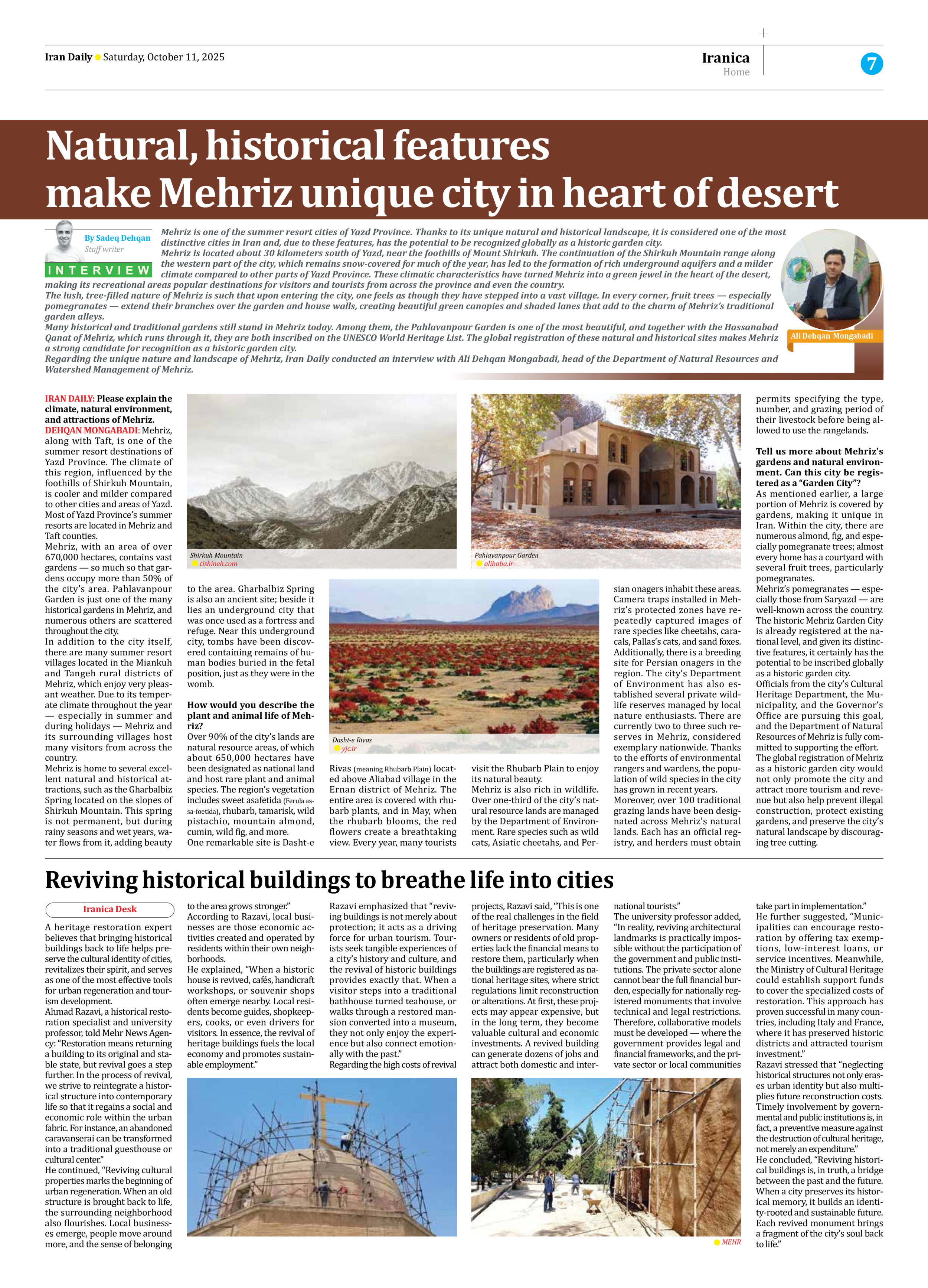
Mehriz is one of the summer resort cities of Yazd Province. Thanks to its unique natural and historical landscape, it is considered one of the most distinctive cities in Iran and, due to these features, has the potential to be recognized globally as a historic garden city. Mehriz is located about 30 kilometers south of Yazd, near the foothills of Mount Shirkuh. The continuation of the Shirkuh Mountain range along the western part of the city, which remains snow-covered for much of the year, has led to the formation of rich underground aquifers and a milder climate compared to other parts of Yazd Province. These climatic characteristics have turned Mehriz into a green jewel in the heart of the desert, making its recreational areas popular destinations for visitors and tourists from across the province and even the country. The lush, tree-filled nature of Mehriz is such that upon entering the city, one feels as though they have stepped into a vast village. In every corner, fruit trees — especially pomegranates — extend their branches over the garden and house walls, creating beautiful green canopies and shaded lanes that add to the charm of Mehriz’s traditional garden alleys. Many historical and traditional gardens still stand in Mehriz today. Among them, the Pahlavanpour Garden is one of the most beautiful, and together with the Hassanabad Qanat of Mehriz, which runs through it, they are both inscribed on the UNESCO World Heritage List. The global registration of these natural and historical sites makes Mehriz a strong candidate for recognition as a historic garden city. Regarding the unique nature and landscape of Mehriz, Iran Daily conducted an interview with Ali Dehqan Mongabadi, head of the Department of Natural Resources and Watershed Management of Mehriz.
By Sadeq Dehqan
Staff writer
IRAN DAILY: Please explain the climate, natural environment, and attractions of Mehriz.
DEHQAN MONGABADI: Mehriz, along with Taft, is one of the summer resort destinations of Yazd Province. The climate of this region, influenced by the foothills of Shirkuh Mountain, is cooler and milder compared to other cities and areas of Yazd. Most of Yazd Province’s summer resorts are located in Mehriz and Taft counties.
Mehriz, with an area of over 670,000 hectares, contains vast gardens — so much so that gardens occupy more than 50% of the city’s area. Pahlavanpour Garden is just one of the many historical gardens in Mehriz, and numerous others are scattered throughout the city.
In addition to the city itself, there are many summer resort villages located in the Miankuh and Tangeh rural districts of Mehriz, which enjoy very pleasant weather. Due to its temperate climate throughout the year — especially in summer and during holidays — Mehriz and its surrounding villages host many visitors from across the country.
Mehriz is home to several excellent natural and historical attractions, such as the Gharbalbiz Spring located on the slopes of Shirkuh Mountain. This spring is not permanent, but during rainy seasons and wet years, water flows from it, adding beauty to the area. Gharbalbiz Spring is also an ancient site; beside it lies an underground city that was once used as a fortress and refuge. Near this underground city, tombs have been discovered containing remains of human bodies buried in the fetal position, just as they were in the womb.
How would you describe the plant and animal life of Mehriz?
Over 90% of the city’s lands are natural resource areas, of which about 650,000 hectares have been designated as national land and host rare plant and animal species. The region’s vegetation includes sweet asafetida (Ferula assa-foetida), rhubarb, tamarisk, wild pistachio, mountain almond, cumin, wild fig, and more.
One remarkable site is Dasht-e Rivas (meaning Rhubarb Plain) located above Aliabad village in the Ernan district of Mehriz. The entire area is covered with rhubarb plants, and in May, when the rhubarb blooms, the red flowers create a breathtaking view. Every year, many tourists visit the Rhubarb Plain to enjoy its natural beauty.
Mehriz is also rich in wildlife. Over one-third of the city’s natural resource lands are managed by the Department of Environment. Rare species such as wild cats, Asiatic cheetahs, and Persian onagers inhabit these areas.
Camera traps installed in Mehriz’s protected zones have repeatedly captured images of rare species like cheetahs, caracals, Pallas’s cats, and sand foxes. Additionally, there is a breeding site for Persian onagers in the region. The city’s Department of Environment has also established several private wildlife reserves managed by local nature enthusiasts. There are currently two to three such reserves in Mehriz, considered exemplary nationwide. Thanks to the efforts of environmental rangers and wardens, the population of wild species in the city has grown in recent years.
Moreover, over 100 traditional grazing lands have been designated across Mehriz’s natural lands. Each has an official registry, and herders must obtain permits specifying the type, number, and grazing period of their livestock before being allowed to use the rangelands.
Tell us more about Mehriz’s gardens and natural environment. Can this city be registered as a “Garden City”?
As mentioned earlier, a large portion of Mehriz is covered by gardens, making it unique in Iran. Within the city, there are numerous almond, fig, and especially pomegranate trees; almost every home has a courtyard with several fruit trees, particularly pomegranates.
Mehriz’s pomegranates — especially those from Saryazd — are well-known across the country. The historic Mehriz Garden City is already registered at the national level, and given its distinctive features, it certainly has the potential to be inscribed globally as a historic garden city.
Officials from the city’s Cultural Heritage Department, the Municipality, and the Governor’s Office are pursuing this goal, and the Department of Natural Resources of Mehriz is fully committed to supporting the effort.
The global registration of Mehriz as a historic garden city would not only promote the city and attract more tourism and revenue but also help prevent illegal construction, protect existing gardens, and preserve the city’s natural landscape by discouraging tree cutting.