







Deputy minister: Ratification of Palermo, CFT key to economic boost
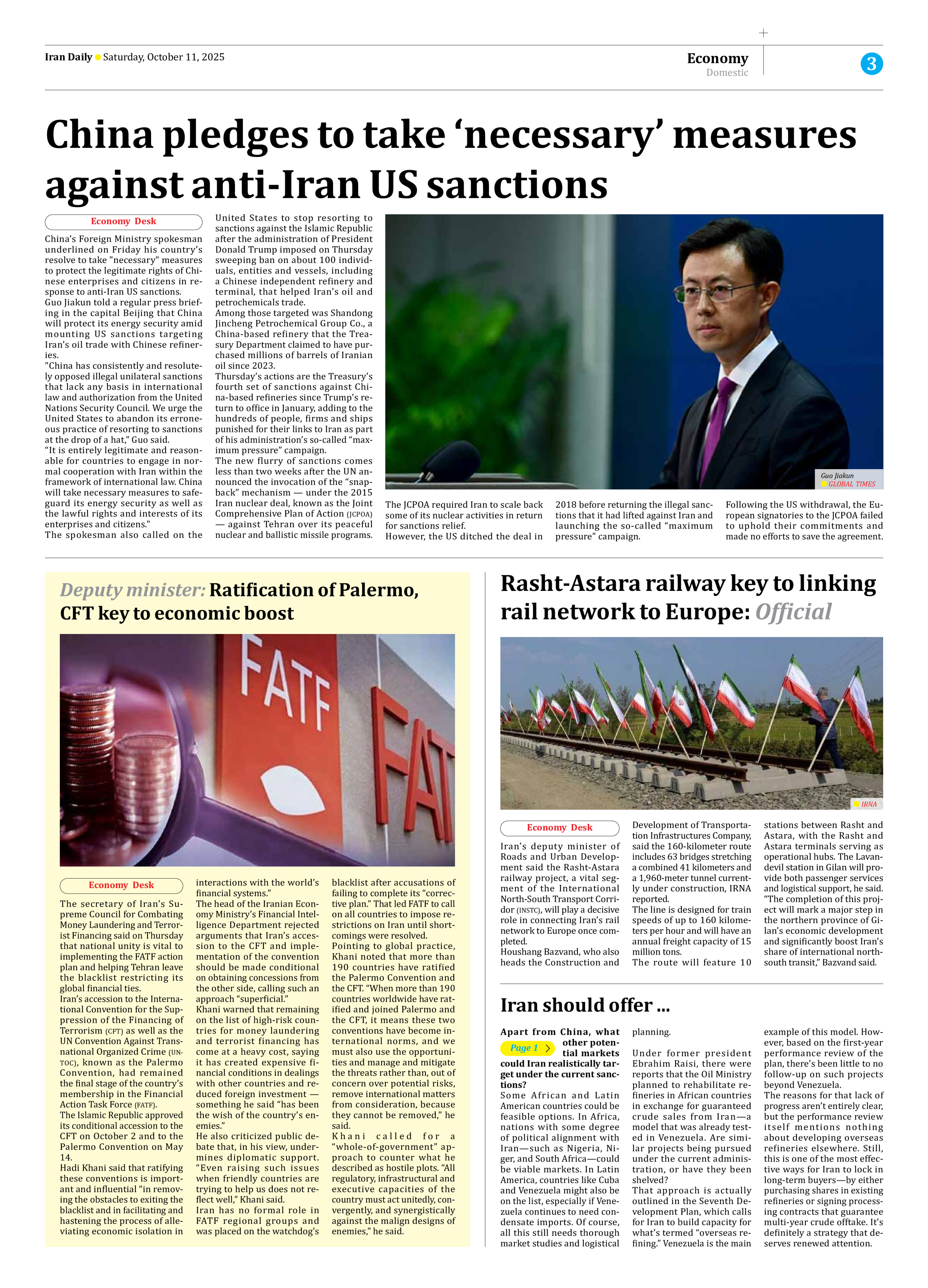
The secretary of Iran’s Supreme Council for Combating Money Laundering and Terrorist Financing said on Thursday that national unity is vital to implementing the FATF action plan and helping Tehran leave the blacklist restricting its global financial ties.
Iran’s accession to the International Convention for the Suppression of the Financing of Terrorism (CFT) as well as the UN Convention Against Transnational Organized Crime (UNTOC), known as the Palermo Convention, had remained the final stage of the country’s membership in the Financial Action Task Force (FATF).
The Islamic Republic approved its conditional accession to the CFT on October 2 and to the Palermo Convention on May 14.
Hadi Khani said that ratifying these conventions is important and influential “in removing the obstacles to exiting the blacklist and in facilitating and hastening the process of alleviating economic isolation in interactions with the world’s financial systems.”
The head of the Iranian Economy Ministry’s Financial Intelligence Department rejected arguments that Iran’s accession to the CFT and implementation of the convention should be made conditional on obtaining concessions from the other side, calling such an approach “superficial.”
Khani warned that remaining on the list of high-risk countries for money laundering and terrorist financing has come at a heavy cost, saying it has created expensive financial conditions in dealings with other countries and reduced foreign investment — something he said “has been the wish of the country’s enemies.”
He also criticized public debate that, in his view, undermines diplomatic support. “Even raising such issues when friendly countries are trying to help us does not reflect well,” Khani said.
Iran has no formal role in FATF regional groups and was placed on the watchdog’s blacklist after accusations of failing to complete its “corrective plan.” That led FATF to call on all countries to impose restrictions on Iran until shortcomings were resolved.
Pointing to global practice, Khani noted that more than 190 countries have ratified the Palermo Convention and the CFT. “When more than 190 countries worldwide have ratified and joined Palermo and the CFT, it means these two conventions have become international norms, and we must also use the opportunities and manage and mitigate the threats rather than, out of concern over potential risks, remove international matters from consideration, because they cannot be removed,” he said.
Khani called for a “whole-of-government” approach to counter what he described as hostile plots. “All regulatory, infrastructural and executive capacities of the country must act unitedly, convergently, and synergistically against the malign designs of enemies,” he said.