





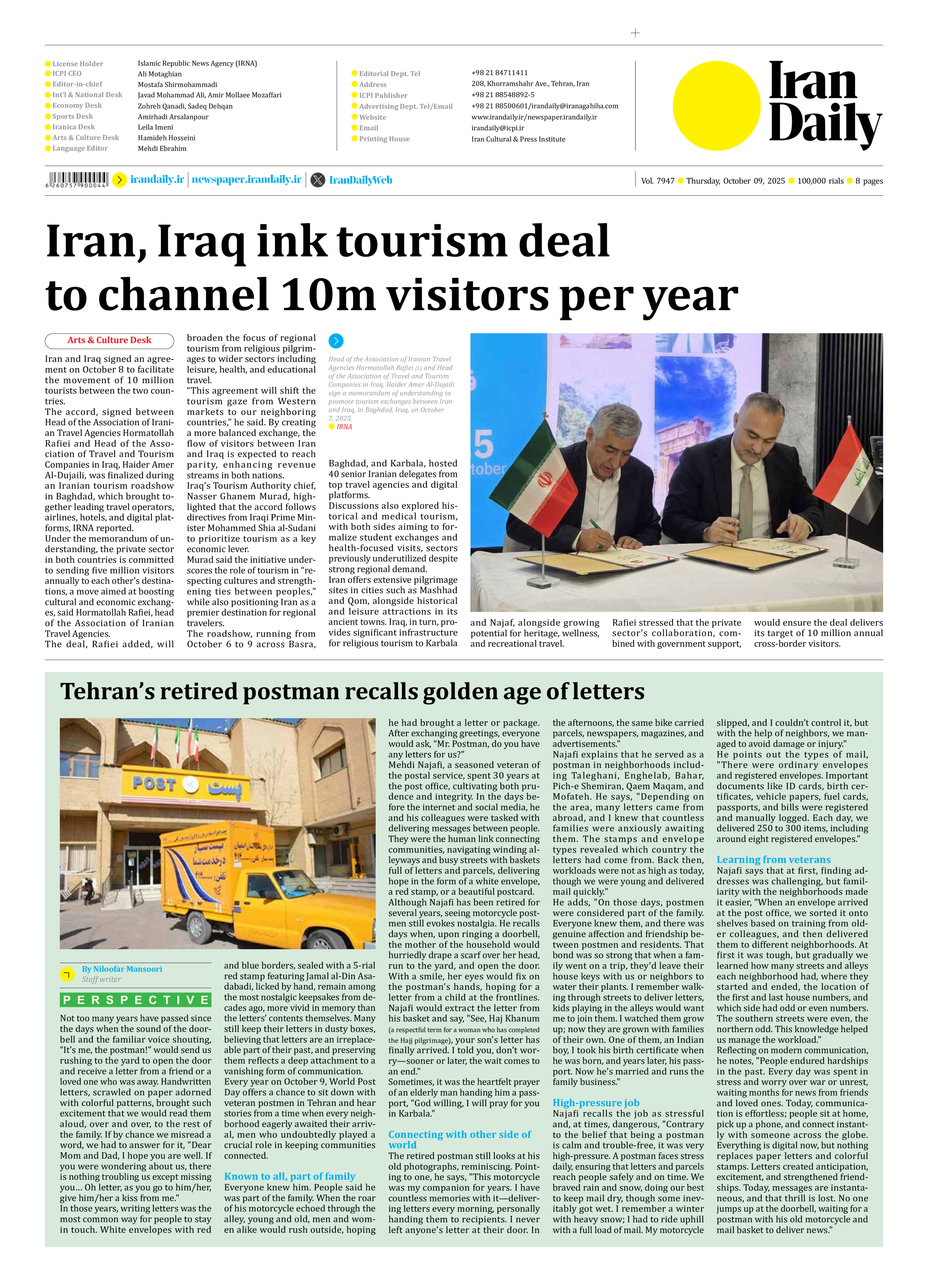


Tehran’s retired postman recalls golden age of letters
By Niloofar Mansoori
Staff writer
Not too many years have passed since the days when the sound of the doorbell and the familiar voice shouting, “It’s me, the postman!” would send us rushing to the yard to open the door and receive a letter from a friend or a loved one who was away. Handwritten letters, scrawled on paper adorned with colorful patterns, brought such excitement that we would read them aloud, over and over, to the rest of the family. If by chance we misread a word, we had to answer for it, "Dear Mom and Dad, I hope you are well. If you were wondering about us, there is nothing troubling us except missing you… Oh letter, as you go to him/her, give him/her a kiss from me."
In those years, writing letters was the most common way for people to stay in touch. White envelopes with red and blue borders, sealed with a 5-rial red stamp featuring Jamal al-Din Asadabadi, licked by hand, remain among the most nostalgic keepsakes from decades ago, more vivid in memory than the letters’ contents themselves. Many still keep their letters in dusty boxes, believing that letters are an irreplaceable part of their past, and preserving them reflects a deep attachment to a vanishing form of communication.
Every year on October 9, World Post Day offers a chance to sit down with veteran postmen in Tehran and hear stories from a time when every neighborhood eagerly awaited their arrival, men who undoubtedly played a crucial role in keeping communities connected.
Known to all, part of family
Everyone knew him. People said he was part of the family. When the roar of his motorcycle echoed through the alley, young and old, men and women alike would rush outside, hoping he had brought a letter or package. After exchanging greetings, everyone would ask, “Mr. Postman, do you have any letters for us?”
Mehdi Najafi, a seasoned veteran of the postal service, spent 30 years at the post office, cultivating both prudence and integrity. In the days before the internet and social media, he and his colleagues were tasked with delivering messages between people. They were the human link connecting communities, navigating winding alleyways and busy streets with baskets full of letters and parcels, delivering hope in the form of a white envelope, a red stamp, or a beautiful postcard.
Although Najafi has been retired for several years, seeing motorcycle postmen still evokes nostalgia. He recalls days when, upon ringing a doorbell, the mother of the household would hurriedly drape a scarf over her head, run to the yard, and open the door. With a smile, her eyes would fix on the postman’s hands, hoping for a letter from a child at the frontlines. Najafi would extract the letter from his basket and say, "See, Haj Khanum (a respectful term for a woman who has completed the Hajj pilgrimage), your son’s letter has finally arrived. I told you, don’t worry—sooner or later, the wait comes to an end."
Sometimes, it was the heartfelt prayer of an elderly man handing him a passport, "God willing, I will pray for you in Karbala."
Connecting with other side of world
The retired postman still looks at his old photographs, reminiscing. Pointing to one, he says, "This motorcycle was my companion for years. I have countless memories with it—delivering letters every morning, personally handing them to recipients. I never left anyone’s letter at their door. In the afternoons, the same bike carried parcels, newspapers, magazines, and advertisements."
Najafi explains that he served as a postman in neighborhoods including Taleghani, Enghelab, Bahar, Pich-e Shemiran, Qaem Maqam, and Mofateh. He says, "Depending on the area, many letters came from abroad, and I knew that countless families were anxiously awaiting them. The stamps and envelope types revealed which country the letters had come from. Back then, workloads were not as high as today, though we were young and delivered mail quickly."
He adds, "On those days, postmen were considered part of the family. Everyone knew them, and there was genuine affection and friendship between postmen and residents. That bond was so strong that when a family went on a trip, they’d leave their house keys with us or neighbors to water their plants. I remember walking through streets to deliver letters, kids playing in the alleys would want me to join them. I watched them grow up; now they are grown with families of their own. One of them, an Indian boy, I took his birth certificate when he was born, and years later, his passport. Now he’s married and runs the family business."
High-pressure job
Najafi recalls the job as stressful and, at times, dangerous, "Contrary to the belief that being a postman is calm and trouble-free, it was very high-pressure. A postman faces stress daily, ensuring that letters and parcels reach people safely and on time. We braved rain and snow, doing our best to keep mail dry, though some inevitably got wet. I remember a winter with heavy snow; I had to ride uphill with a full load of mail. My motorcycle slipped, and I couldn’t control it, but with the help of neighbors, we managed to avoid damage or injury."
He points out the types of mail, "There were ordinary envelopes and registered envelopes. Important documents like ID cards, birth certificates, vehicle papers, fuel cards, passports, and bills were registered and manually logged. Each day, we delivered 250 to 300 items, including around eight registered envelopes."
Learning from veterans
Najafi says that at first, finding addresses was challenging, but familiarity with the neighborhoods made it easier, "When an envelope arrived at the post office, we sorted it onto shelves based on training from older colleagues, and then delivered them to different neighborhoods. At first it was tough, but gradually we learned how many streets and alleys each neighborhood had, where they started and ended, the location of the first and last house numbers, and which side had odd or even numbers. The southern streets were even, the northern odd. This knowledge helped us manage the workload."
Reflecting on modern communication, he notes, "People endured hardships in the past. Every day was spent in stress and worry over war or unrest, waiting months for news from friends and loved ones. Today, communication is effortless; people sit at home, pick up a phone, and connect instantly with someone across the globe. Everything is digital now, but nothing replaces paper letters and colorful stamps. Letters created anticipation, excitement, and strengthened friendships. Today, messages are instantaneous, and that thrill is lost. No one jumps up at the doorbell, waiting for a postman with his old motorcycle and mail basket to deliver news."