







World Space Week: Iran simulates lunar soil for first time
Iranian researchers at the Iran University of Science and Technology unveiled on Saturday their first domestic simulation of lunar soil, based on the composition of samples from NASA’s Apollo 14 mission.
The announcement came during the opening ceremony of World Space Week in Tehran on October 4, attended by Information and Communication Technology (ICT) Minister, Sattar Hashemi and Head of the Iranian Space Agency (ISA) Hassan Salarieh, ISNA reported.
In a departure from past events that focused on achievements, this year’s opening zeroed in on “Life in Space.”
Researchers led by Mehdi Nasiri Sarvi said they began by mimicking the Moon’s regolith and have moved on to experiments in agriculture, mining and settlement design under simulated lunar conditions.
Nasiri Sarvi, an assistant professor in satellite technology engineering, explained that the soil simulant was crafted by analyzing mineral compositions of Iranian rocks and blending them to match curves recorded in Apollo 11, 14, 15 and 16 mission reports.
He said the new sample is “very close” in elemental proportions to the real lunar material.
He noted that in moon environments, the absence of atmosphere means no carbon dioxide or oxygen. To mimic a life-support cycle, the team planted two base plant species in sealed chambers. One absorbs CO₂ and produces O₂, the other does the reverse — the process driven by an initial oxygen capsule. He said this could pave the way for a self-sustaining gas cycle in lunar habitats.
Their broader strategy includes extracting oxygen and hydrogen, recovering metals, and harvesting helium-3, a rare and clean fusion fuel thought to exist in Moon soil.
Salarieh underlined the aim, “We want to shift from symbolic space presence to resource-driven missions.”
Among design proposals is an “origami” shelter — a telescoping, foldable paper-inspired shell that expands on deployment, lightweight yet radiation-shielding when clad with processed lunar regolith. The researchers have built a one-meter prototype and are exploring use of lunar-derived cement to block heat and radiation.
They also hope to deploy 3D printers on the Moon, using in-situ materials to build modular habitations. Site selection — between poles, equatorial regions, shadows or elevated terrain — depends on sunlight, temperature swings and radiation.
Nasiri Sarvi warned that equatorial surfaces can exceed 100 °C during lunar daytime, while shadowed regions behave drastically differently.
Their mineral analysis shows that silicon and magnesium dominate lunar soil — in line with prior international studies.
The team conducted spectroscopic comparisons, meteorite studies, and cross-validation with Apollo data. He emphasized that mining and resource extraction underpin renewed global interest in the Moon. “This is not about prestige anymore,” he said. “It’s about economics.”
The minister remarked that Iran must “catch up” in lunar science to avoid falling behind. For now, the project remains in university laboratories, but Nasiri Sarvi called for a national lunar research center with support from the Space Agency and research institutions.
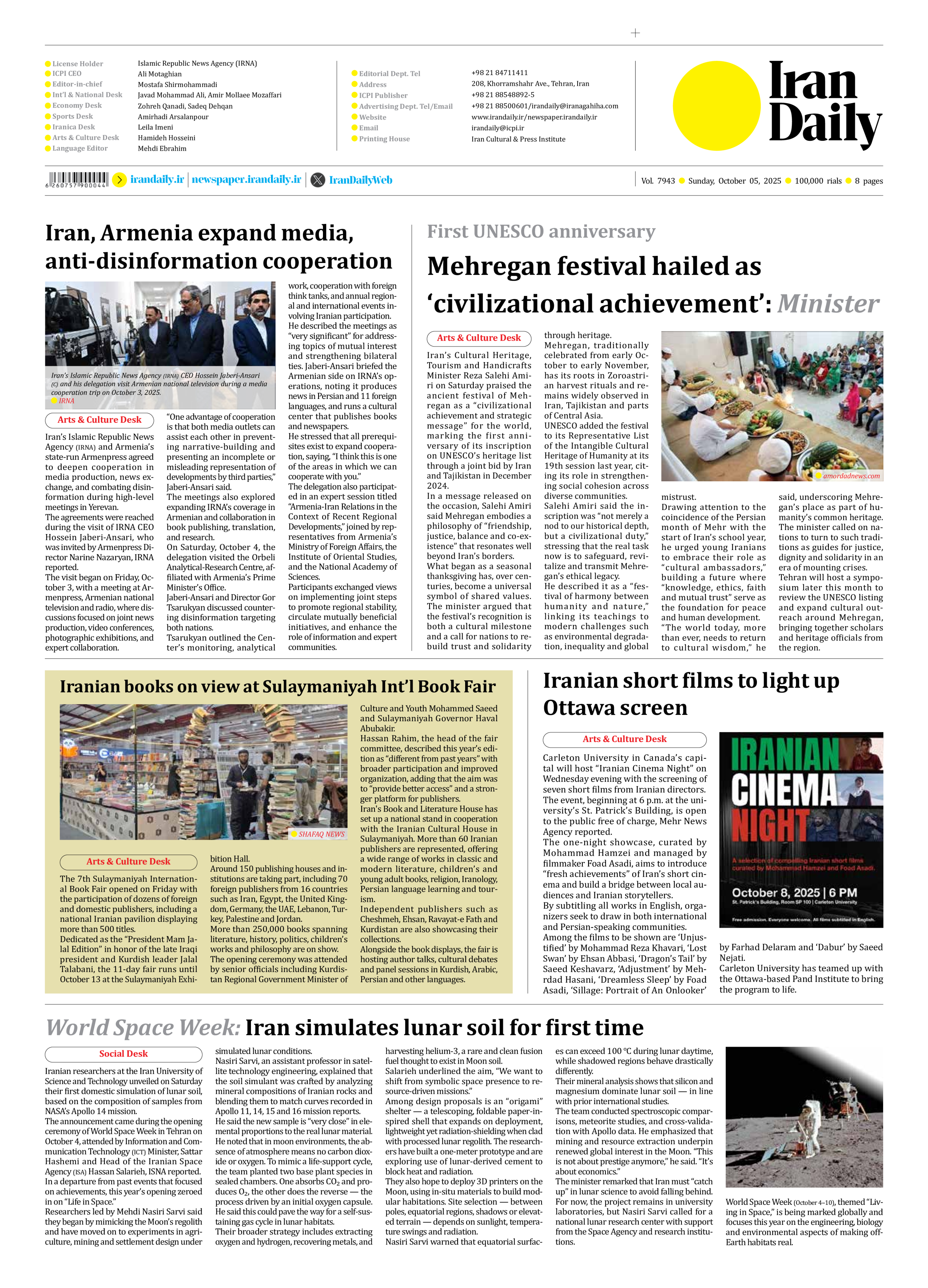
World Space Week (October 4–10), themed “Living in Space,” is being marked globally and focuses this year on the engineering, biology and environmental aspects of making off-Earth habitats real.