







Iran, Armenia expand media, anti-disinformation cooperation
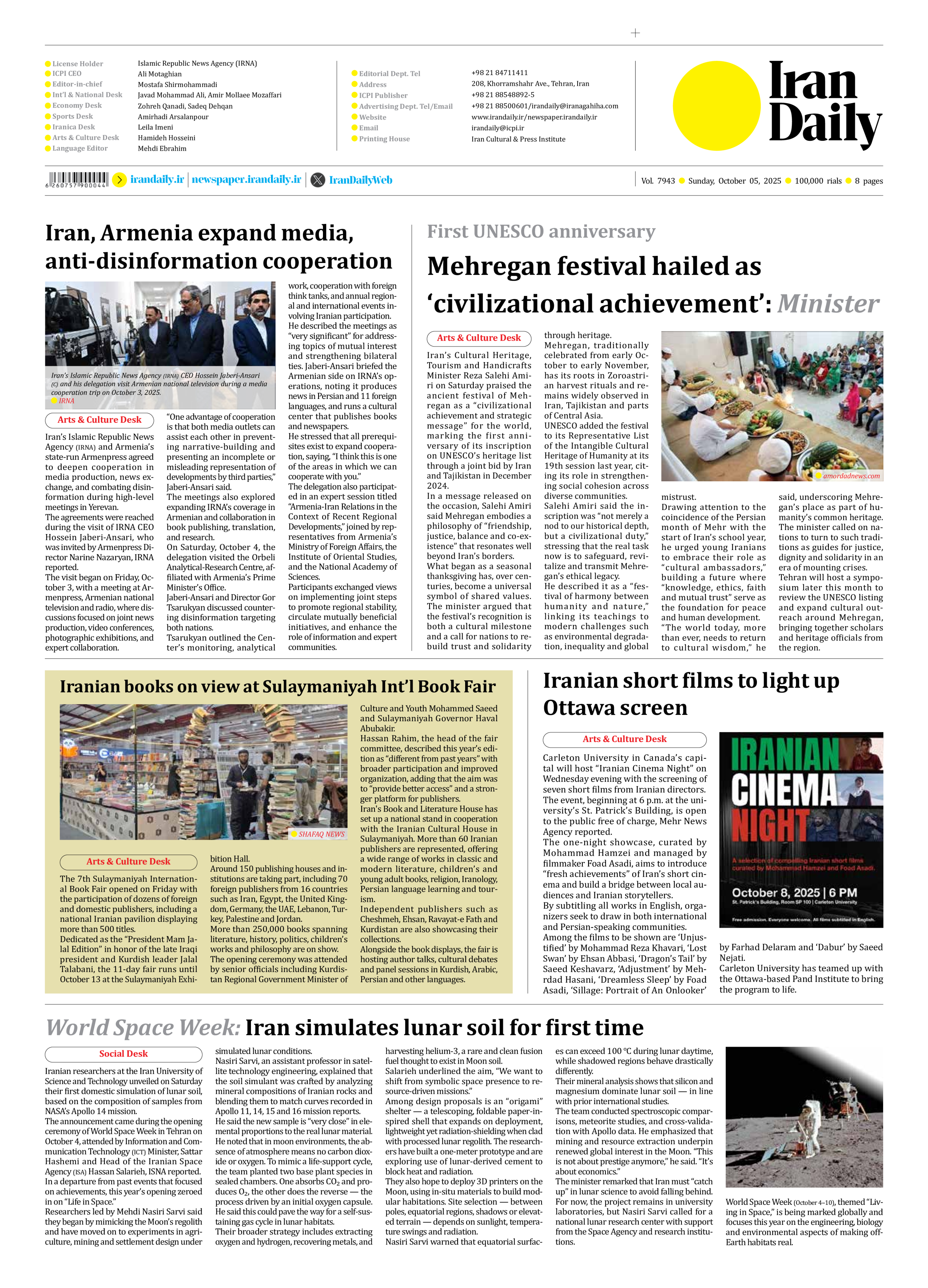
Iran’s Islamic Republic News Agency (IRNA) and Armenia’s state-run Armenpress agreed to deepen cooperation in media production, news exchange, and combating disinformation during high-level meetings in Yerevan.
The agreements were reached during the visit of IRNA CEO Hossein Jaberi-Ansari, who was invited by Armenpress Director Narine Nazaryan, IRNA reported.
The visit began on Friday, October 3, with a meeting at Armenpress, Armenian national television and radio, where discussions focused on joint news production, video conferences, photographic exhibitions, and expert collaboration.
“One advantage of cooperation is that both media outlets can assist each other in preventing narrative-building and presenting an incomplete or misleading representation of developments by third parties,” Jaberi-Ansari said.
The meetings also explored expanding IRNA’s coverage in Armenian and collaboration in book publishing, translation, and research.
On Saturday, October 4, the delegation visited the Orbeli Analytical-Research Centre, affiliated with Armenia’s Prime Minister’s Office.
Jaberi-Ansari and Director Gor Tsarukyan discussed countering disinformation targeting both nations.
Tsarukyan outlined the Center’s monitoring, analytical work, cooperation with foreign think tanks, and annual regional and international events involving Iranian participation.
He described the meetings as “very significant” for addressing topics of mutual interest and strengthening bilateral ties. Jaberi-Ansari briefed the Armenian side on IRNA’s operations, noting it produces news in Persian and 11 foreign languages, and runs a cultural center that publishes books and newspapers.
He stressed that all prerequisites exist to expand cooperation, saying, “I think this is one of the areas in which we can cooperate with you.”
The delegation also participated in an expert session titled “Armenia-Iran Relations in the Context of Recent Regional Developments,” joined by representatives from Armenia’s Ministry of Foreign Affairs, the Institute of Oriental Studies, and the National Academy of Sciences.
Participants exchanged views on implementing joint steps to promote regional stability, circulate mutually beneficial initiatives, and enhance the role of information and expert communities.