





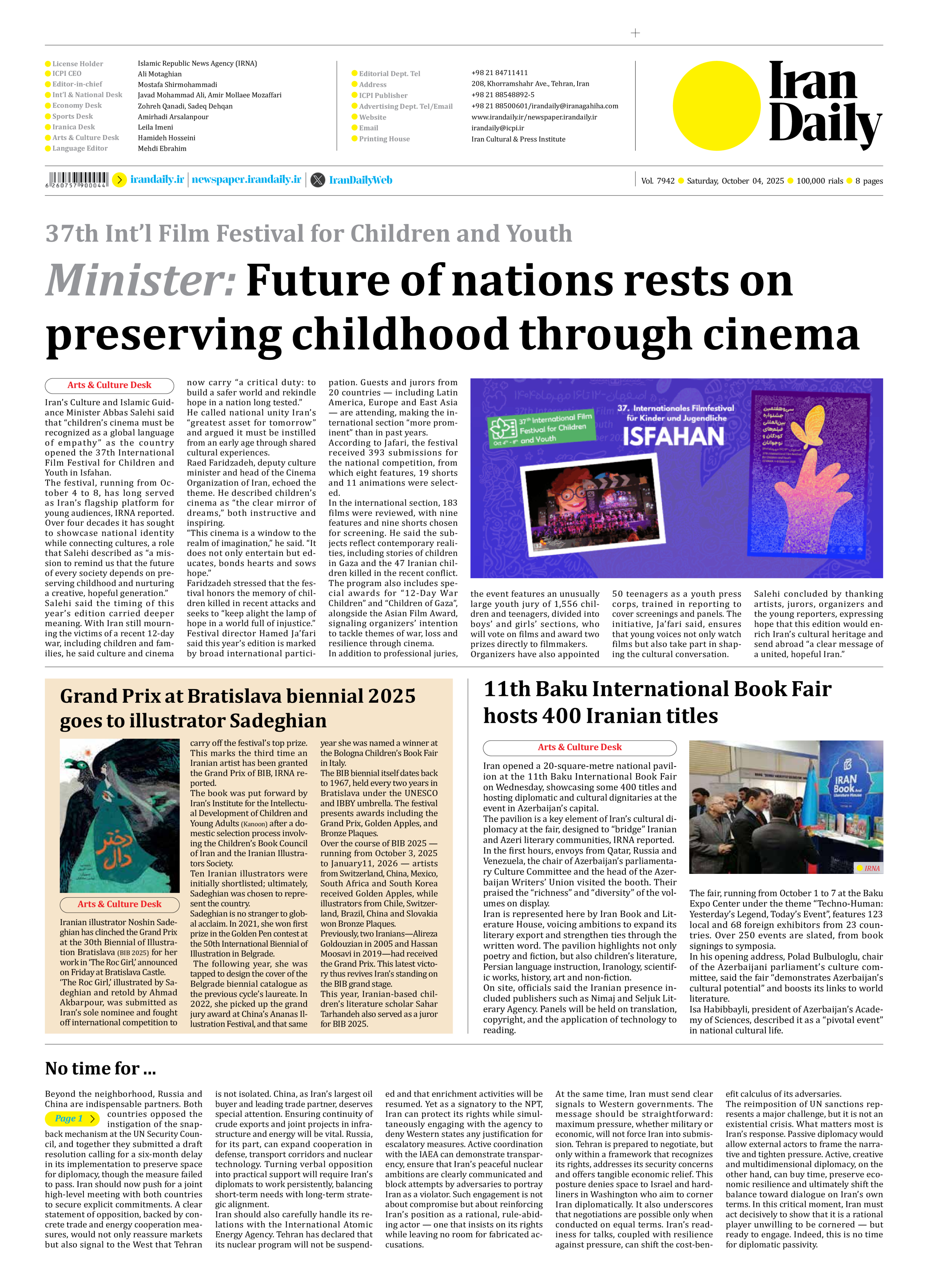


37th Int’l Film Festival for Children and Youth
Minister: Future of nations rests on preserving childhood through cinema
Iran’s Culture and Islamic Guidance Minister Abbas Salehi said that “children’s cinema must be recognized as a global language of empathy” as the country opened the 37th International Film Festival for Children and Youth in Isfahan.
The festival, running from October 4 to 8, has long served as Iran’s flagship platform for young audiences, IRNA reported.
Over four decades it has sought to showcase national identity while connecting cultures, a role that Salehi described as “a mission to remind us that the future of every society depends on preserving childhood and nurturing a creative, hopeful generation.”
Salehi said the timing of this year’s edition carried deeper meaning. With Iran still mourning the victims of a recent 12-day war, including children and families, he said culture and cinema now carry “a critical duty: to build a safer world and rekindle hope in a nation long tested.”
He called national unity Iran’s “greatest asset for tomorrow” and argued it must be instilled from an early age through shared cultural experiences.
Raed Faridzadeh, deputy culture minister and head of the Cinema Organization of Iran, echoed the theme. He described children’s cinema as “the clear mirror of dreams,” both instructive and inspiring.
“This cinema is a window to the realm of imagination,” he said. “It does not only entertain but educates, bonds hearts and sows hope.”
Faridzadeh stressed that the festival honors the memory of children killed in recent attacks and seeks to “keep alight the lamp of hope in a world full of injustice.”
Festival director Hamed Ja’fari said this year’s edition is marked by broad international participation. Guests and jurors from 20 countries — including Latin America, Europe and East Asia — are attending, making the international section “more prominent” than in past years.
According to Jafari, the festival received 393 submissions for the national competition, from which eight features, 19 shorts and 11 animations were selected.
In the international section, 183 films were reviewed, with nine features and nine shorts chosen for screening. He said the subjects reflect contemporary realities, including stories of children in Gaza and the 47 Iranian children killed in the recent conflict.
The program also includes special awards for “12-Day War Children” and “Children of Gaza”, alongside the Asian Film Award, signaling organizers’ intention to tackle themes of war, loss and resilience through cinema.
In addition to professional juries, the event features an unusually large youth jury of 1,556 children and teenagers, divided into boys’ and girls’ sections, who will vote on films and award two prizes directly to filmmakers.
Organizers have also appointed 50 teenagers as a youth press corps, trained in reporting to cover screenings and panels. The initiative, Ja’fari said, ensures that young voices not only watch films but also take part in shaping the cultural conversation.
Salehi concluded by thanking artists, jurors, organizers and the young reporters, expressing hope that this edition would enrich Iran’s cultural heritage and send abroad “a clear message of a united, hopeful Iran.”