







Mend village preserves pottery traditions in eastern Iran
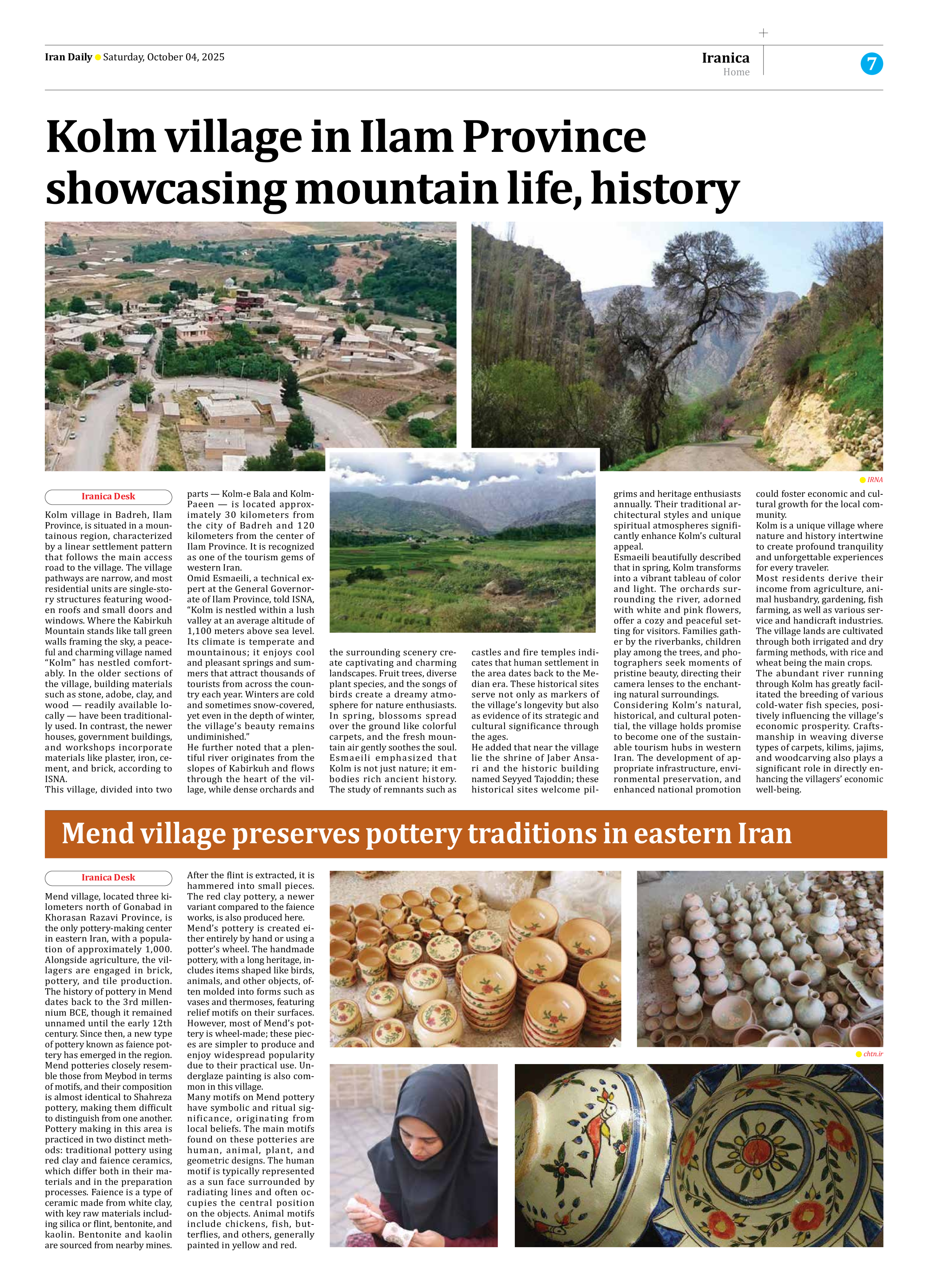
Mend village, located three kilometers north of Gonabad in Khorasan Razavi Province, is the only pottery-making center in eastern Iran, with a population of approximately 1,000. Alongside agriculture, the villagers are engaged in brick, pottery, and tile production. The history of pottery in Mend dates back to the 3rd millennium BCE, though it remained unnamed until the early 12th century. Since then, a new type of pottery known as faience pottery has emerged in the region. Mend potteries closely resemble those from Meybod in terms of motifs, and their composition is almost identical to Shahreza pottery, making them difficult to distinguish from one another.
Pottery making in this area is practiced in two distinct methods: traditional pottery using red clay and faience ceramics, which differ both in their materials and in the preparation processes. Faience is a type of ceramic made from white clay, with key raw materials including silica or flint, bentonite, and kaolin. Bentonite and kaolin are sourced from nearby mines. After the flint is extracted, it is hammered into small pieces. The red clay pottery, a newer variant compared to the faience works, is also produced here.
Mend’s pottery is created either entirely by hand or using a potter’s wheel. The handmade pottery, with a long heritage, includes items shaped like birds, animals, and other objects, often molded into forms such as vases and thermoses, featuring relief motifs on their surfaces. However, most of Mend’s pottery is wheel-made; these pieces are simpler to produce and enjoy widespread popularity due to their practical use. Underglaze painting is also common in this village.
Many motifs on Mend pottery have symbolic and ritual significance, originating from local beliefs. The main motifs found on these potteries are human, animal, plant, and geometric designs. The human motif is typically represented as a sun face surrounded by radiating lines and often occupies the central position on the objects. Animal motifs include chickens, fish, butterflies, and others, generally painted in yellow and red.