







Copy in clipboard...
4,000-year-old Elamite relief discovered in southwest Iran
The discovery was made by a team led by Hossein Feyzi of Faculty of Archaeology (Susa) and Director of the National Base for the Cultural and Industrial Landscape of Masjed Soleiman Ayoub Soltani, ISNA reported.
It offers a fresh glimpse into Elamite religious rites and their cultural ties with Mesopotamia, the ministry said on its website.
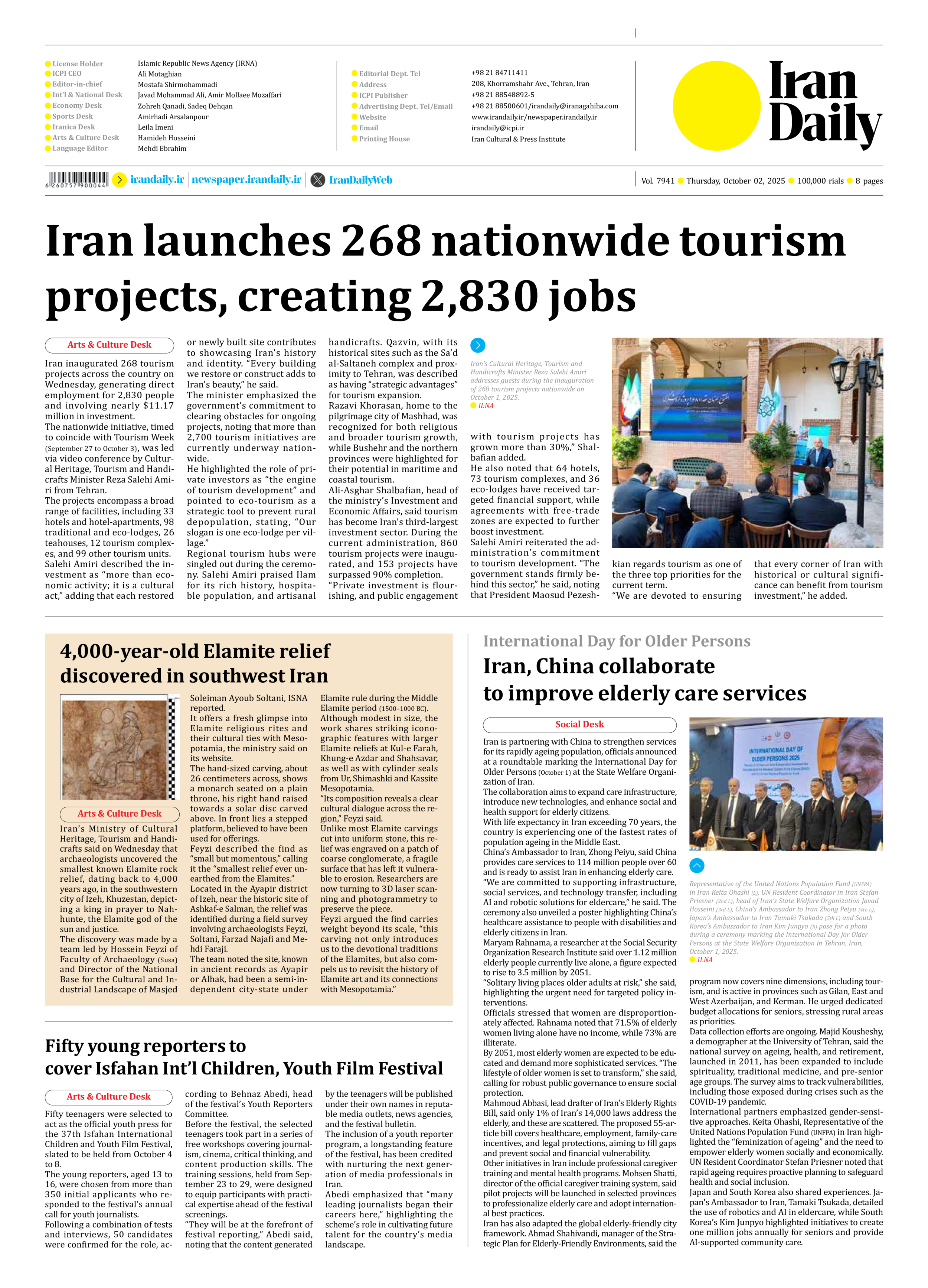
The hand-sized carving, about 26 centimeters across, shows a monarch seated on a plain throne, his right hand raised towards a solar disc carved above. In front lies a stepped platform, believed to have been used for offerings.
Feyzi described the find as “small but momentous,” calling it the “smallest relief ever unearthed from the Elamites.”
Located in the Ayapir district of Izeh, near the historic site of Ashkaf-e Salman, the relief was identified during a field survey involving archaeologists Feyzi, Soltani, Farzad Najafi and Mehdi Faraji.
The team noted the site, known in ancient records as Ayapir or Alhak, had been a semi-independent city-state under Elamite rule during the Middle Elamite period (1500–1000 BC).
Although modest in size, the work shares striking iconographic features with larger Elamite reliefs at Kul-e Farah, Khung-e Azdar and Shahsavar, as well as with cylinder seals from Ur, Shimashki and Kassite Mesopotamia.
“Its composition reveals a clear cultural dialogue across the region,” Feyzi said.
Unlike most Elamite carvings cut into uniform stone, this relief was engraved on a patch of coarse conglomerate, a fragile surface that has left it vulnerable to erosion. Researchers are now turning to 3D laser scanning and photogrammetry to preserve the piece.
Feyzi argued the find carries weight beyond its scale, “this carving not only introduces us to the devotional traditions of the Elamites, but also compels us to revisit the history of Elamite art and its connections with Mesopotamia.”