







Walk through Zanjan Bazaar to experience history, vibrant traditions
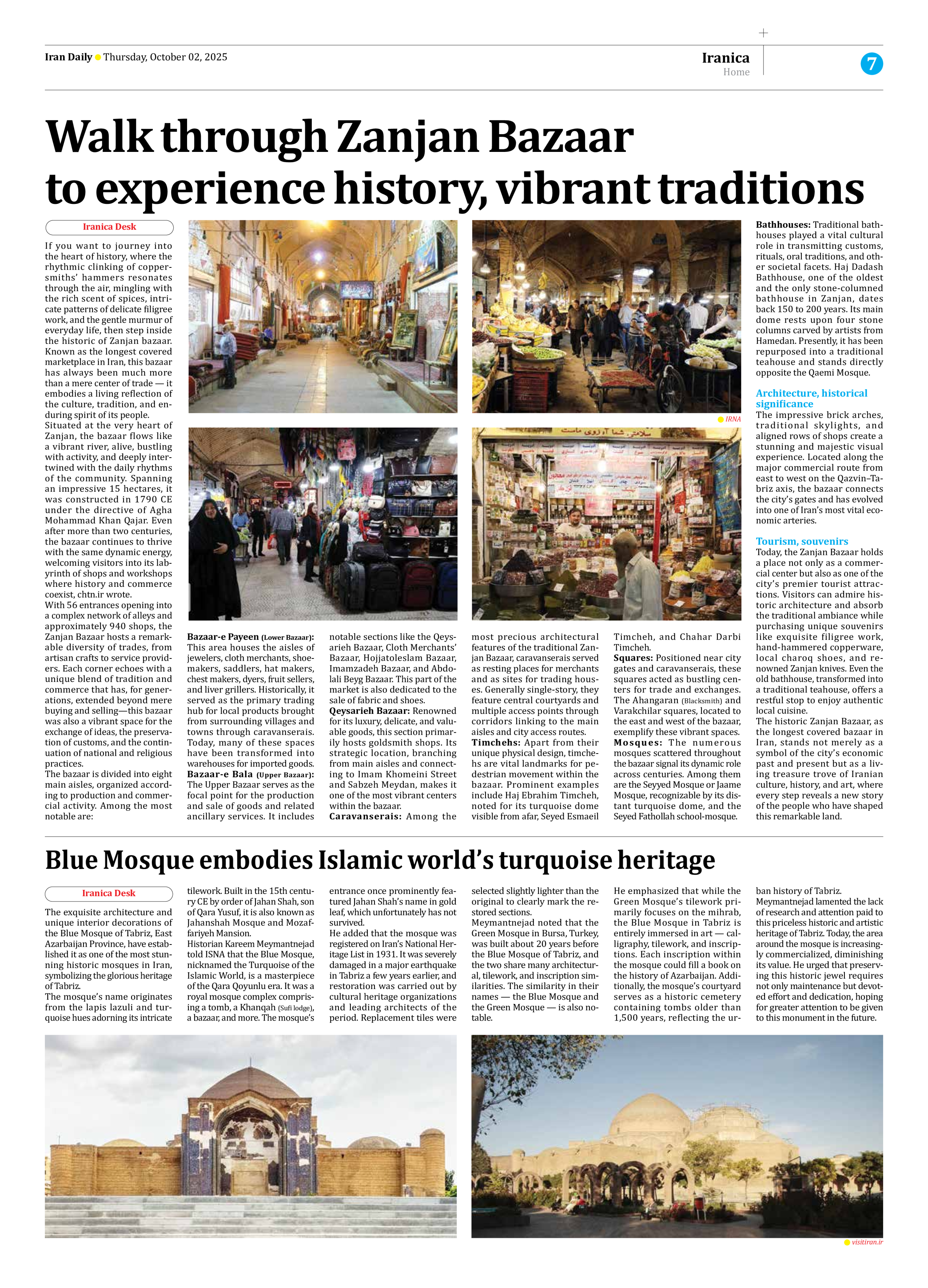
If you want to journey into the heart of history, where the rhythmic clinking of coppersmiths’ hammers resonates through the air, mingling with the rich scent of spices, intricate patterns of delicate filigree work, and the gentle murmur of everyday life, then step inside the historic of Zanjan bazaar. Known as the longest covered marketplace in Iran, this bazaar has always been much more than a mere center of trade — it embodies a living reflection of the culture, tradition, and enduring spirit of its people.
Situated at the very heart of Zanjan, the bazaar flows like a vibrant river, alive, bustling with activity, and deeply intertwined with the daily rhythms of the community. Spanning an impressive 15 hectares, it was constructed in 1790 CE under the directive of Agha Mohammad Khan Qajar. Even after more than two centuries, the bazaar continues to thrive with the same dynamic energy, welcoming visitors into its labyrinth of shops and workshops where history and commerce coexist, chtn.ir wrote.
With 56 entrances opening into a complex network of alleys and approximately 940 shops, the Zanjan Bazaar hosts a remarkable diversity of trades, from artisan crafts to service providers. Each corner echoes with a unique blend of tradition and commerce that has, for generations, extended beyond mere buying and selling—this bazaar was also a vibrant space for the exchange of ideas, the preservation of customs, and the continuation of national and religious practices.
The bazaar is divided into eight main aisles, organized according to production and commercial activity. Among the most notable are:
Bazaar-e Payeen (Lower Bazaar): This area houses the aisles of jewelers, cloth merchants, shoemakers, saddlers, hat makers, chest makers, dyers, fruit sellers, and liver grillers. Historically, it served as the primary trading hub for local products brought from surrounding villages and towns through caravanserais. Today, many of these spaces have been transformed into warehouses for imported goods.
Bazaar-e Bala (Upper Bazaar): The Upper Bazaar serves as the focal point for the production and sale of goods and related ancillary services. It includes notable sections like the Qeysarieh Bazaar, Cloth Merchants’ Bazaar, Hojjatoleslam Bazaar, Imamzadeh Bazaar, and Abdolali Beyg Bazaar. This part of the market is also dedicated to the sale of fabric and shoes.
Qeysarieh Bazaar: Renowned for its luxury, delicate, and valuable goods, this section primarily hosts goldsmith shops. Its strategic location, branching from main aisles and connecting to Imam Khomeini Street and Sabzeh Meydan, makes it one of the most vibrant centers within the bazaar.
Caravanserais: Among the most precious architectural features of the traditional Zanjan Bazaar, caravanserais served as resting places for merchants and as sites for trading houses. Generally single-story, they feature central courtyards and multiple access points through corridors linking to the main aisles and city access routes.
Timchehs: Apart from their unique physical design, timchehs are vital landmarks for pedestrian movement within the bazaar. Prominent examples include Haj Ebrahim Timcheh, noted for its turquoise dome visible from afar, Seyed Esmaeil Timcheh, and Chahar Darbi Timcheh.
Squares: Positioned near city gates and caravanserais, these squares acted as bustling centers for trade and exchanges. The Ahangaran (Blacksmith) and Varakchilar squares, located to the east and west of the bazaar, exemplify these vibrant spaces.
Mosques: The numerous mosques scattered throughout the bazaar signal its dynamic role across centuries. Among them are the Seyyed Mosque or Jaame Mosque, recognizable by its distant turquoise dome, and the Seyed Fathollah school-mosque.
Bathhouses: Traditional bathhouses played a vital cultural role in transmitting customs, rituals, oral traditions, and other societal facets. Haj Dadash Bathhouse, one of the oldest and the only stone-columned bathhouse in Zanjan, dates back 150 to 200 years. Its main dome rests upon four stone columns carved by artists from Hamedan. Presently, it has been repurposed into a traditional teahouse and stands directly opposite the Qaemi Mosque.
Architecture, historical significance
The impressive brick arches, traditional skylights, and aligned rows of shops create a stunning and majestic visual experience. Located along the major commercial route from east to west on the Qazvin–Tabriz axis, the bazaar connects the city’s gates and has evolved into one of Iran’s most vital economic arteries.
Tourism, souvenirs
Today, the Zanjan Bazaar holds a place not only as a commercial center but also as one of the city’s premier tourist attractions. Visitors can admire historic architecture and absorb the traditional ambiance while purchasing unique souvenirs like exquisite filigree work, hand-hammered copperware, local charoq shoes, and renowned Zanjan knives. Even the old bathhouse, transformed into a traditional teahouse, offers a restful stop to enjoy authentic local cuisine.
The historic Zanjan Bazaar, as the longest covered bazaar in Iran, stands not merely as a symbol of the city’s economic past and present but as a living treasure trove of Iranian culture, history, and art, where every step reveals a new story of the people who have shaped this remarkable land.