







Boldaji Gaz revitalizes sweet-making heritage
When it comes to Gaz, the name Boldaji Gaz instantly comes to mind, evoking a sense of sweetness that delights people’s palates. For over half a century, Gaz producers in Boldaji, a city in Chaharmahal and Bakhtiari Province, have significantly transformed the Gaz market in Iran and beyond by establishing themselves in this industry and registering the “Boldaji Gaz” brand. Their efforts have not only revitalized the market but also contributed to alleviating some of the country’s employment challenges while boosting the regional economy.
Gaz is regarded as one of Iran’s most important traditional sweet confections, with roots tracing back to the Qajar era. It was during the reign of Agha Mohammad Khan Qajar that Gaz was introduced as an export product to international markets, marking its entry onto the world stage. Throughout various historical periods, Gaz has carried many meanings, one of the most well-known being its association with a shrub of the same name, of which approximately 30 species have been identified. Among these, Gaz-Angabin is the most famous, flourishing in desert areas around Isfahan, Khansar, and several parts of Chaharmahal and Bakhtiari Province, including Boldaji in Borujen. The sap extracted from this shrub is the key ingredient used to produce authentic Gaz, chtn.ir wrote.
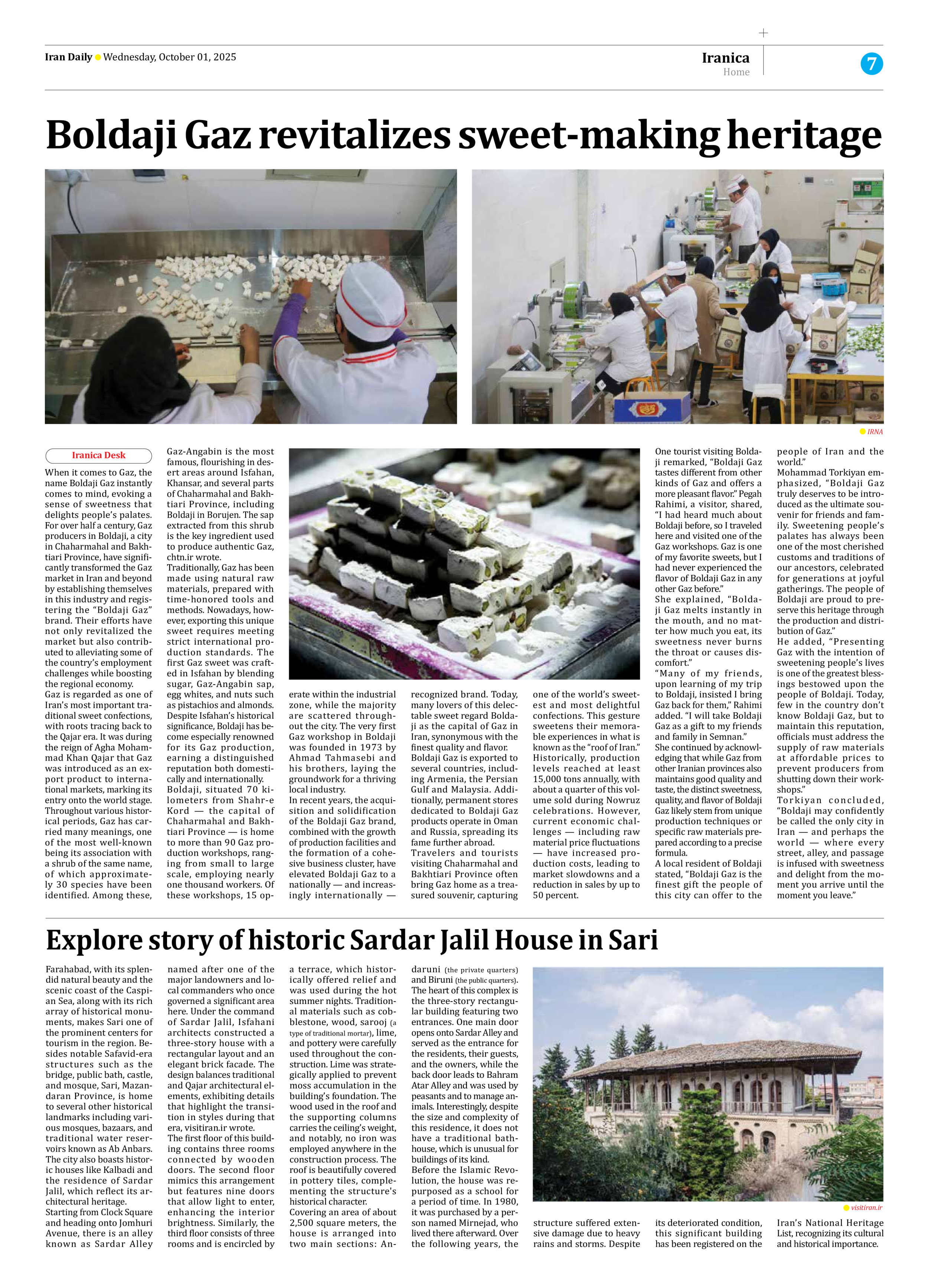
Traditionally, Gaz has been made using natural raw materials, prepared with time-honored tools and methods. Nowadays, however, exporting this unique sweet requires meeting strict international production standards. The first Gaz sweet was crafted in Isfahan by blending sugar, Gaz-Angabin sap, egg whites, and nuts such as pistachios and almonds. Despite Isfahan’s historical significance, Boldaji has become especially renowned for its Gaz production, earning a distinguished reputation both domestically and internationally.
Boldaji, situated 70 kilometers from Shahr-e Kord — the capital of Chaharmahal and Bakhtiari Province — is home to more than 90 Gaz production workshops, ranging from small to large scale, employing nearly one thousand workers. Of these workshops, 15 operate within the industrial zone, while the majority are scattered throughout the city. The very first Gaz workshop in Boldaji was founded in 1973 by Ahmad Tahmasebi and his brothers, laying the groundwork for a thriving local industry.
In recent years, the acquisition and solidification of the Boldaji Gaz brand, combined with the growth of production facilities and the formation of a cohesive business cluster, have elevated Boldaji Gaz to a nationally — and increasingly internationally — recognized brand. Today, many lovers of this delectable sweet regard Boldaji as the capital of Gaz in Iran, synonymous with the finest quality and flavor.
Boldaji Gaz is exported to several countries, including Armenia, the Persian Gulf and Malaysia. Additionally, permanent stores dedicated to Boldaji Gaz products operate in Oman and Russia, spreading its fame further abroad.
Travelers and tourists visiting Chaharmahal and Bakhtiari Province often bring Gaz home as a treasured souvenir, capturing one of the world’s sweetest and most delightful confections. This gesture sweetens their memorable experiences in what is known as the “roof of Iran.”
Historically, production levels reached at least 15,000 tons annually, with about a quarter of this volume sold during Nowruz celebrations. However, current economic challenges — including raw material price fluctuations — have increased production costs, leading to market slowdowns and a reduction in sales by up to 50 percent.
One tourist visiting Boldaji remarked, “Boldaji Gaz tastes different from other kinds of Gaz and offers a more pleasant flavor.” Pegah Rahimi, a visitor, shared, “I had heard much about Boldaji before, so I traveled here and visited one of the Gaz workshops. Gaz is one of my favorite sweets, but I had never experienced the flavor of Boldaji Gaz in any other Gaz before.”
She explained, “Boldaji Gaz melts instantly in the mouth, and no matter how much you eat, its sweetness never burns the throat or causes discomfort.”
“Many of my friends, upon learning of my trip to Boldaji, insisted I bring Gaz back for them,” Rahimi added. “I will take Boldaji Gaz as a gift to my friends and family in Semnan.”
She continued by acknowledging that while Gaz from other Iranian provinces also maintains good quality and taste, the distinct sweetness, quality, and flavor of Boldaji Gaz likely stem from unique production techniques or specific raw materials prepared according to a precise formula.
A local resident of Boldaji stated, “Boldaji Gaz is the finest gift the people of this city can offer to the people of Iran and the world.”
Mohammad Torkiyan emphasized, “Boldaji Gaz truly deserves to be introduced as the ultimate souvenir for friends and family. Sweetening people’s palates has always been one of the most cherished customs and traditions of our ancestors, celebrated for generations at joyful gatherings. The people of Boldaji are proud to preserve this heritage through the production and distribution of Gaz.”
He added, “Presenting Gaz with the intention of sweetening people’s lives is one of the greatest blessings bestowed upon the people of Boldaji. Today, few in the country don’t know Boldaji Gaz, but to maintain this reputation, officials must address the supply of raw materials at affordable prices to prevent producers from shutting down their workshops.”
Torkiyan concluded, “Boldaji may confidently be called the only city in Iran — and perhaps the world — where every street, alley, and passage is infused with sweetness and delight from the moment you arrive until the moment you leave.”