







Darvish Duzi combines simplicity, elegance in fabric art
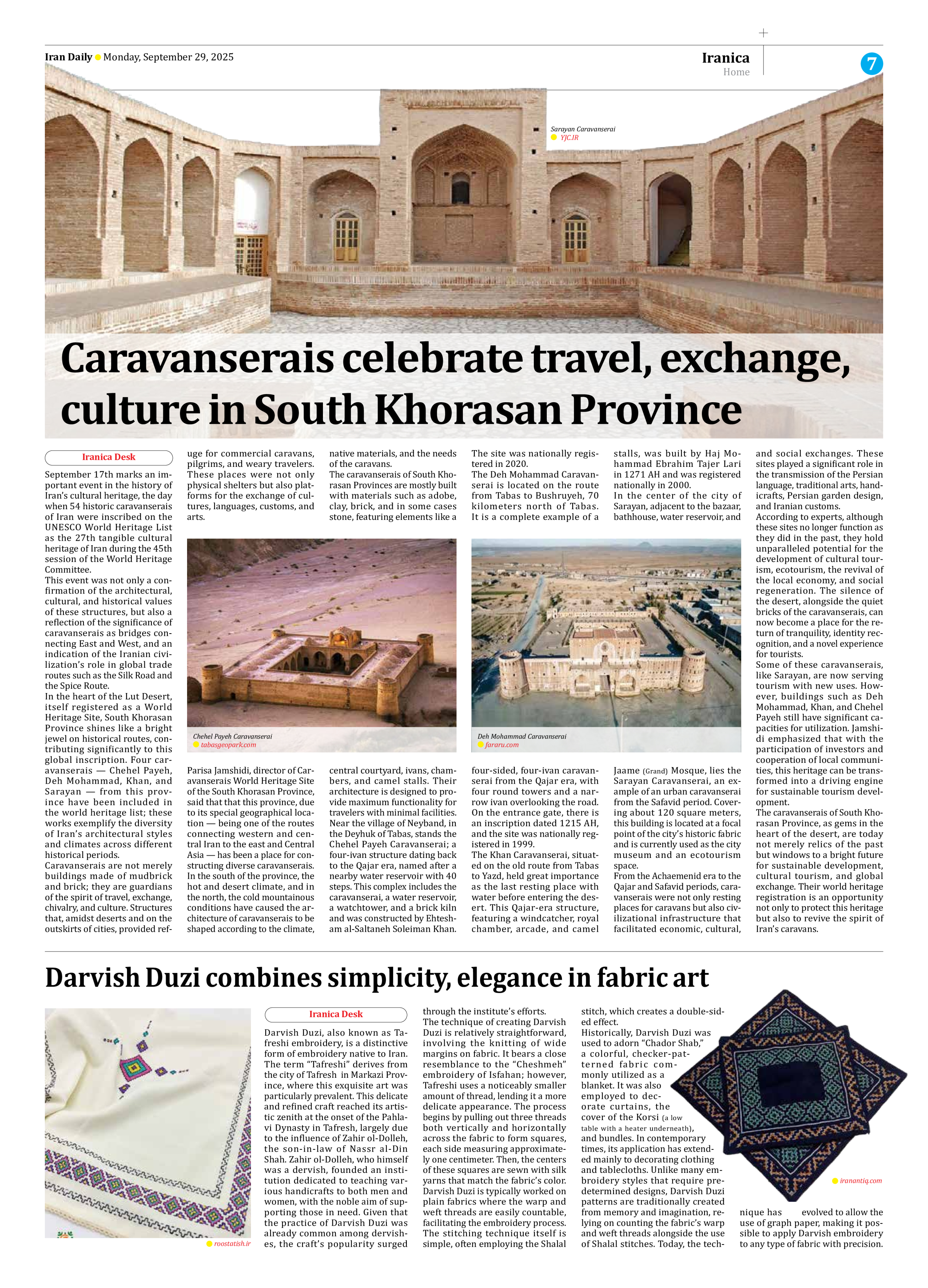
Darvish Duzi, also known as Tafreshi embroidery, is a distinctive form of embroidery native to Iran. The term “Tafreshi” derives from the city of Tafresh in Markazi Province, where this exquisite art was particularly prevalent. This delicate and refined craft reached its artistic zenith at the onset of the Pahlavi Dynasty in Tafresh, largely due to the influence of Zahir ol-Dolleh, the son-in-law of Nassr al-Din Shah. Zahir ol-Dolleh, who himself was a dervish, founded an institution dedicated to teaching various handicrafts to both men and women, with the noble aim of supporting those in need. Given that the practice of Darvish Duzi was already common among dervishes, the craft’s popularity surged through the institute’s efforts.
The technique of creating Darvish Duzi is relatively straightforward, involving the knitting of wide margins on fabric. It bears a close resemblance to the “Cheshmeh” embroidery of Isfahan; however, Tafreshi uses a noticeably smaller amount of thread, lending it a more delicate appearance. The process begins by pulling out three threads both vertically and horizontally across the fabric to form squares, each side measuring approximately one centimeter. Then, the centers of these squares are sewn with silk yarns that match the fabric’s color. Darvish Duzi is typically worked on plain fabrics where the warp and weft threads are easily countable, facilitating the embroidery process. The stitching technique itself is simple, often employing the Shalal stitch, which creates a double-sided effect.
Historically, Darvish Duzi was used to adorn “Chador Shab,” a colorful, checker-patterned fabric commonly utilized as a blanket. It was also employed to decorate curtains, the cover of the Korsi (a low table with a heater underneath), and bundles. In contemporary times, its application has extended mainly to decorating clothing and tablecloths. Unlike many embroidery styles that require predetermined designs, Darvish Duzi patterns are traditionally created from memory and imagination, relying on counting the fabric’s warp and weft threads alongside the use of Shalal stitches. Today, the technique has evolved to allow the use of graph paper, making it possible to apply Darvish embroidery to any type of fabric with precision.