





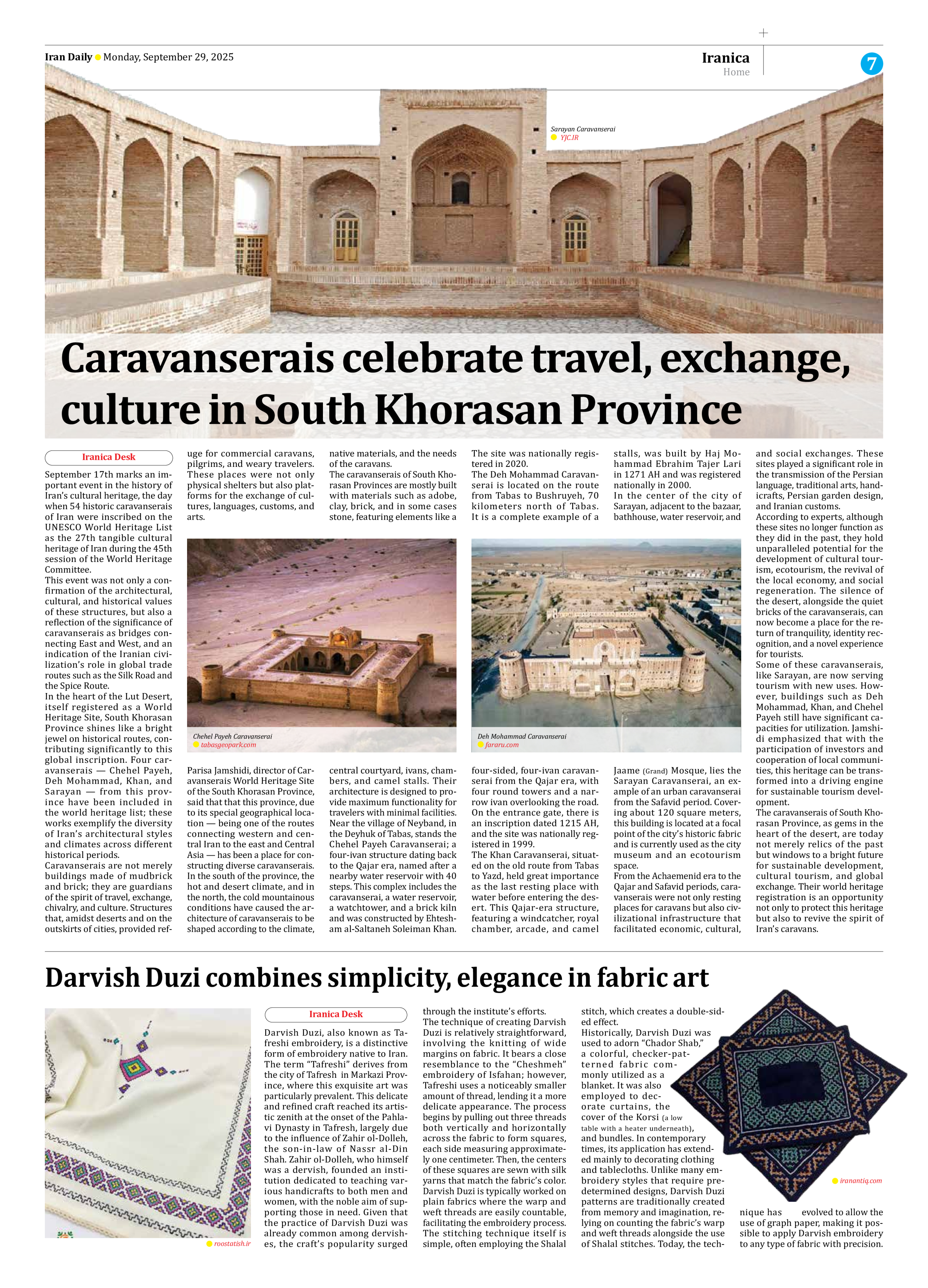


Caravanserais celebrate travel, exchange, culture in South Khorasan Province
September 17th marks an important event in the history of Iran’s cultural heritage, the day when 54 historic caravanserais of Iran were inscribed on the UNESCO World Heritage List as the 27th tangible cultural heritage of Iran during the 45th session of the World Heritage Committee.
This event was not only a confirmation of the architectural, cultural, and historical values of these structures, but also a reflection of the significance of caravanserais as bridges connecting East and West, and an indication of the Iranian civilization’s role in global trade routes such as the Silk Road and the Spice Route.
In the heart of the Lut Desert, itself registered as a World Heritage Site, South Khorasan Province shines like a bright jewel on historical routes, contributing significantly to this global inscription. Four caravanserais — Chehel Payeh, Deh Mohammad, Khan, and Sarayan — from this province have been included in the world heritage list; these works exemplify the diversity of Iran’s architectural styles and climates across different historical periods.
Caravanserais are not merely buildings made of mudbrick and brick; they are guardians of the spirit of travel, exchange, chivalry, and culture. Structures that, amidst deserts and on the outskirts of cities, provided refuge for commercial caravans, pilgrims, and weary travelers. These places were not only physical shelters but also platforms for the exchange of cultures, languages, customs, and arts.
Parisa Jamshidi, director of Caravanserais World Heritage Site of the South Khorasan Province, said that that this province, due to its special geographical location — being one of the routes connecting western and central Iran to the east and Central Asia — has been a place for constructing diverse caravanserais. In the south of the province, the hot and desert climate, and in the north, the cold mountainous conditions have caused the architecture of caravanserais to be shaped according to the climate, native materials, and the needs of the caravans.
The caravanserais of South Khorasan Provinces are mostly built with materials such as adobe, clay, brick, and in some cases stone, featuring elements like a central courtyard, ivans, chambers, and camel stalls. Their architecture is designed to provide maximum functionality for travelers with minimal facilities.
Near the village of Neyband, in the Deyhuk of Tabas, stands the Chehel Payeh Caravanserai; a four-ivan structure dating back to the Qajar era, named after a nearby water reservoir with 40 steps. This complex includes the caravanserai, a water reservoir, a watchtower, and a brick kiln and was constructed by Ehtesham al-Saltaneh Soleiman Khan. The site was nationally registered in 2020.
The Deh Mohammad Caravanserai is located on the route from Tabas to Bushruyeh, 70 kilometers north of Tabas. It is a complete example of a four-sided, four-ivan caravanserai from the Qajar era, with four round towers and a narrow ivan overlooking the road. On the entrance gate, there is an inscription dated 1215 AH, and the site was nationally registered in 1999.
The Khan Caravanserai, situated on the old route from Tabas to Yazd, held great importance as the last resting place with water before entering the desert. This Qajar-era structure, featuring a windcatcher, royal chamber, arcade, and camel stalls, was built by Haj Mohammad Ebrahim Tajer Lari in 1271 AH and was registered nationally in 2000.
In the center of the city of Sarayan, adjacent to the bazaar, bathhouse, water reservoir, and Jaame (Grand) Mosque, lies the Sarayan Caravanserai, an example of an urban caravanserai from the Safavid period. Covering about 120 square meters, this building is located at a focal point of the city’s historic fabric and is currently used as the city museum and an ecotourism space.
From the Achaemenid era to the Qajar and Safavid periods, caravanserais were not only resting places for caravans but also civilizational infrastructure that facilitated economic, cultural, and social exchanges. These sites played a significant role in the transmission of the Persian language, traditional arts, handicrafts, Persian garden design, and Iranian customs.
According to experts, although these sites no longer function as they did in the past, they hold unparalleled potential for the development of cultural tourism, ecotourism, the revival of the local economy, and social regeneration. The silence of the desert, alongside the quiet bricks of the caravanserais, can now become a place for the return of tranquility, identity recognition, and a novel experience for tourists.
Some of these caravanserais, like Sarayan, are now serving tourism with new uses. However, buildings such as Deh Mohammad, Khan, and Chehel Payeh still have significant capacities for utilization. Jamshidi emphasized that with the participation of investors and cooperation of local communities, this heritage can be transformed into a driving engine for sustainable tourism development.
The caravanserais of South Khorasan Province, as gems in the heart of the desert, are today not merely relics of the past but windows to a bright future for sustainable development, cultural tourism, and global exchange. Their world heritage registration is an opportunity not only to protect this heritage but also to revive the spirit of Iran’s caravans.