







Copy in clipboard...
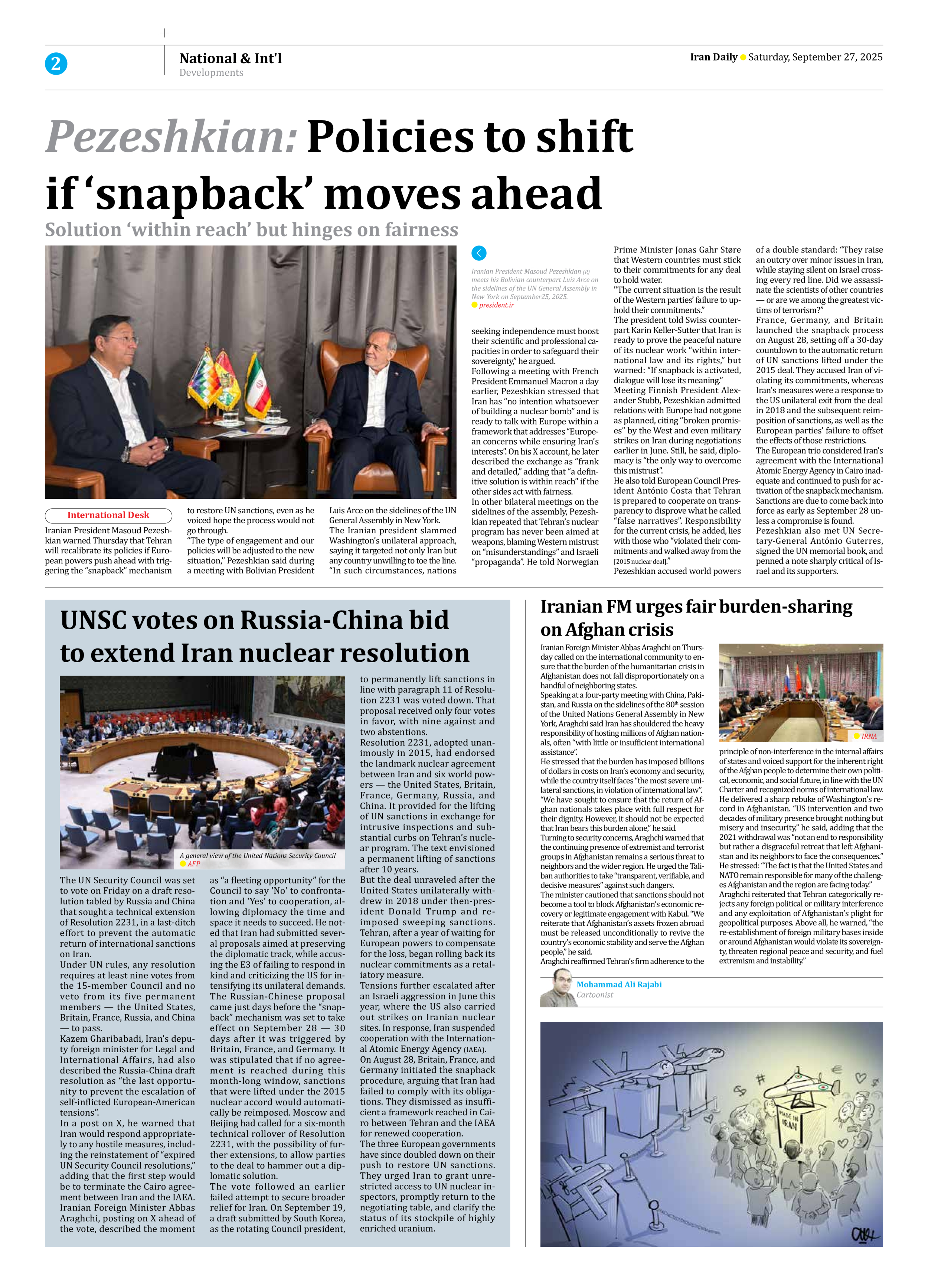
UNSC votes on Russia-China bid to extend Iran nuclear resolution
Under UN rules, any resolution requires at least nine votes from the 15-member Council and no veto from its five permanent members — the United States, Britain, France, Russia, and China — to pass.
Kazem Gharibabadi, Iran’s deputy foreign minister for Legal and International Affairs, had also described the Russia-China draft resolution as “the last opportunity to prevent the escalation of self-inflicted European-American tensions”.
In a post on X, he warned that Iran would respond appropriately to any hostile measures, including the reinstatement of “expired UN Security Council resolutions,” adding that the first step would be to terminate the Cairo agreement between Iran and the IAEA.
Iranian Foreign Minister Abbas Araghchi, posting on X ahead of the vote, described the moment as “a fleeting opportunity” for the Council to say 'No' to confrontation and 'Yes' to cooperation, allowing diplomacy the time and space it needs to succeed. He noted that Iran had submitted several proposals aimed at preserving the diplomatic track, while accusing the E3 of failing to respond in kind and criticizing the US for intensifying its unilateral demands.
The Russian-Chinese proposal came just days before the “snapback” mechanism was set to take effect on September 28 — 30 days after it was triggered by Britain, France, and Germany. It was stipulated that if no agreement is reached during this month-long window, sanctions that were lifted under the 2015 nuclear accord would automatically be reimposed. Moscow and Beijing had called for a six-month technical rollover of Resolution 2231, with the possibility of further extensions, to allow parties to the deal to hammer out a diplomatic solution.
The vote followed an earlier failed attempt to secure broader relief for Iran. On September 19, a draft submitted by South Korea, as the rotating Council president, to permanently lift sanctions in line with paragraph 11 of Resolution 2231 was voted down. That proposal received only four votes in favor, with nine against and two abstentions.
Resolution 2231, adopted unanimously in 2015, had endorsed the landmark nuclear agreement between Iran and six world powers — the United States, Britain, France, Germany, Russia, and China. It provided for the lifting of UN sanctions in exchange for intrusive inspections and substantial curbs on Tehran’s nuclear program. The text envisioned a permanent lifting of sanctions after 10 years.
But the deal unraveled after the United States unilaterally withdrew in 2018 under then-president Donald Trump and reimposed sweeping sanctions. Tehran, after a year of waiting for European powers to compensate for the loss, began rolling back its nuclear commitments as a retaliatory measure.
Tensions further escalated after an Israeli aggression in June this year, where the US also carried out strikes on Iranian nuclear sites. In response, Iran suspended cooperation with the International Atomic Energy Agency (IAEA).
On August 28, Britain, France, and Germany initiated the snapback procedure, arguing that Iran had failed to comply with its obligations. They dismissed as insufficient a framework reached in Cairo between Tehran and the IAEA for renewed cooperation.
The three European governments have since doubled down on their push to restore UN sanctions. They urged Iran to grant unrestricted access to UN nuclear inspectors, promptly return to the negotiating table, and clarify the status of its stockpile of highly enriched uranium.