







Pezeshkian: Policies to shift if ‘snapback’ moves ahead
Solution ‘within reach’ but hinges on fairness
Iranian President Masoud Pezeshkian warned Thursday that Tehran will recalibrate its policies if European powers push ahead with triggering the “snapback” mechanism to restore UN sanctions, even as he voiced hope the process would not go through.
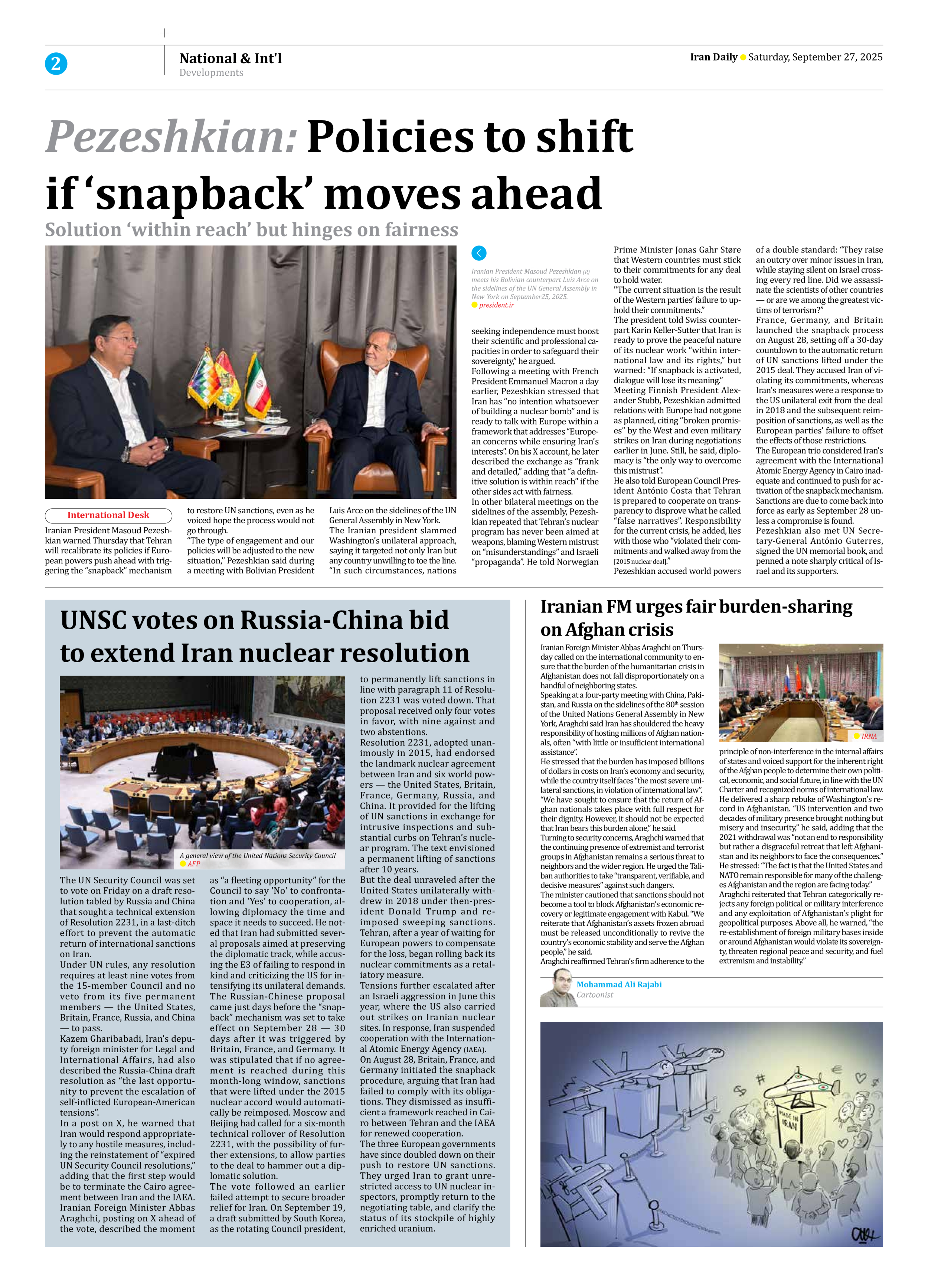
“The type of engagement and our policies will be adjusted to the new situation,” Pezeshkian said during a meeting with Bolivian President Luis Arce on the sidelines of the UN General Assembly in New York.
The Iranian president slammed Washington’s unilateral approach, saying it targeted not only Iran but any country unwilling to toe the line.
“In such circumstances, nations seeking independence must boost their scientific and professional capacities in order to safeguard their sovereignty,” he argued.
Following a meeting with French President Emmanuel Macron a day earlier, Pezeshkian stressed that Iran has “no intention whatsoever of building a nuclear bomb” and is ready to talk with Europe within a framework that addresses “European concerns while ensuring Iran’s interests”. On his X account, he later described the exchange as “frank and detailed,” adding that “a definitive solution is within reach” if the other sides act with fairness.
In other bilateral meetings on the sidelines of the assembly, Pezeshkian repeated that Tehran’s nuclear program has never been aimed at weapons, blaming Western mistrust on “misunderstandings” and Israeli “propaganda”. He told Norwegian Prime Minister Jonas Gahr Støre that Western countries must stick to their commitments for any deal to hold water.
"The current situation is the result of the Western parties’ failure to uphold their commitments.”
The president told Swiss counterpart Karin Keller-Sutter that Iran is ready to prove the peaceful nature of its nuclear work “within international law and its rights,” but warned: “If snapback is activated, dialogue will lose its meaning.”
Meeting Finnish President Alexander Stubb, Pezeshkian admitted relations with Europe had not gone as planned, citing “broken promises” by the West and even military strikes on Iran during negotiations earlier in June. Still, he said, diplomacy is “the only way to overcome this mistrust”.
He also told European Council President António Costa that Tehran is prepared to cooperate on transparency to disprove what he called “false narratives”. Responsibility for the current crisis, he added, lies with those who “violated their commitments and walked away from the [2015 nuclear deal].”
Pezeshkian accused world powers of a double standard: “They raise an outcry over minor issues in Iran, while staying silent on Israel crossing every red line. Did we assassinate the scientists of other countries — or are we among the greatest victims of terrorism?”
France, Germany, and Britain launched the snapback process on August 28, setting off a 30-day countdown to the automatic return of UN sanctions lifted under the 2015 deal. They accused Iran of violating its commitments, whereas Iran’s measures were a response to the US unilateral exit from the deal in 2018 and the subsequent reimposition of sanctions, as well as the European parties’ failure to offset the effects of those restrictions.
The European trio considered Iran’s agreement with the International Atomic Energy Agency in Cairo inadequate and continued to push for activation of the snapback mechanism. Sanctions are due to come back into force as early as September 28 unless a compromise is found.
Pezeshkian also met UN Secretary-General António Guterres, signed the UN memorial book, and penned a note sharply critical of Israel and its supporters.