







Bandar Anzali welcoming tourists with unique attractions
Every Iranian who has traveled to the western part of Gilan Province has also visited Bandar Anzali, a city renowned for its unique attractions, including the international wetland, coastal boulevard, breakwaters, the place of musical melodies, the clock tower, Mian Poshteh Palace, and the free zone — features that have placed this city among the country’s top tourist destinations.
Bandar Anzali, once known as the gateway to Europe, is the second most populous city in Gilan, with around 140,000 inhabitants and 26 villages. The city stretches along a 47-kilometer coastline on the Caspian Sea, bordered on one side by the sea and on the other by the valuable ecosystem of the Bandar Anzali Wetland, IRNA wrote.
The Anzali International Wetland covers approximately 20,000 hectares and is bordered to the north by Anzali, to the south by Soumehsara, to the east by Khomam, to the southeast by Rasht, and to the west by Kapurchal and Abkenar. It is among the most important tourist attractions in Gilan Province and Bandar Anzali, welcoming countless tourists every year.
This wetland is one of Iran’s most significant and largest natural habitats for wildlife, annually hosting numerous birds migrating from neighboring northern countries. From late June each year, its water lilies emerge above the surface and float on the water.
The water lily is one of the many unique beauties of the Anzali International Wetland. It is a perennial plant with large, round, heart-shaped leaves that rise above the water, with thick, abundant pink petals. The lagoon is also home to many aquatic species that spawn here.
Many rare native and migratory bird species choose this area as their permanent residence or temporary resting place. Every summer, numerous tourists select this lagoon and its exceptional beauty for their visits.
The head of Bandar Anzali’s Cultural Heritage, Handicrafts, and Tourism Department told IRNA that the Anzali Wetland, with its special natural attractions, draws visitors from across the country to this city. The wetland’s presence has facilitated the growth of the water lily, a flower considered sacred in ancient Iranian civilization.
Esmail Saheli added that the presence of this valuable flower led to the establishment of the annually held Water Lily Festival, organized with the municipality’s efforts in Bandar Anzali; this festival is nationally registered.
He emphasized, “Next year, with proper planning, we will bring domestic and international tours to view the wetland.”
He stated that life in the wetland and the city of Anzali are interdependent, adding that the water of this vital resource is highly valued. Therefore, many local family names have a deep connection to water, such as Qayeqrn (boatman), Saheli (coastal), Mahigir (fisherman), Bahri (marine), and others.
The Anzali Port Complex, with a history spanning 300 years, is recognized as one of Iran’s oldest and best-equipped ports on the Caspian Sea coast, playing a crucial role in maritime transport with Caspian littoral and European countries.
He described the Anzali Port Complex as the most important port in northern Iran, noting that the port has existed since the Safavid era, while the historic urban fabric of the city took shape from the mid-Qajar period.
He added that the rise of shipping in the Caspian Sea during the Safavid era brought fundamental changes to the country and doubled the performance of port cities like Anzali. The expansion of commercial exchanges greatly increased the number of buildings in the city.
Saheli referred to the attention of England and Russia from the early Safavid period, emphasizing that due to trade relations with Russia, this port complex significantly influenced the city’s architecture, structures, and buildings. Most of Bandar Anzali’s historic buildings were constructed in the style of Eastern European architecture.
The Bandar Anzali Palace Museum, also known as Mian Poshteh Palace, is located between the Anzali and Ghazian bridges on an extensive site. It is another relic from the Qajar era that was restored during the Pahlavi period. The palace museum overlooks the sea and tall cypress trees, offering visitors a unique and beautiful experience.
Bandar Anzali features two beautiful historic bridges in Ghazian and Anzali, both overlooking the sea and wetland. These bridges are registered as cultural heritage sites and are nearly 100 years old.
The historic Ghazian Bridge was one of the world’s most advanced bridges and is recognized as one of Iran’s historic bridges; it was put into operation in 1938.
From this beautiful bridge, visitors can see the sea and wetland, flying seagulls, colorful recreational boats passing by, small and large ships unloading and loading at the port docks, the wetland’s reed beds, huts built along the lagoon, and boatmen practicing on the water.
The Bandar Anzali Clock Tower, a Qajar-era structure, is located on Sepah Street in Anzali. Historically, it served as a watchtower for the armory and military facilities, as well as a lighthouse.
Built during the Qajar period, it functioned as a watchtower. In 1929, German engineers rebuilt the tower with cement and bricks and installed a clock on top, after which it became known as the Clock Tower. Following restoration in 1928, a four-faced clock was mounted at its summit.
Currently, Bandar Anzali has 25 registered heritage sites, with 13 more eligible for registration. It is the destination for 40 percent of travelers visiting Gilan Province. Saheli added that during Nowruz, Anzali welcomed marine tourists from the wetland and sea with four marine vessels and passenger boats. There were 17,459 maritime movements and 94,500 marine tourists recorded.
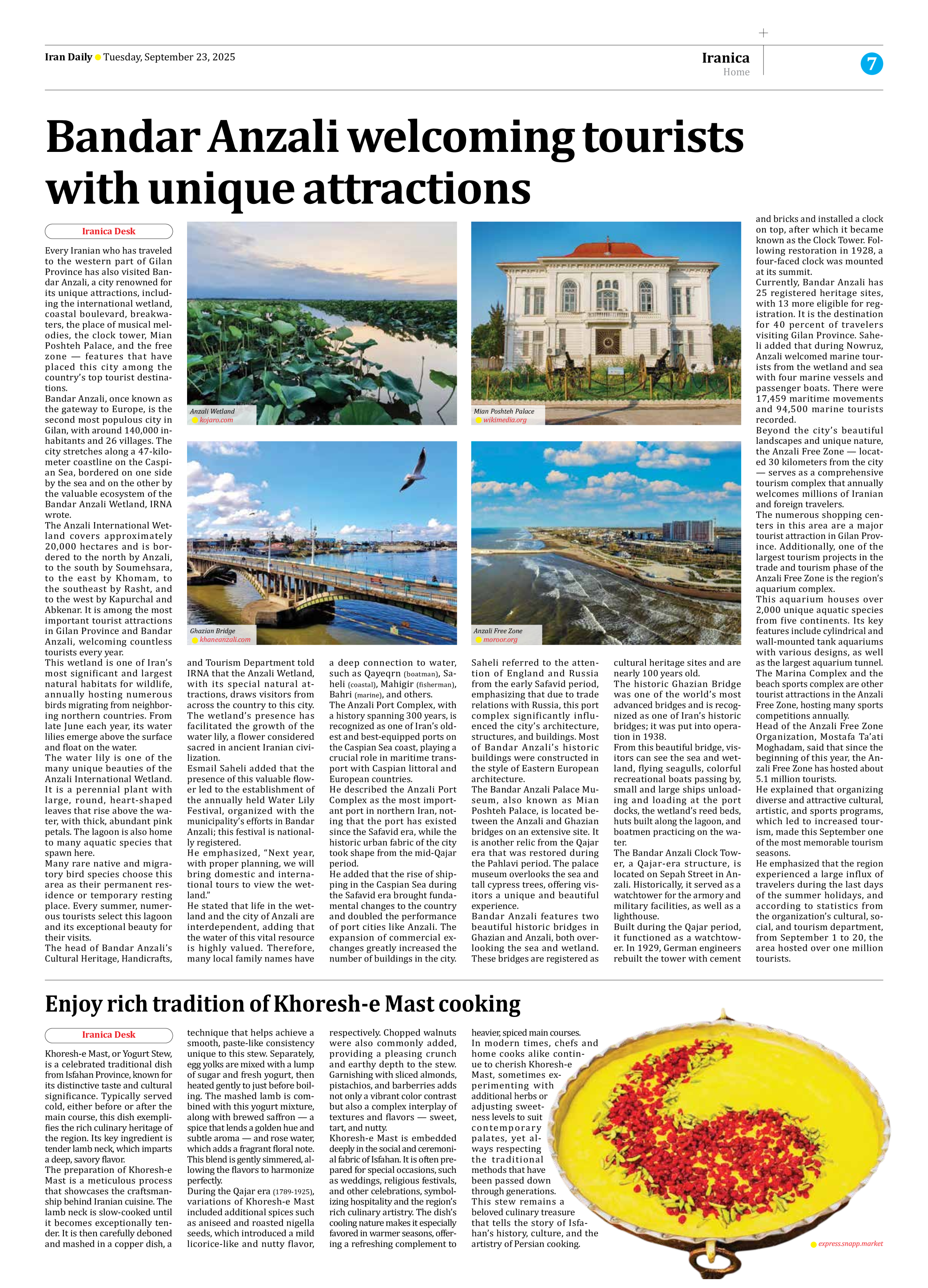
Beyond the city’s beautiful landscapes and unique nature, the Anzali Free Zone — located 30 kilometers from the city — serves as a comprehensive tourism complex that annually welcomes millions of Iranian and foreign travelers.
The numerous shopping centers in this area are a major tourist attraction in Gilan Province. Additionally, one of the largest tourism projects in the trade and tourism phase of the Anzali Free Zone is the region’s aquarium complex.
This aquarium houses over 2,000 unique aquatic species from five continents. Its key features include cylindrical and wall-mounted tank aquariums with various designs, as well as the largest aquarium tunnel.
The Marina Complex and the beach sports complex are other tourist attractions in the Anzali Free Zone, hosting many sports competitions annually.
Head of the Anzali Free Zone Organization, Mostafa Ta’ati Moghadam, said that since the beginning of this year, the Anzali Free Zone has hosted about 5.1 million tourists.
He explained that organizing diverse and attractive cultural, artistic, and sports programs, which led to increased tourism, made this September one of the most memorable tourism seasons.
He emphasized that the region experienced a large influx of travelers during the last days of the summer holidays, and according to statistics from the organization’s cultural, social, and tourism department, from September 1 to 20, the area hosted over one million tourists.