







Iran’s sophisticated pistachio processing tech boosting global demand: Association head
Economic logic behind cultivation drives stable income
By Sadeq Dehqan & Zohreh Qanadi
Staff writers
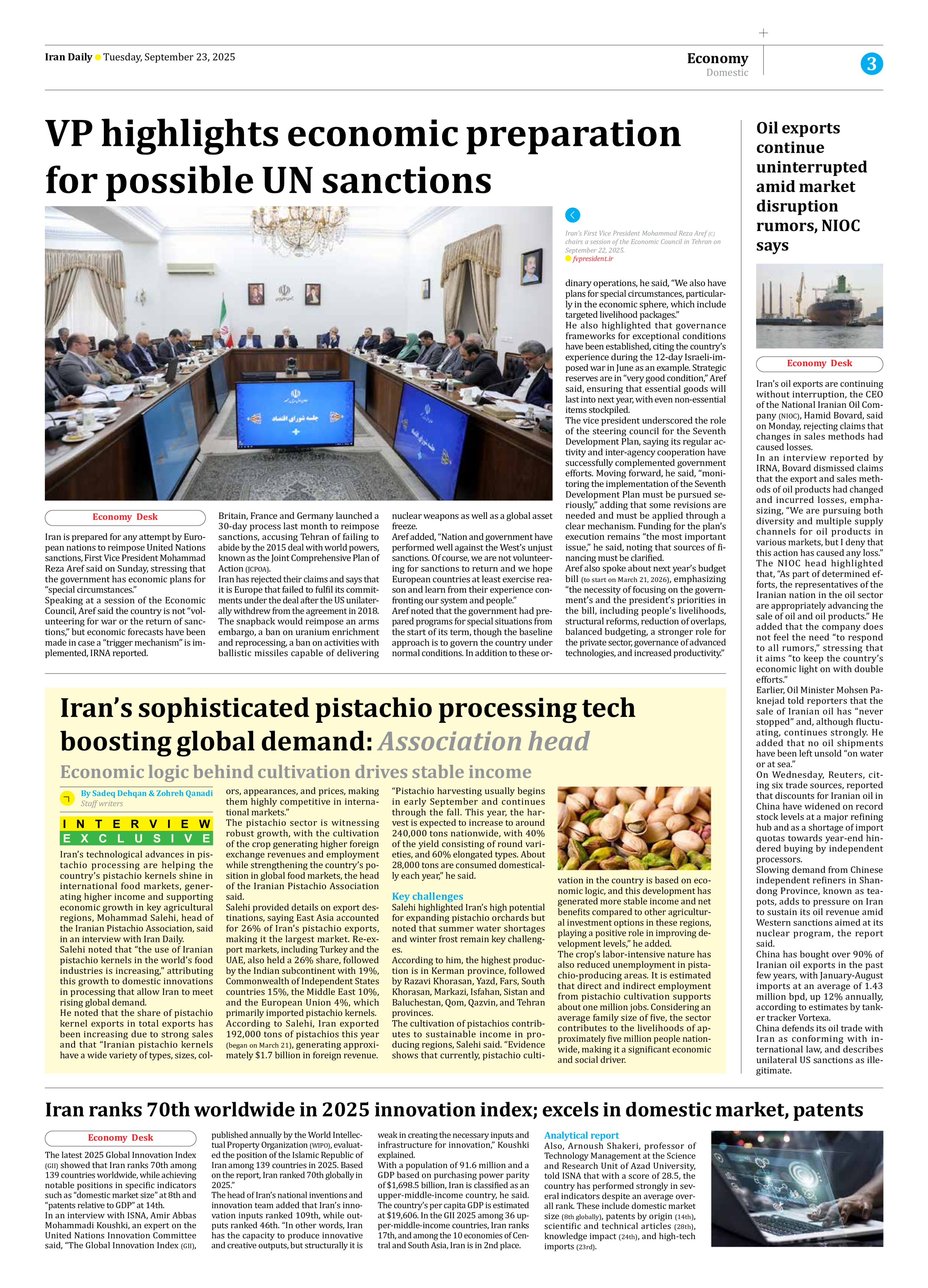
Iran’s technological advances in pistachio processing are helping the country’s pistachio kernels shine in international food markets, generating higher income and supporting economic growth in key agricultural regions, Mohammad Salehi, head of the Iranian Pistachio Association, said in an interview with Iran Daily.
Salehi noted that “the use of Iranian pistachio kernels in the world’s food industries is increasing,” attributing this growth to domestic innovations in processing that allow Iran to meet rising global demand.
He noted that the share of pistachio kernel exports in total exports has been increasing due to strong sales and that “Iranian pistachio kernels have a wide variety of types, sizes, colors, appearances, and prices, making them highly competitive in international markets.”
The pistachio sector is witnessing robust growth, with the cultivation of the crop generating higher foreign exchange revenues and employment while strengthening the country’s position in global food markets, the head of the Iranian Pistachio Association said.
Salehi provided details on export destinations, saying East Asia accounted for 26% of Iran’s pistachio exports, making it the largest market. Re-export markets, including Turkey and the UAE, also held a 26% share, followed by the Indian subcontinent with 19%, Commonwealth of Independent States countries 15%, the Middle East 10%, and the European Union 4%, which primarily imported pistachio kernels.
According to Salehi, Iran exported 192,000 tons of pistachios this year (began on March 21), generating approximately $1.7 billion in foreign revenue.
“Pistachio harvesting usually begins in early September and continues through the fall. This year, the harvest is expected to increase to around 240,000 tons nationwide, with 40% of the yield consisting of round varieties, and 60% elongated types. About 28,000 tons are consumed domestically each year,” he said.
Key challenges
Salehi highlighted Iran’s high potential for expanding pistachio orchards but noted that summer water shortages and winter frost remain key challenges.
According to him, the highest production is in Kerman province, followed by Razavi Khorasan, Yazd, Fars, South Khorasan, Markazi, Isfahan, Sistan and Baluchestan, Qom, Qazvin, and Tehran provinces.
The cultivation of pistachios contributes to sustainable income in producing regions, Salehi said. “Evidence shows that currently, pistachio cultivation in the country is based on economic logic, and this development has generated more stable income and net benefits compared to other agricultural investment options in these regions, playing a positive role in improving development levels,” he added.
The crop’s labor-intensive nature has also reduced unemployment in pistachio-producing areas. It is estimated that direct and indirect employment from pistachio cultivation supports about one million jobs. Considering an average family size of five, the sector contributes to the livelihoods of approximately five million people nationwide, making it a significant economic and social driver.