





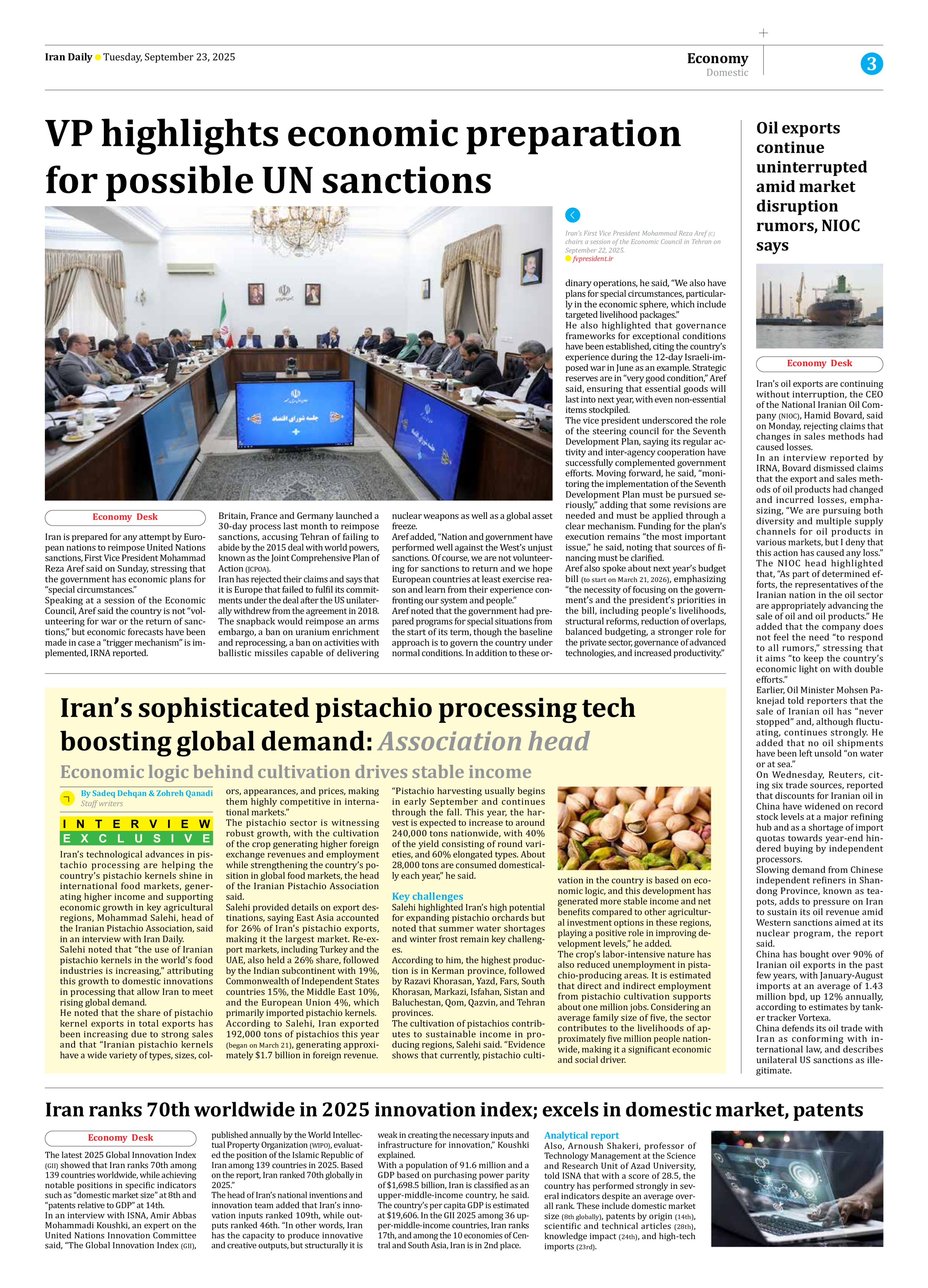


VP highlights economic preparation for possible UN sanctions
Iran is prepared for any attempt by European nations to reimpose United Nations sanctions, First Vice President Mohammad Reza Aref said on Sunday, stressing that the government has economic plans for “special circumstances.”
Speaking at a session of the Economic Council, Aref said the country is not “volunteering for war or the return of sanctions,” but economic forecasts have been made in case a “trigger mechanism” is implemented, IRNA reported.
Britain, France and Germany launched a 30-day process last month to reimpose sanctions, accusing Tehran of failing to abide by the 2015 deal with world powers, known as the Joint Comprehensive Plan of Action (JCPOA).
Iran has rejected their claims and says that it is Europe that failed to fulfil its commitments under the deal after the US unilaterally withdrew from the agreement in 2018.
The snapback would reimpose an arms embargo, a ban on uranium enrichment and reprocessing, a ban on activities with ballistic missiles capable of delivering nuclear weapons as well as a global asset freeze.
Aref added, “Nation and government have performed well against the West’s unjust sanctions. Of course, we are not volunteering for sanctions to return and we hope European countries at least exercise reason and learn from their experience confronting our system and people.”
Aref noted that the government had prepared programs for special situations from the start of its term, though the baseline approach is to govern the country under normal conditions. In addition to these ordinary operations, he said, “We also have plans for special circumstances, particularly in the economic sphere, which include targeted livelihood packages.”
He also highlighted that governance frameworks for exceptional conditions have been established, citing the country’s experience during the 12-day Israeli-imposed war in June as an example. Strategic reserves are in “very good condition,” Aref said, ensuring that essential goods will last into next year, with even non-essential items stockpiled.
The vice president underscored the role of the steering council for the Seventh Development Plan, saying its regular activity and inter-agency cooperation have successfully complemented government efforts. Moving forward, he said, “monitoring the implementation of the Seventh Development Plan must be pursued seriously,” adding that some revisions are needed and must be applied through a clear mechanism. Funding for the plan’s execution remains “the most important issue,” he said, noting that sources of financing must be clarified.
Aref also spoke about next year’s budget bill (to start on March 21, 2026), emphasizing “the necessity of focusing on the government’s and the president’s priorities in the bill, including people’s livelihoods, structural reforms, reduction of overlaps, balanced budgeting, a stronger role for the private sector, governance of advanced technologies, and increased productivity.”