







Siahkal combines nature, heritage, spirituality in Gilan Province
Siahkal, located in eastern part of Gilan Province, is recognized as one of the key tourist destinations in northern Iran due to its pristine nature, valuable historical sites, and numerous religious centers. Combining natural beauty, cultural heritage, and spirituality, it attracts thousands of visitors annually. It borders Lahijan and Astaneh to the north, Rudsar, Langarud, and Amlash to the east, Rudbar and the Alamut (in Qazvin Province) to the south, and Rasht to the west. The distance from Siahkal to Rasht, the provincial capital, is 44 kilometers.
Siahkal lies about 45 kilometers from the Caspian Sea and covers an area exceeding one million square kilometers. The population mainly speaks Gilaki. The lowlands feature the standard Gilaki dialect, while in the mountainous areas such as Deylaman, the Deylami dialect — a branch of Gilaki — is more common, IRNA wrote.
Most residents are Shia Muslims, and the presence of Imamzadehs and Shia religious centers in both the city and villages of Siahkal confirms this.
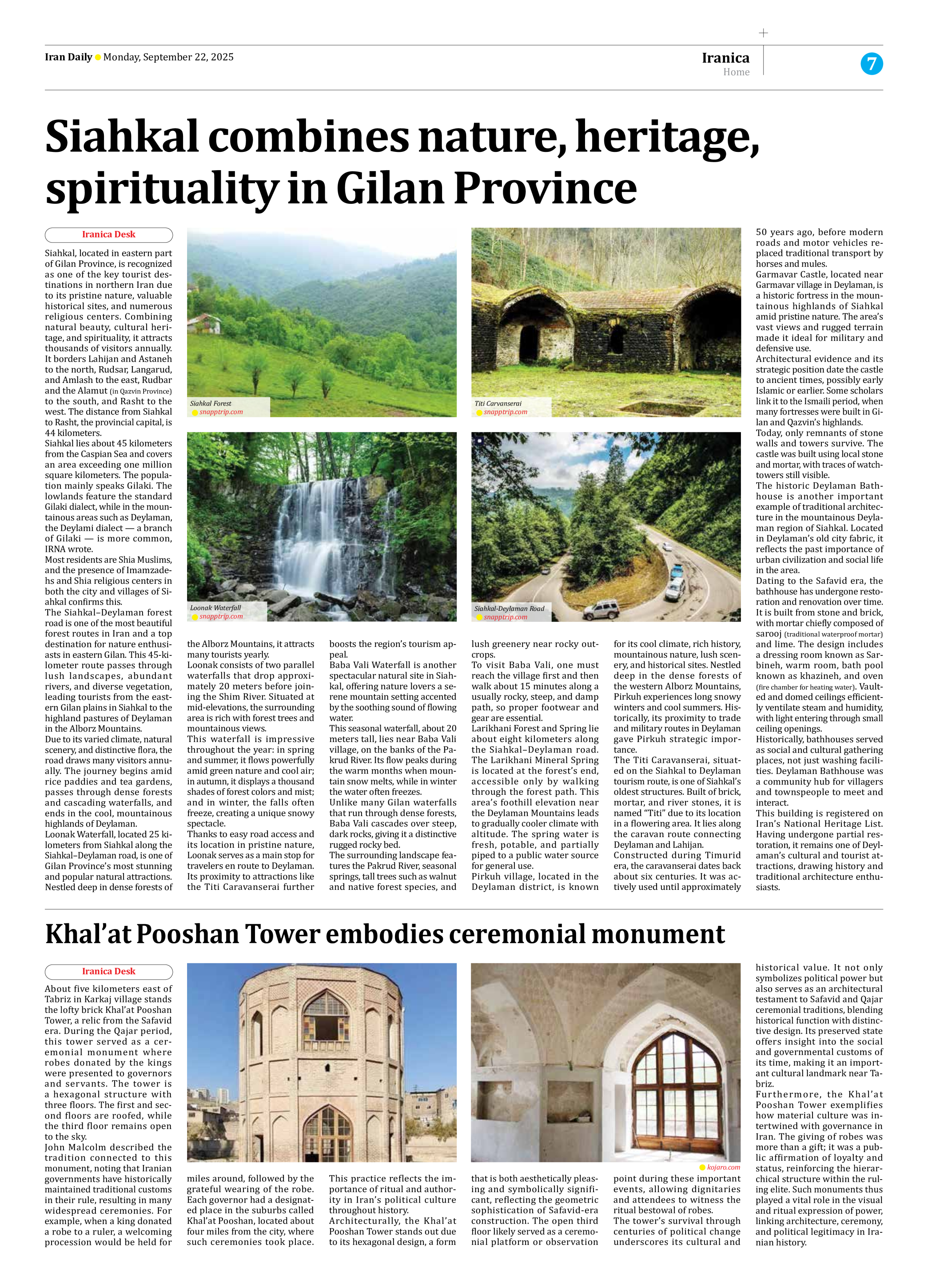
The Siahkal–Deylaman forest road is one of the most beautiful forest routes in Iran and a top destination for nature enthusiasts in eastern Gilan. This 45-kilometer route passes through lush landscapes, abundant rivers, and diverse vegetation, leading tourists from the eastern Gilan plains in Siahkal to the highland pastures of Deylaman in the Alborz Mountains.
Due to its varied climate, natural scenery, and distinctive flora, the road draws many visitors annually. The journey begins amid rice paddies and tea gardens, passes through dense forests and cascading waterfalls, and ends in the cool, mountainous highlands of Deylaman.
Loonak Waterfall, located 25 kilometers from Siahkal along the Siahkal–Deylaman road, is one of Gilan Province’s most stunning and popular natural attractions. Nestled deep in dense forests of the Alborz Mountains, it attracts many tourists yearly.
Loonak consists of two parallel waterfalls that drop approximately 20 meters before joining the Shim River. Situated at mid-elevations, the surrounding area is rich with forest trees and mountainous views.
This waterfall is impressive throughout the year: in spring and summer, it flows powerfully amid green nature and cool air; in autumn, it displays a thousand shades of forest colors and mist; and in winter, the falls often freeze, creating a unique snowy spectacle.
Thanks to easy road access and its location in pristine nature, Loonak serves as a main stop for travelers en route to Deylaman. Its proximity to attractions like the Titi Caravanserai further boosts the region’s tourism appeal.
Baba Vali Waterfall is another spectacular natural site in Siahkal, offering nature lovers a serene mountain setting accented by the soothing sound of flowing water.
This seasonal waterfall, about 20 meters tall, lies near Baba Vali village, on the banks of the Pakrud River. Its flow peaks during the warm months when mountain snow melts, while in winter the water often freezes.
Unlike many Gilan waterfalls that run through dense forests, Baba Vali cascades over steep, dark rocks, giving it a distinctive rugged rocky bed.
The surrounding landscape features the Pakrud River, seasonal springs, tall trees such as walnut and native forest species, and lush greenery near rocky outcrops.
To visit Baba Vali, one must reach the village first and then walk about 15 minutes along a usually rocky, steep, and damp path, so proper footwear and gear are essential.
Larikhani Forest and Spring lie about eight kilometers along the Siahkal–Deylaman road. The Larikhani Mineral Spring is located at the forest’s end, accessible only by walking through the forest path. This area’s foothill elevation near the Deylaman Mountains leads to gradually cooler climate with altitude. The spring water is fresh, potable, and partially piped to a public water source for general use.
Pirkuh village, located in the Deylaman district, is known for its cool climate, rich history, mountainous nature, lush scenery, and historical sites. Nestled deep in the dense forests of the western Alborz Mountains, Pirkuh experiences long snowy winters and cool summers. Historically, its proximity to trade and military routes in Deylaman gave Pirkuh strategic importance.
The Titi Caravanserai, situated on the Siahkal to Deylaman tourism route, is one of Siahkal’s oldest structures. Built of brick, mortar, and river stones, it is named “Titi” due to its location in a flowering area. It lies along the caravan route connecting Deylaman and Lahijan.
Constructed during Timurid era, the caravanserai dates back about six centuries. It was actively used until approximately 50 years ago, before modern roads and motor vehicles replaced traditional transport by horses and mules.
Garmavar Castle, located near Garmavar village in Deylaman, is a historic fortress in the mountainous highlands of Siahkal amid pristine nature. The area’s vast views and rugged terrain made it ideal for military and defensive use.
Architectural evidence and its strategic position date the castle to ancient times, possibly early Islamic or earlier. Some scholars link it to the Ismaili period, when many fortresses were built in Gilan and Qazvin’s highlands.
Today, only remnants of stone walls and towers survive. The castle was built using local stone and mortar, with traces of watchtowers still visible.
The historic Deylaman Bathhouse is another important example of traditional architecture in the mountainous Deylaman region of Siahkal. Located in Deylaman’s old city fabric, it reflects the past importance of urban civilization and social life in the area.
Dating to the Safavid era, the bathhouse has undergone restoration and renovation over time. It is built from stone and brick, with mortar chiefly composed of sarooj (traditional waterproof mortar) and lime. The design includes a dressing room known as Sarbineh, warm room, bath pool known as khazineh, and oven (fire chamber for heating water). Vaulted and domed ceilings efficiently ventilate steam and humidity, with light entering through small ceiling openings.
Historically, bathhouses served as social and cultural gathering places, not just washing facilities. Deylaman Bathhouse was a community hub for villagers and townspeople to meet and interact.
This building is registered on Iran’s National Heritage List. Having undergone partial restoration, it remains one of Deylaman’s cultural and tourist attractions, drawing history and traditional architecture enthusiasts.