







Japan’s diplomatic discontents after US strikes on Iran
By Christopher Hughes
Professor of Japanese Studies
The Israeli and US strikes on Iran in June 2025 highlighted a critical dilemma for Japanese policymakers. Japan’s reaction reflects immediate diplomatic and economic interests in its dealings with the United States and the Middle East, as well as anxieties over its wider international strategy in the longer term.
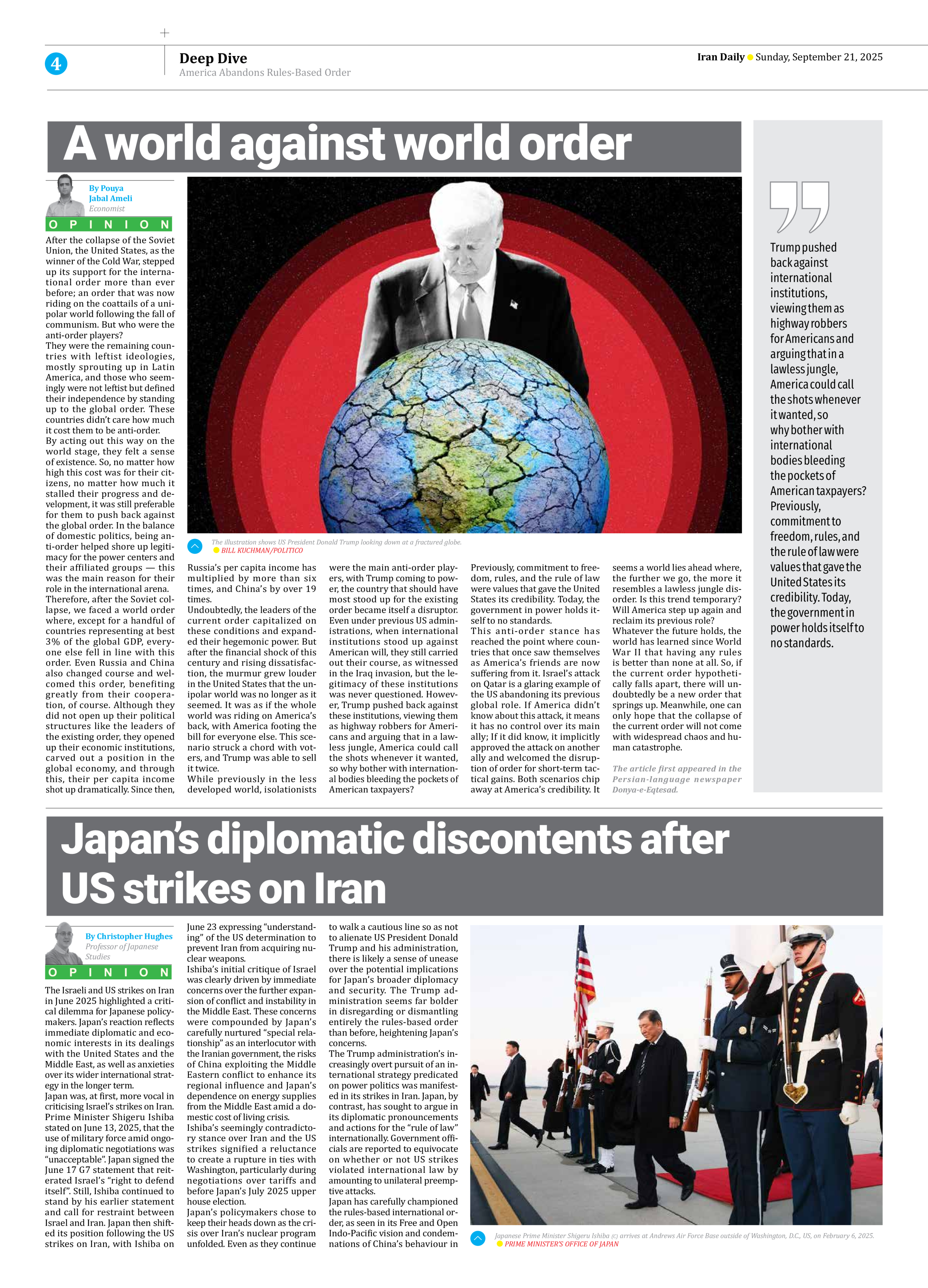
Japan was, at first, more vocal in criticising Israel’s strikes on Iran. Prime Minister Shigeru Ishiba stated on June 13, 2025, that the use of military force amid ongoing diplomatic negotiations was “unacceptable”. Japan signed the June 17 G7 statement that reiterated Israel’s “right to defend itself”. Still, Ishiba continued to stand by his earlier statement and call for restraint between Israel and Iran. Japan then shifted its position following the US strikes on Iran, with Ishiba on June 23 expressing “understanding” of the US determination to prevent Iran from acquiring nuclear weapons.
Ishiba’s initial critique of Israel was clearly driven by immediate concerns over the further expansion of conflict and instability in the Middle East. These concerns were compounded by Japan’s carefully nurtured “special relationship” as an interlocutor with the Iranian government, the risks of China exploiting the Middle Eastern conflict to enhance its regional influence and Japan’s dependence on energy supplies from the Middle East amid a domestic cost of living crisis.
Ishiba’s seemingly contradictory stance over Iran and the US strikes signified a reluctance to create a rupture in ties with Washington, particularly during negotiations over tariffs and before Japan’s July 2025 upper house election.
Japan’s policymakers chose to keep their heads down as the crisis over Iran’s nuclear program unfolded. Even as they continue to walk a cautious line so as not to alienate US President Donald Trump and his administration, there is likely a sense of unease over the potential implications for Japan’s broader diplomacy and security. The Trump administration seems far bolder in disregarding or dismantling entirely the rules-based order than before, heightening Japan’s concerns.
The Trump administration’s increasingly overt pursuit of an international strategy predicated on power politics was manifested in its strikes in Iran. Japan, by contrast, has sought to argue in its diplomatic pronouncements and actions for the “rule of law” internationally. Government officials are reported to equivocate on whether or not US strikes violated international law by amounting to unilateral preemptive attacks.
Japan has carefully championed the rules-based international order, as seen in its Free and Open Indo-Pacific vision and condemnations of China’s behaviour in the East China Sea and South China Sea, as well as Russia’s war on Ukraine. But Japan’s position starts to look thin, or even a double standard, in the face of its US ally’s use of force.
The crisis over Iran and its challenge to the principles of international diplomacy that Japan advocates may have further spillover effects in key areas. Japan’s long-term concern is that Iran, after enduring US and Israeli military attacks, will conclude that its only option is to accelerate its nuclear program and withdraw entirely from International Atomic Energy Agency oversight to develop a nuclear deterrent. This compounds the risks of nuclear proliferation in the Middle East, further undermining international rules-based cooperative regimes.
Israel’s de facto status as a nuclear weapons entity, standing free of International Atomic Energy Agency oversight, confirms for critics the contradictions of the rules-based international order. The spillover from the Iran crisis could extend to North Korea. Pyongyang may conclude from the US strikes that its strategy of acquiring nuclear weapons has been correct to prevent US coercion. This means it will insist on framing future negotiations as “arms control,” rather than complete dismantlement of its nuclear program, with possible ripple effects for nuclear proliferation in East Asia.
Japan’s inability to exercise significant influence over the United States or G7 regarding Iran brings into question its ability to act as a bridge between the Global South and the West. The US strikes and wider international reaction revealed that Iran was in the end short on friends and allies willing to intervene on its behalf, limiting escalation of the conflict. Over the longer term, though, the United States and Israel’s exercise of force against Iran, coupled with Israel’s relatively untrammelled military action in the region, may only embolden military action by states in other contexts and signify that the rules-based international order does not necessarily apply to the Global South.
In this climate, Japan’s self-proclaimed stance and credibility as one of the main proponents of the rules-based international order and its ability to promote the interests of the Global South appear hollow.
The article first appeared on
the East Asia Forum.