







A world against world order
By Pouya
Jabal Ameli
Economist
After the collapse of the Soviet Union, the United States, as the winner of the Cold War, stepped up its support for the international order more than ever before; an order that was now riding on the coattails of a unipolar world following the fall of communism. But who were the anti-order players?
They were the remaining countries with leftist ideologies, mostly sprouting up in Latin America, and those who seemingly were not leftist but defined their independence by standing up to the global order. These countries didn’t care how much it cost them to be anti-order.
By acting out this way on the world stage, they felt a sense of existence. So, no matter how high this cost was for their citizens, no matter how much it stalled their progress and development, it was still preferable for them to push back against the global order. In the balance of domestic politics, being anti-order helped shore up legitimacy for the power centers and their affiliated groups — this was the main reason for their role in the international arena.
Therefore, after the Soviet collapse, we faced a world order where, except for a handful of countries representing at best 3% of the global GDP, everyone else fell in line with this order. Even Russia and China also changed course and welcomed this order, benefiting greatly from their cooperation, of course. Although they did not open up their political structures like the leaders of the existing order, they opened up their economic institutions, carved out a position in the global economy, and through this, their per capita income shot up dramatically. Since then, Russia’s per capita income has multiplied by more than six times, and China’s by over 19 times.
Undoubtedly, the leaders of the current order capitalized on these conditions and expanded their hegemonic power. But after the financial shock of this century and rising dissatisfaction, the murmur grew louder in the United States that the unipolar world was no longer as it seemed. It was as if the whole world was riding on America’s back, with America footing the bill for everyone else. This scenario struck a chord with voters, and Trump was able to sell it twice.
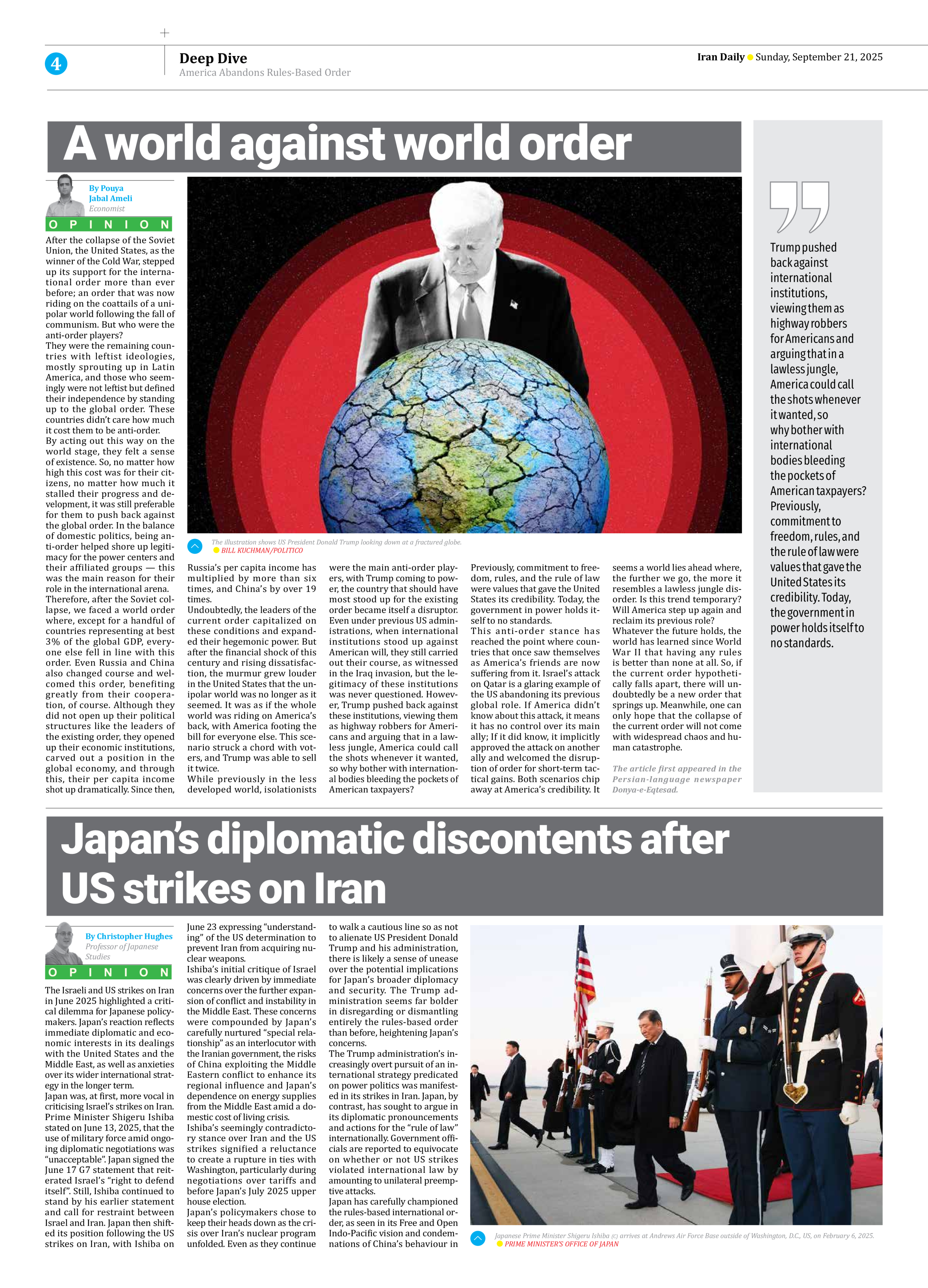
While previously in the less developed world, isolationists were the main anti-order players, with Trump coming to power, the country that should have most stood up for the existing order became itself a disruptor. Even under previous US administrations, when international institutions stood up against American will, they still carried out their course, as witnessed in the Iraq invasion, but the legitimacy of these institutions was never questioned. However, Trump pushed back against these institutions, viewing them as highway robbers for Americans and arguing that in a lawless jungle, America could call the shots whenever it wanted, so why bother with international bodies bleeding the pockets of American taxpayers?
Previously, commitment to freedom, rules, and the rule of law were values that gave the United States its credibility. Today, the government in power holds itself to no standards.
This anti-order stance has reached the point where countries that once saw themselves as America’s friends are now suffering from it. Israel’s attack on Qatar is a glaring example of the US abandoning its previous global role. If America didn’t know about this attack, it means it has no control over its main ally; If it did know, it implicitly approved the attack on another ally and welcomed the disruption of order for short-term tactical gains. Both scenarios chip away at America’s credibility. It seems a world lies ahead where, the further we go, the more it resembles a lawless jungle disorder. Is this trend temporary? Will America step up again and reclaim its previous role?
Whatever the future holds, the world has learned since World War II that having any rules is better than none at all. So, if the current order hypothetically falls apart, there will undoubtedly be a new order that springs up. Meanwhile, one can only hope that the collapse of the current order will not come with widespread chaos and human catastrophe.
The article first appeared in the Persian-language newspaper
Donya-e-Eqtesad.