





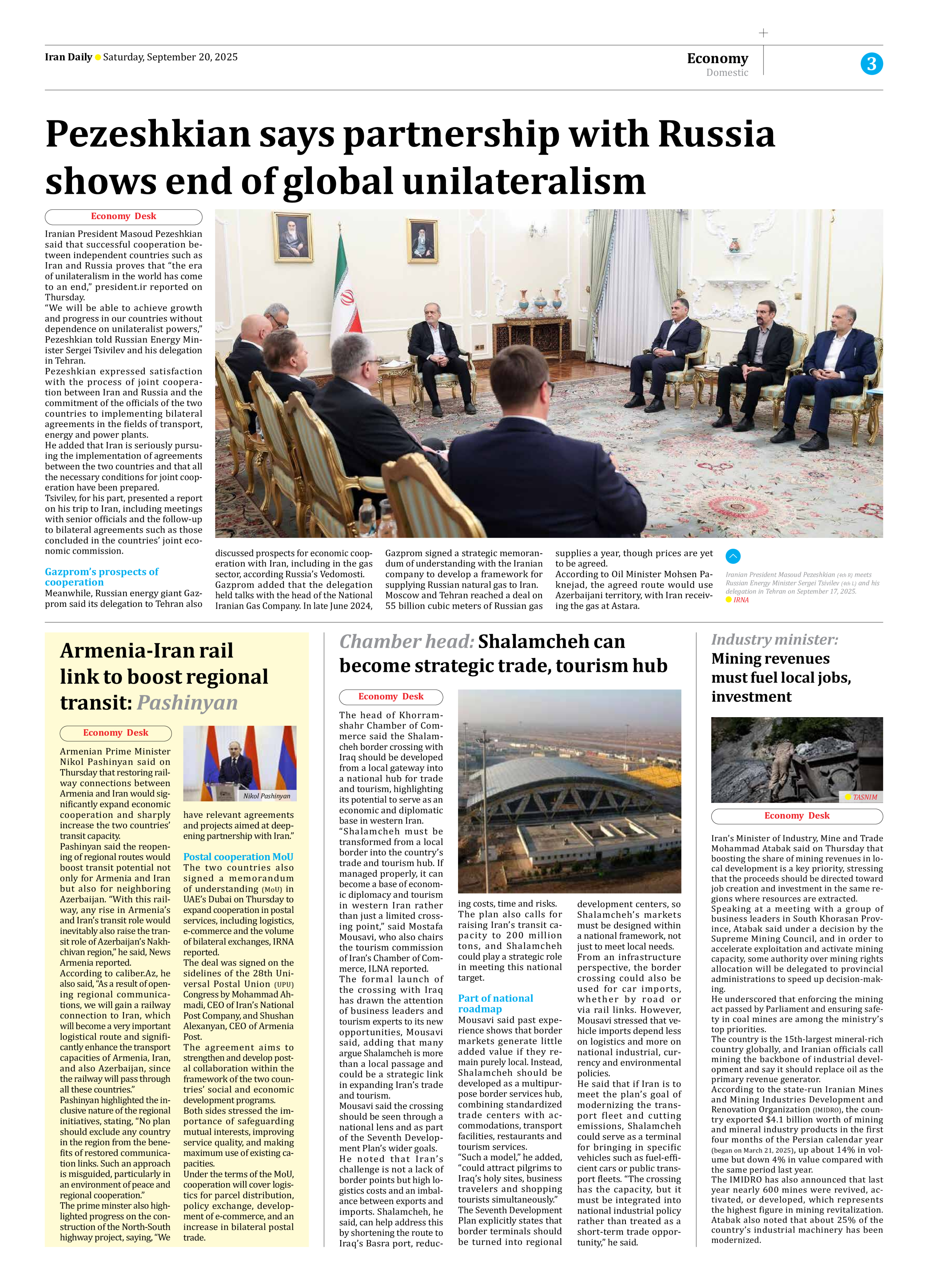


Chamber head: Shalamcheh can become strategic trade, tourism hub
The head of Khorramshahr Chamber of Commerce said the Shalamcheh border crossing with Iraq should be developed from a local gateway into a national hub for trade and tourism, highlighting its potential to serve as an economic and diplomatic base in western Iran.
“Shalamcheh must be transformed from a local border into the country’s trade and tourism hub. If managed properly, it can become a base of economic diplomacy and tourism in western Iran rather than just a limited crossing point,” said Mostafa Mousavi, who also chairs the tourism commission of Iran’s Chamber of Commerce, ILNA reported.
The formal launch of the crossing with Iraq has drawn the attention of business leaders and tourism experts to its new opportunities, Mousavi said, adding that many argue Shalamcheh is more than a local passage and could be a strategic link in expanding Iran’s trade and tourism.
Mousavi said the crossing should be seen through a national lens and as part of the Seventh Development Plan’s wider goals.
He noted that Iran’s challenge is not a lack of border points but high logistics costs and an imbalance between exports and imports. Shalamcheh, he said, can help address this by shortening the route to Iraq’s Basra port, reducing costs, time and risks.
The plan also calls for raising Iran’s transit capacity to 200 million tons, and Shalamcheh could play a strategic role in meeting this national target.
Part of national roadmap
Mousavi said past experience shows that border markets generate little added value if they remain purely local. Instead, Shalamcheh should be developed as a multipurpose border services hub, combining standardized trade centers with accommodations, transport facilities, restaurants and tourism services.
“Such a model,” he added, “could attract pilgrims to Iraq’s holy sites, business travelers and shopping tourists simultaneously.”
The Seventh Development Plan explicitly states that border terminals should be turned into regional development centers, so Shalamcheh’s markets must be designed within a national framework, not just to meet local needs.
From an infrastructure perspective, the border crossing could also be used for car imports, whether by road or via rail links. However, Mousavi stressed that vehicle imports depend less on logistics and more on national industrial, currency and environmental policies.
He said that if Iran is to meet the plan’s goal of modernizing the transport fleet and cutting emissions, Shalamcheh could serve as a terminal for bringing in specific vehicles such as fuel-efficient cars or public transport fleets. “The crossing has the capacity, but it must be integrated into national industrial policy rather than treated as a short-term trade opportunity,” he said.