





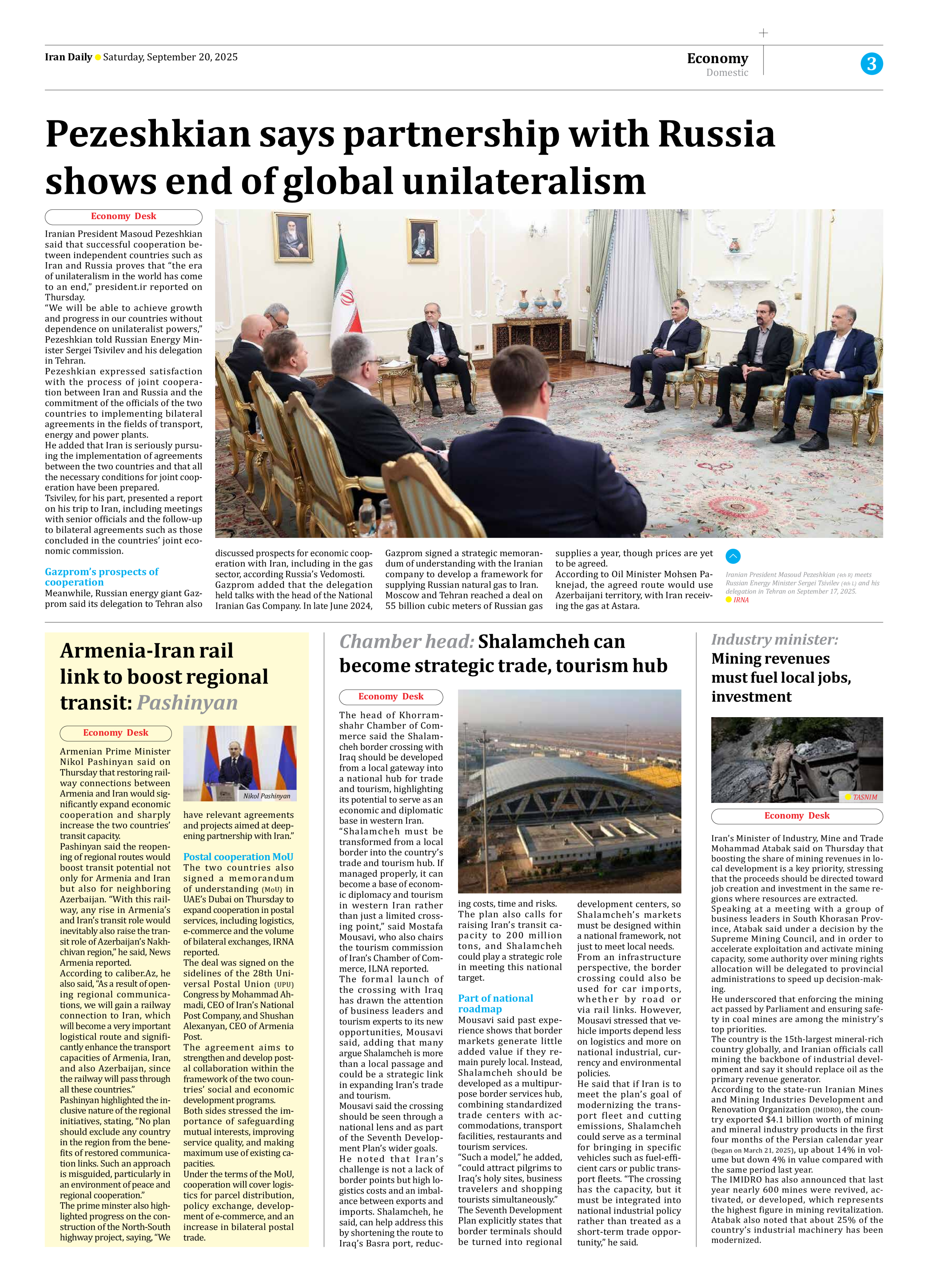


Armenia-Iran rail link to boost regional transit: Pashinyan
Armenian Prime Minister Nikol Pashinyan said on Thursday that restoring railway connections between Armenia and Iran would significantly expand economic cooperation and sharply increase the two countries’ transit capacity.
Pashinyan said the reopening of regional routes would boost transit potential not only for Armenia and Iran but also for neighboring Azerbaijan. “With this railway, any rise in Armenia’s and Iran’s transit role would inevitably also raise the transit role of Azerbaijan’s Nakhchivan region,” he said, News Armenia reported.
According to caliber.Az, he also said, “As a result of opening regional communications, we will gain a railway connection to Iran, which will become a very important logistical route and significantly enhance the transport capacities of Armenia, Iran, and also Azerbaijan, since the railway will pass through all these countries.”
Pashinyan highlighted the inclusive nature of the regional initiatives, stating, “No plan should exclude any country in the region from the benefits of restored communication links. Such an approach is misguided, particularly in an environment of peace and regional cooperation.”
The prime minster also highlighted progress on the construction of the North-South highway project, saying, “We have relevant agreements and projects aimed at deepening partnership with Iran.”
Postal cooperation MoU
The two countries also signed a memorandum of understanding (MoU) in UAE’s Dubai on Thursday to expand cooperation in postal services, including logistics, e-commerce and the volume of bilateral exchanges, IRNA reported.
The deal was signed on the sidelines of the 28th Universal Postal Union (UPU) Congress by Mohammad Ahmadi, CEO of Iran’s National Post Company, and Shushan Alexanyan, CEO of Armenia Post.
The agreement aims to strengthen and develop postal collaboration within the framework of the two countries’ social and economic development programs.
Both sides stressed the importance of safeguarding mutual interests, improving service quality, and making maximum use of existing capacities.
Under the terms of the MoU, cooperation will cover logistics for parcel distribution, policy exchange, development of e-commerce, and an increase in bilateral postal trade.