







Copy in clipboard...
Haftcheshmeh bridge connects past and present in Ardebil
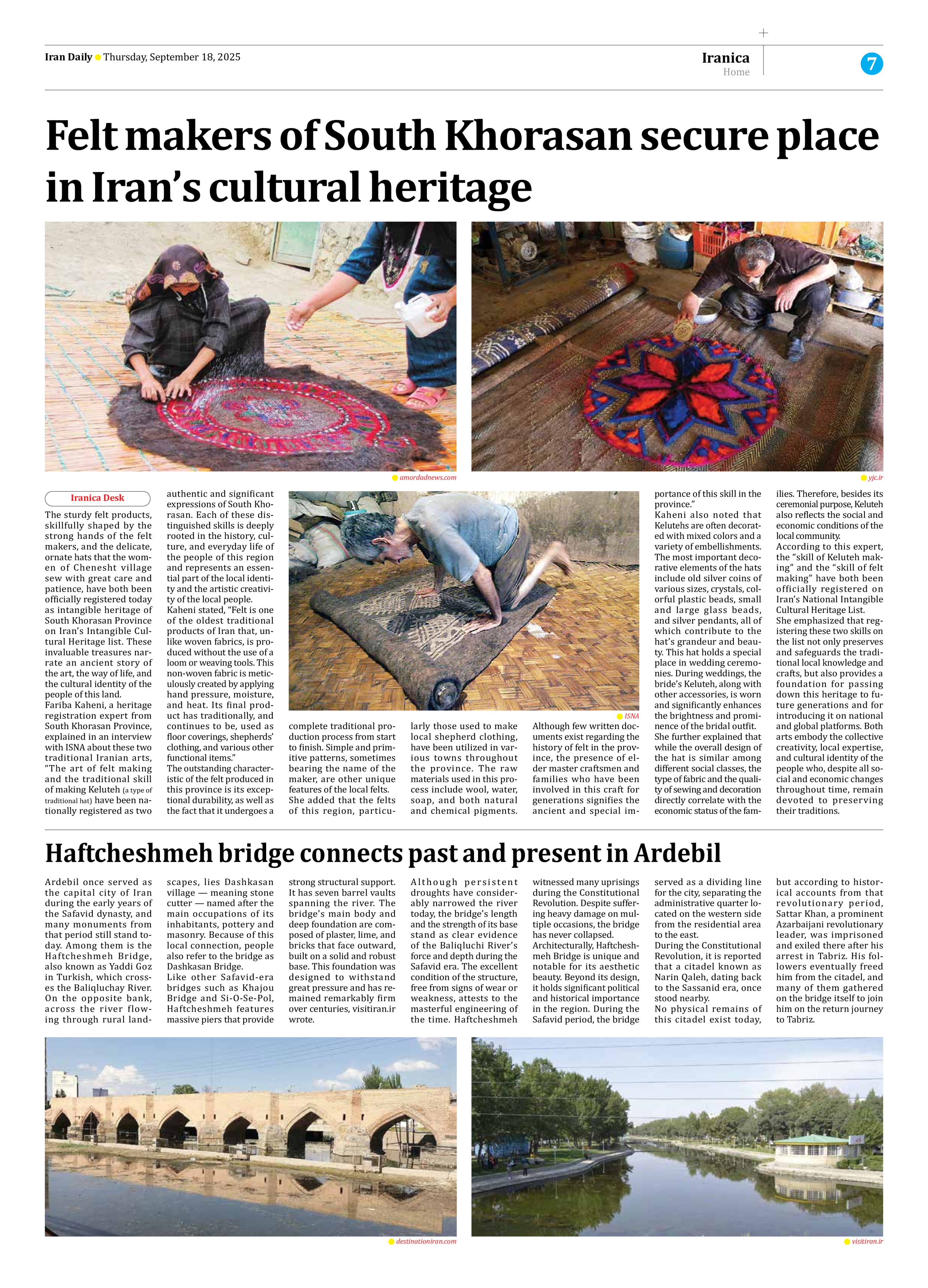
Like other Safavid-era bridges such as Khajou Bridge and Si-O-Se-Pol, Haftcheshmeh features massive piers that provide strong structural support. It has seven barrel vaults spanning the river. The bridge’s main body and deep foundation are composed of plaster, lime, and bricks that face outward, built on a solid and robust base. This foundation was designed to withstand great pressure and has remained remarkably firm over centuries, visitiran.ir wrote.
Although persistent droughts have considerably narrowed the river today, the bridge’s length and the strength of its base stand as clear evidence of the Baliqluchi River’s force and depth during the Safavid era. The excellent condition of the structure, free from signs of wear or weakness, attests to the masterful engineering of the time. Haftcheshmeh witnessed many uprisings during the Constitutional Revolution. Despite suffering heavy damage on multiple occasions, the bridge has never collapsed.
Architecturally, Haftcheshmeh Bridge is unique and notable for its aesthetic beauty. Beyond its design, it holds significant political and historical importance in the region. During the Safavid period, the bridge served as a dividing line for the city, separating the administrative quarter located on the western side from the residential area to the east.
During the Constitutional Revolution, it is reported that a citadel known as Narin Qaleh, dating back to the Sassanid era, once stood nearby.
No physical remains of this citadel exist today, but according to historical accounts from that revolutionary period, Sattar Khan, a prominent Azarbaijani revolutionary leader, was imprisoned and exiled there after his arrest in Tabriz. His followers eventually freed him from the citadel, and many of them gathered on the bridge itself to join him on the return journey to Tabriz.