







Grand Mosque of Isfahan showing twelve centuries of Iranian-Islamic heritage
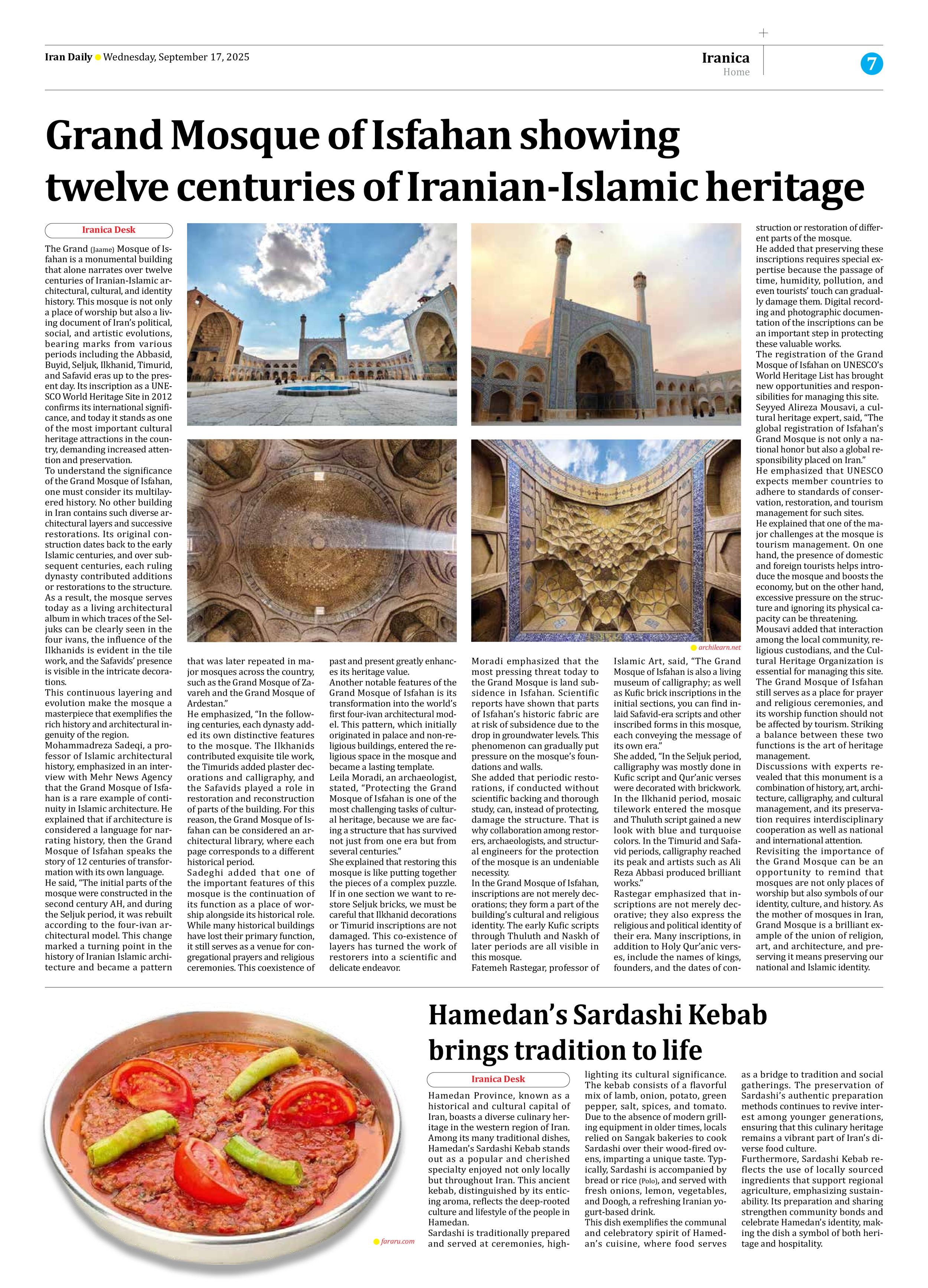
The Grand (Jaame) Mosque of Isfahan is a monumental building that alone narrates over twelve centuries of Iranian-Islamic architectural, cultural, and identity history. This mosque is not only a place of worship but also a living document of Iran’s political, social, and artistic evolutions, bearing marks from various periods including the Abbasid, Buyid, Seljuk, Ilkhanid, Timurid, and Safavid eras up to the present day. Its inscription as a UNESCO World Heritage Site in 2012 confirms its international significance, and today it stands as one of the most important cultural heritage attractions in the country, demanding increased attention and preservation.
To understand the significance of the Grand Mosque of Isfahan, one must consider its multilayered history. No other building in Iran contains such diverse architectural layers and successive restorations. Its original construction dates back to the early Islamic centuries, and over subsequent centuries, each ruling dynasty contributed additions or restorations to the structure. As a result, the mosque serves today as a living architectural album in which traces of the Seljuks can be clearly seen in the four ivans, the influence of the Ilkhanids is evident in the tile work, and the Safavids’ presence is visible in the intricate decorations.
This continuous layering and evolution make the mosque a masterpiece that exemplifies the rich history and architectural ingenuity of the region.
Mohammadreza Sadeqi, a professor of Islamic architectural history, emphasized in an interview with Mehr News Agency that the Grand Mosque of Isfahan is a rare example of continuity in Islamic architecture. He explained that if architecture is considered a language for narrating history, then the Grand Mosque of Isfahan speaks the story of 12 centuries of transformation with its own language.
He said, “The initial parts of the mosque were constructed in the second century AH, and during the Seljuk period, it was rebuilt according to the four-ivan architectural model. This change marked a turning point in the history of Iranian Islamic architecture and became a pattern that was later repeated in major mosques across the country, such as the Grand Mosque of Zavareh and the Grand Mosque of Ardestan.”
He emphasized, “In the following centuries, each dynasty added its own distinctive features to the mosque. The Ilkhanids contributed exquisite tile work, the Timurids added plaster decorations and calligraphy, and the Safavids played a role in restoration and reconstruction of parts of the building. For this reason, the Grand Mosque of Isfahan can be considered an architectural library, where each page corresponds to a different historical period.
Sadeghi added that one of the important features of this mosque is the continuation of its function as a place of worship alongside its historical role. While many historical buildings have lost their primary function, it still serves as a venue for congregational prayers and religious ceremonies. This coexistence of past and present greatly enhances its heritage value.
Another notable features of the Grand Mosque of Isfahan is its transformation into the world’s first four-ivan architectural model. This pattern, which initially originated in palace and non-religious buildings, entered the religious space in the mosque and became a lasting template.
Leila Moradi, an archaeologist, stated, “Protecting the Grand Mosque of Isfahan is one of the most challenging tasks of cultural heritage, because we are facing a structure that has survived not just from one era but from several centuries.”
She explained that restoring this mosque is like putting together the pieces of a complex puzzle. If in one section we want to restore Seljuk bricks, we must be careful that Ilkhanid decorations or Timurid inscriptions are not damaged. This co-existence of layers has turned the work of restorers into a scientific and delicate endeavor.
Moradi emphasized that the most pressing threat today to the Grand Mosque is land subsidence in Isfahan. Scientific reports have shown that parts of Isfahan’s historic fabric are at risk of subsidence due to the drop in groundwater levels. This phenomenon can gradually put pressure on the mosque’s foundations and walls.
She added that periodic restorations, if conducted without scientific backing and thorough study, can, instead of protecting, damage the structure. That is why collaboration among restorers, archaeologists, and structural engineers for the protection of the mosque is an undeniable necessity.
In the Grand Mosque of Isfahan, inscriptions are not merely decorations; they form a part of the building’s cultural and religious identity. The early Kufic scripts through Thuluth and Naskh of later periods are all visible in this mosque.
Fatemeh Rastegar, professor of Islamic Art, said, “The Grand Mosque of Isfahan is also a living museum of calligraphy; as well as Kufic brick inscriptions in the initial sections, you can find inlaid Safavid-era scripts and other inscribed forms in this mosque, each conveying the message of its own era.”
She added, “In the Seljuk period, calligraphy was mostly done in Kufic script and Qur’anic verses were decorated with brickwork. In the Ilkhanid period, mosaic tilework entered the mosque and Thuluth script gained a new look with blue and turquoise colors. In the Timurid and Safavid periods, calligraphy reached its peak and artists such as Ali Reza Abbasi produced brilliant works.”
Rastegar emphasized that inscriptions are not merely decorative; they also express the religious and political identity of their era. Many inscriptions, in addition to Holy Qur’anic verses, include the names of kings, founders, and the dates of construction or restoration of different parts of the mosque.
He added that preserving these inscriptions requires special expertise because the passage of time, humidity, pollution, and even tourists’ touch can gradually damage them. Digital recording and photographic documentation of the inscriptions can be an important step in protecting these valuable works.
The registration of the Grand Mosque of Isfahan on UNESCO’s World Heritage List has brought new opportunities and responsibilities for managing this site.
Seyyed Alireza Mousavi, a cultural heritage expert, said, “The global registration of Isfahan’s Grand Mosque is not only a national honor but also a global responsibility placed on Iran.”
He emphasized that UNESCO expects member countries to adhere to standards of conservation, restoration, and tourism management for such sites.
He explained that one of the major challenges at the mosque is tourism management. On one hand, the presence of domestic and foreign tourists helps introduce the mosque and boosts the economy, but on the other hand, excessive pressure on the structure and ignoring its physical capacity can be threatening.
Mousavi added that interaction among the local community, religious custodians, and the Cultural Heritage Organization is essential for managing this site. The Grand Mosque of Isfahan still serves as a place for prayer and religious ceremonies, and its worship function should not be affected by tourism. Striking a balance between these two functions is the art of heritage management.
Discussions with experts revealed that this monument is a combination of history, art, architecture, calligraphy, and cultural management, and its preservation requires interdisciplinary cooperation as well as national and international attention.
Revisiting the importance of the Grand Mosque can be an opportunity to remind that mosques are not only places of worship but also symbols of our identity, culture, and history. As the mother of mosques in Iran, Grand Mosque is a brilliant example of the union of religion, art, and architecture, and preserving it means preserving our national and Islamic identity.