





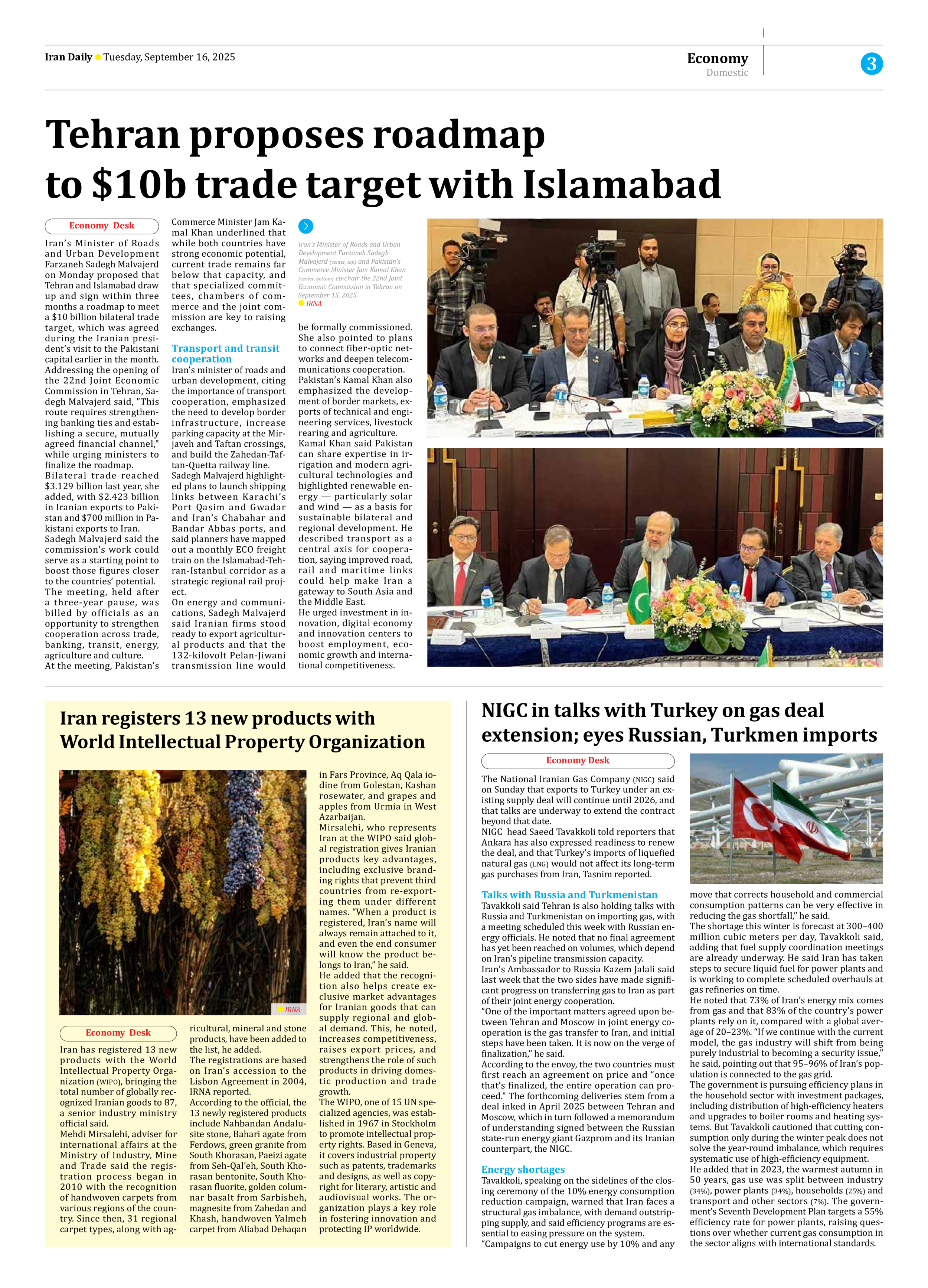


NIGC in talks with Turkey on gas deal extension; eyes Russian, Turkmen imports
The National Iranian Gas Company (NIGC) said on Sunday that exports to Turkey under an existing supply deal will continue until 2026, and that talks are underway to extend the contract beyond that date.
NIGC head Saeed Tavakkoli told reporters that Ankara has also expressed readiness to renew the deal, and that Turkey’s imports of liquefied natural gas (LNG) would not affect its long-term gas purchases from Iran, Tasnim reported.
Talks with Russia and Turkmenistan
Tavakkoli said Tehran is also holding talks with Russia and Turkmenistan on importing gas, with a meeting scheduled this week with Russian energy officials. He noted that no final agreement has yet been reached on volumes, which depend on Iran’s pipeline transmission capacity.
Iran’s Ambassador to Russia Kazem Jalali said last week that the two sides have made significant progress on transferring gas to Iran as part of their joint energy cooperation.
“One of the important matters agreed upon between Tehran and Moscow in joint energy cooperation is the gas transfer to Iran, and initial steps have been taken. It is now on the verge of finalization,” he said.
According to the envoy, the two countries must first reach an agreement on price and “once that’s finalized, the entire operation can proceed." The forthcoming deliveries stem from a deal inked in April 2025 between Tehran and Moscow, which in turn followed a memorandum of understanding signed between the Russian state-run energy giant Gazprom and its Iranian counterpart, the NIGC.
Energy shortages
Tavakkoli, speaking on the sidelines of the closing ceremony of the 10% energy consumption reduction campaign, warned that Iran faces a structural gas imbalance, with demand outstripping supply, and said efficiency programs are essential to easing pressure on the system.
“Campaigns to cut energy use by 10% and any move that corrects household and commercial consumption patterns can be very effective in reducing the gas shortfall,” he said.
The shortage this winter is forecast at 300–400 million cubic meters per day, Tavakkoli said, adding that fuel supply coordination meetings are already underway. He said Iran has taken steps to secure liquid fuel for power plants and is working to complete scheduled overhauls at gas refineries on time.
He noted that 73% of Iran’s energy mix comes from gas and that 83% of the country’s power plants rely on it, compared with a global average of 20–23%. “If we continue with the current model, the gas industry will shift from being purely industrial to becoming a security issue,” he said, pointing out that 95–96% of Iran’s population is connected to the gas grid.
The government is pursuing efficiency plans in the household sector with investment packages, including distribution of high-efficiency heaters and upgrades to boiler rooms and heating systems. But Tavakkoli cautioned that cutting consumption only during the winter peak does not solve the year-round imbalance, which requires systematic use of high-efficiency equipment.
He added that in 2023, the warmest autumn in 50 years, gas use was split between industry (34%), power plants (34%), households (25%) and transport and other sectors (7%). The government’s Seventh Development Plan targets a 55% efficiency rate for power plants, raising questions over whether current gas consumption in the sector aligns with international standards.