







Tehran proposes roadmap to $10b trade target with Islamabad
Iran’s Minister of Roads and Urban Development Farzaneh Sadegh Malvajerd on Monday proposed that Tehran and Islamabad draw up and sign within three months a roadmap to meet a $10 billion bilateral trade target, which was agreed during the Iranian president’s visit to the Pakistani capital earlier in the month.
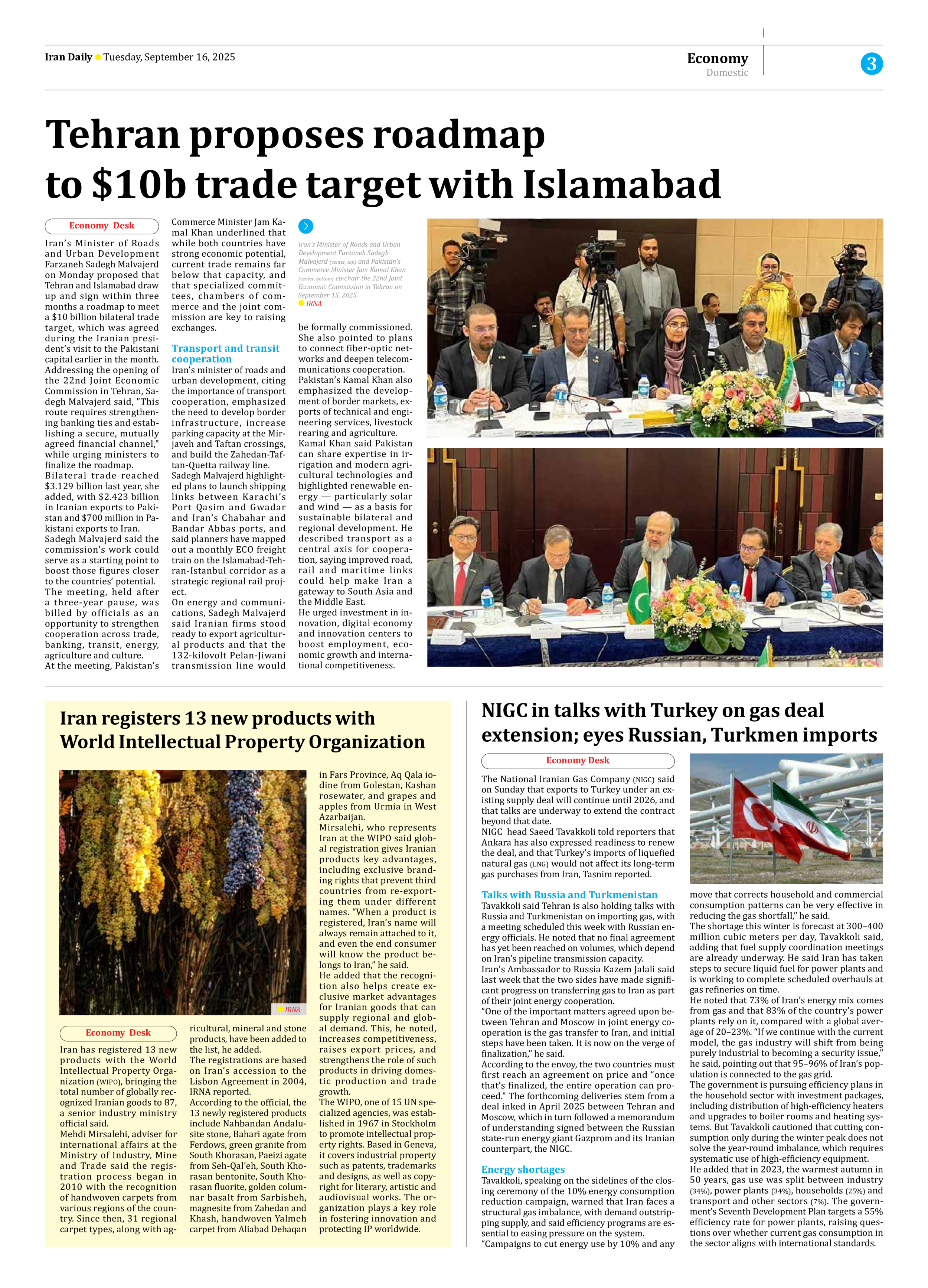
Addressing the opening of the 22nd Joint Economic Commission in Tehran, Sadegh Malvajerd said, "This route requires strengthening banking ties and establishing a secure, mutually agreed financial channel," while urging ministers to finalize the roadmap.
Bilateral trade reached $3.129 billion last year, she added, with $2.423 billion in Iranian exports to Pakistan and $700 million in Pakistani exports to Iran.
Sadegh Malvajerd said the commission’s work could serve as a starting point to boost those figures closer to the countries’ potential.
The meeting, held after a three-year pause, was billed by officials as an opportunity to strengthen cooperation across trade, banking, transit, energy, agriculture and culture.
At the meeting, Pakistan’s Commerce Minister Jam Kamal Khan underlined that while both countries have strong economic potential, current trade remains far below that capacity, and that specialized committees, chambers of commerce and the joint commission are key to raising exchanges.
Transport and transit cooperation
Iran’s minister of roads and urban development, citing the importance of transport cooperation, emphasized the need to develop border infrastructure, increase parking capacity at the Mirjaveh and Taftan crossings, and build the Zahedan-Taftan-Quetta railway line.
Sadegh Malvajerd highlighted plans to launch shipping links between Karachi’s Port Qasim and Gwadar and Iran’s Chabahar and Bandar Abbas ports, and said planners have mapped out a monthly ECO freight train on the Islamabad-Tehran-Istanbul corridor as a strategic regional rail project.
On energy and communications, Sadegh Malvajerd said Iranian firms stood ready to export agricultural products and that the 132-kilovolt Pelan-Jiwani transmission line would be formally commissioned. She also pointed to plans to connect fiber-optic networks and deepen telecommunications cooperation.
Pakistan’s Kamal Khan also emphasized the development of border markets, exports of technical and engineering services, livestock rearing and agriculture.
Kamal Khan said Pakistan can share expertise in irrigation and modern agricultural technologies and highlighted renewable energy — particularly solar and wind — as a basis for sustainable bilateral and regional development. He described transport as a central axis for cooperation, saying improved road, rail and maritime links could help make Iran a gateway to South Asia and the Middle East.
He urged investment in innovation, digital economy and innovation centers to boost employment, economic growth and international competitiveness.