







Losers of attack on Doha
By Salahuddin Khadiv
Political analyst
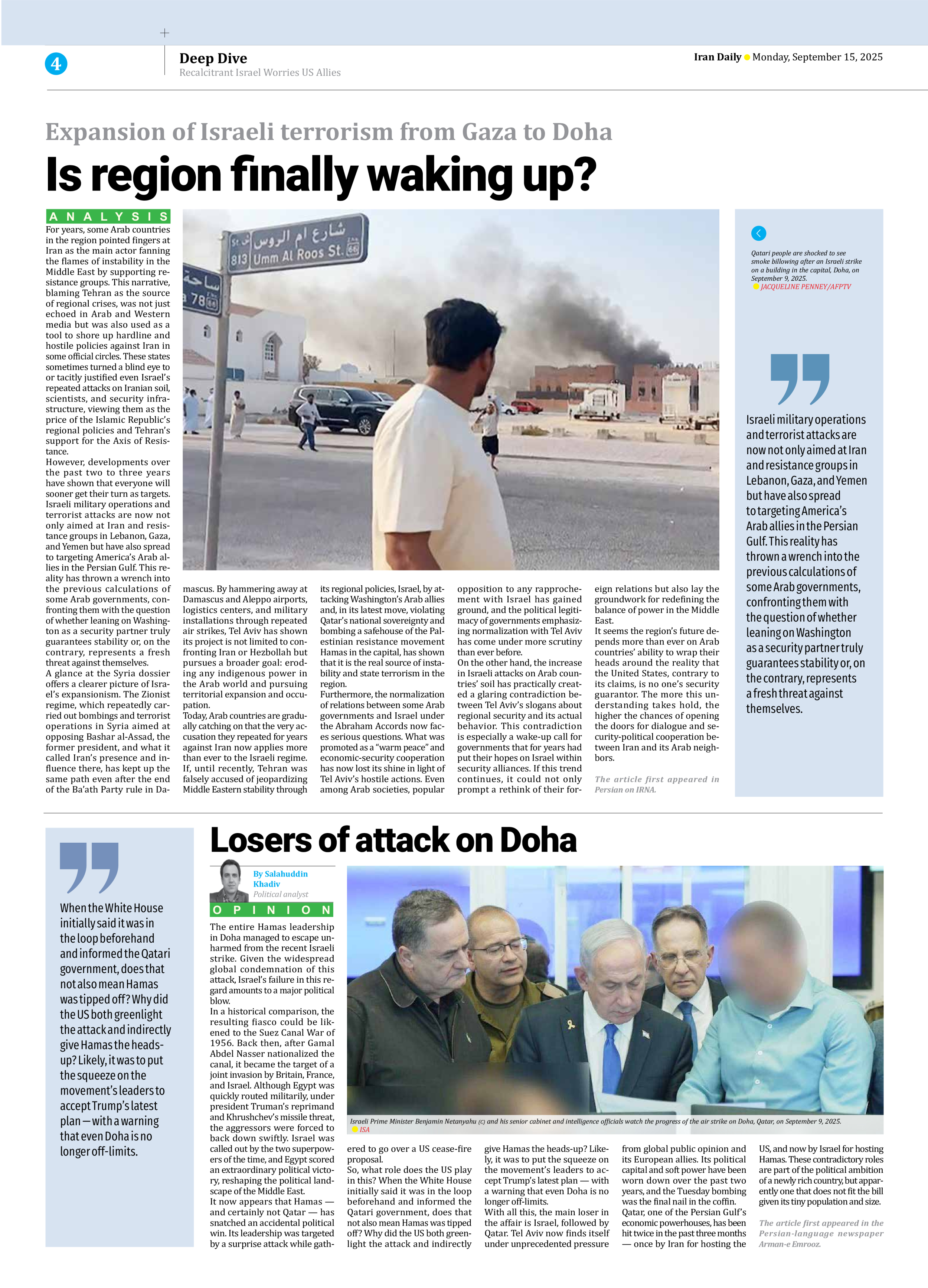
The entire Hamas leadership in Doha managed to escape unharmed from the recent Israeli strike. Given the widespread global condemnation of this attack, Israel’s failure in this regard amounts to a major political blow.
In a historical comparison, the resulting fiasco could be likened to the Suez Canal War of 1956. Back then, after Gamal Abdel Nasser nationalized the canal, it became the target of a joint invasion by Britain, France, and Israel. Although Egypt was quickly routed militarily, under president Truman’s reprimand and Khrushchev’s missile threat, the aggressors were forced to back down swiftly. Israel was called out by the two superpowers of the time, and Egypt scored an extraordinary political victory, reshaping the political landscape of the Middle East.
It now appears that Hamas — and certainly not Qatar — has snatched an accidental political win. Its leadership was targeted by a surprise attack while gathered to go over a US cease-fire proposal.
So, what role does the US play in this? When the White House initially said it was in the loop beforehand and informed the Qatari government, does that not also mean Hamas was tipped off? Why did the US both greenlight the attack and indirectly give Hamas the heads-up? Likely, it was to put the squeeze on the movement’s leaders to accept Trump’s latest plan — with a warning that even Doha is no longer off-limits.
With all this, the main loser in the affair is Israel, followed by Qatar. Tel Aviv now finds itself under unprecedented pressure from global public opinion and its European allies. Its political capital and soft power have been worn down over the past two years, and the Tuesday bombing was the final nail in the coffin.
Qatar, one of the Persian Gulf’s economic powerhouses, has been hit twice in the past three months — once by Iran for hosting the US, and now by Israel for hosting Hamas. These contradictory roles are part of the political ambition of a newly rich country, but apparently one that does not fit the bill given its tiny population and size.
The article first appeared in the Persian-language newspaper
Arman-e Emrooz.