







Expansion of Israeli terrorism from Gaza to Doha
Is region finally waking up?
For years, some Arab countries in the region pointed fingers at Iran as the main actor fanning the flames of instability in the Middle East by supporting resistance groups. This narrative, blaming Tehran as the source of regional crises, was not just echoed in Arab and Western media but was also used as a tool to shore up hardline and hostile policies against Iran in some official circles. These states sometimes turned a blind eye to or tacitly justified even Israel’s repeated attacks on Iranian soil, scientists, and security infrastructure, viewing them as the price of the Islamic Republic’s regional policies and Tehran’s support for the Axis of Resistance.
However, developments over the past two to three years have shown that everyone will sooner get their turn as targets. Israeli military operations and terrorist attacks are now not only aimed at Iran and resistance groups in Lebanon, Gaza, and Yemen but have also spread to targeting America’s Arab allies in the Persian Gulf. This reality has thrown a wrench into the previous calculations of some Arab governments, confronting them with the question of whether leaning on Washington as a security partner truly guarantees stability or, on the contrary, represents a fresh threat against themselves.
A glance at the Syria dossier offers a clearer picture of Israel’s expansionism. The Zionist regime, which repeatedly carried out bombings and terrorist operations in Syria aimed at opposing Bashar al-Assad, the former president, and what it called Iran’s presence and influence there, has kept up the same path even after the end of the Ba’ath Party rule in Damascus. By hammering away at Damascus and Aleppo airports, logistics centers, and military installations through repeated air strikes, Tel Aviv has shown its project is not limited to confronting Iran or Hezbollah but pursues a broader goal: eroding any indigenous power in the Arab world and pursuing territorial expansion and occupation.
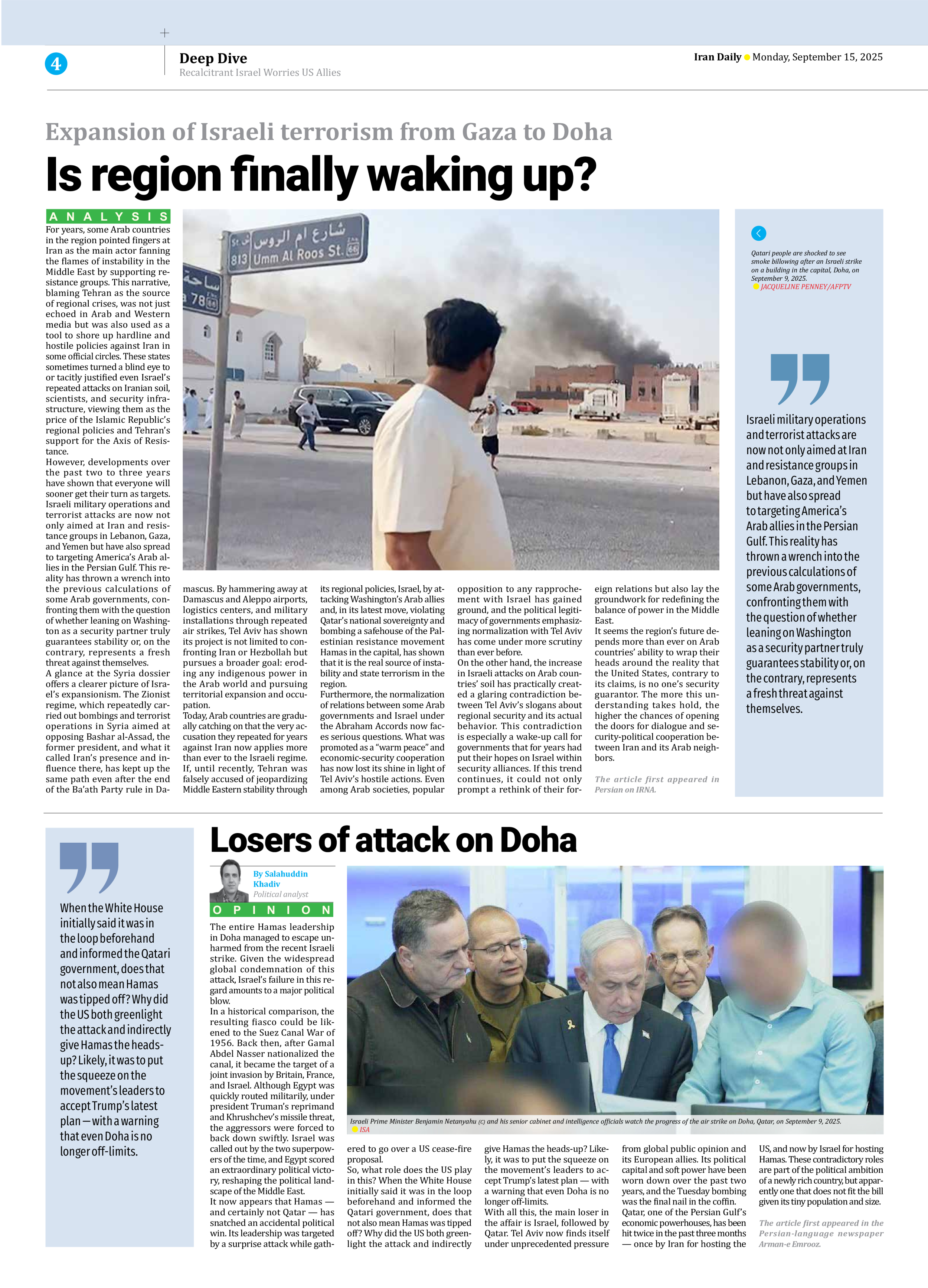
Today, Arab countries are gradually catching on that the very accusation they repeated for years against Iran now applies more than ever to the Israeli regime. If, until recently, Tehran was falsely accused of jeopardizing Middle Eastern stability through its regional policies, Israel, by attacking Washington’s Arab allies and, in its latest move, violating Qatar’s national sovereignty and bombing a safehouse of the Palestinian resistance movement Hamas in the capital, has shown that it is the real source of instability and state terrorism in the region.
Furthermore, the normalization of relations between some Arab governments and Israel under the Abraham Accords now faces serious questions. What was promoted as a “warm peace” and economic-security cooperation has now lost its shine in light of Tel Aviv’s hostile actions. Even among Arab societies, popular opposition to any rapprochement with Israel has gained ground, and the political legitimacy of governments emphasizing normalization with Tel Aviv has come under more scrutiny than ever before.
On the other hand, the increase in Israeli attacks on Arab countries’ soil has practically created a glaring contradiction between Tel Aviv’s slogans about regional security and its actual behavior. This contradiction is especially a wake-up call for governments that for years had put their hopes on Israel within security alliances. If this trend continues, it could not only prompt a rethink of their foreign relations but also lay the groundwork for redefining the balance of power in the Middle East.
It seems the region’s future depends more than ever on Arab countries’ ability to wrap their heads around the reality that the United States, contrary to its claims, is no one’s security guarantor. The more this understanding takes hold, the higher the chances of opening the doors for dialogue and security-political cooperation between Iran and its Arab neighbors.
The article first appeared in
Persian on IRNA.