







Top security body says approved Iran-IAEA cooperation pact
Iran’s Supreme National Security Council (SNSC) said in a statement on Sunday that the cooperation document recently signed between Iran and the International Atomic Energy Agency (IAEA) had been approved by the council.
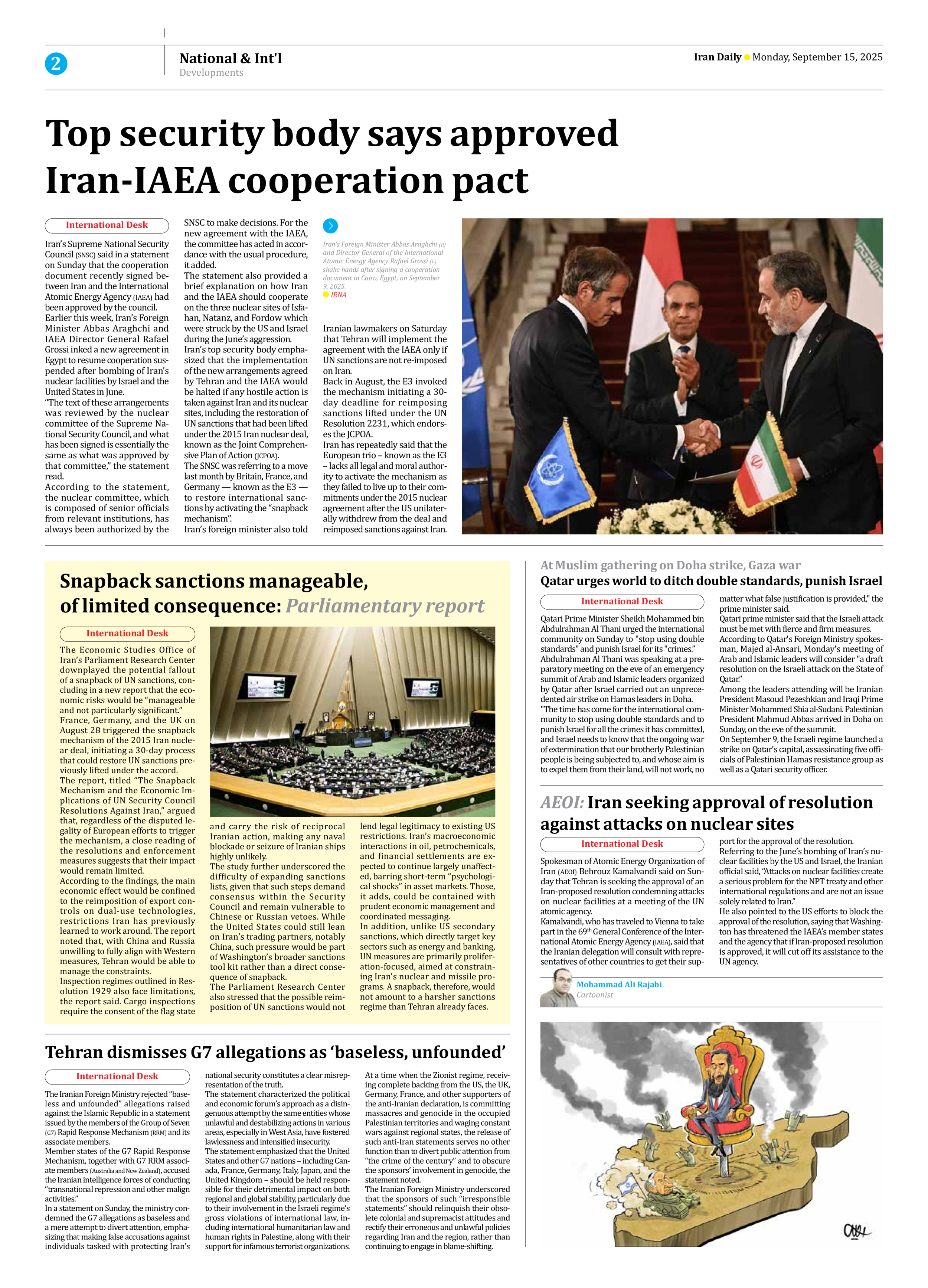
Earlier this week, Iran’s Foreign Minister Abbas Araghchi and IAEA Director General Rafael Grossi inked a new agreement in Egypt to resume cooperation suspended after bombing of Iran’s nuclear facilities by Israel and the United States in June.
“The text of these arrangements was reviewed by the nuclear committee of the Supreme National Security Council, and what has been signed is essentially the same as what was approved by that committee,” the statement read.
According to the statement, the nuclear committee, which is composed of senior officials from relevant institutions, has always been authorized by the SNSC to make decisions. For the new agreement with the IAEA, the committee has acted in accordance with the usual procedure, it added.
The statement also provided a brief explanation on how Iran and the IAEA should cooperate on the three nuclear sites of Isfahan, Natanz, and Fordow which were struck by the US and Israel during the June’s aggression.
Iran’s top security body emphasized that the implementation of the new arrangements agreed by Tehran and the IAEA would be halted if any hostile action is taken against Iran and its nuclear sites, including the restoration of UN sanctions that had been lifted under the 2015 Iran nuclear deal, known as the Joint Comprehensive Plan of Action (JCPOA).
The SNSC was referring to a move last month by Britain, France, and Germany — known as the E3 — to restore international sanctions by activating the “snapback mechanism”.
Iran’s foreign minister also told Iranian lawmakers on Saturday that Tehran will implement the agreement with the IAEA only if UN sanctions are not re-imposed on Iran.
Back in August, the E3 invoked the mechanism initiating a 30-day deadline for reimposing sanctions lifted under the UN Resolution 2231, which endorses the JCPOA.
Iran has repeatedly said that the European trio – known as the E3 – lacks all legal and moral authority to activate the mechanism as they failed to live up to their commitments under the 2015 nuclear agreement after the US unilaterally withdrew from the deal and reimposed sanctions against Iran.