







IAEA chief declares progress in Iran talks over nuclear site inspections
Talks on resuming International Atomic Energy Agency (IAEA) inspections of Iran’s nuclear sites have made progress, but its chief warned that there was “not much” time remaining.
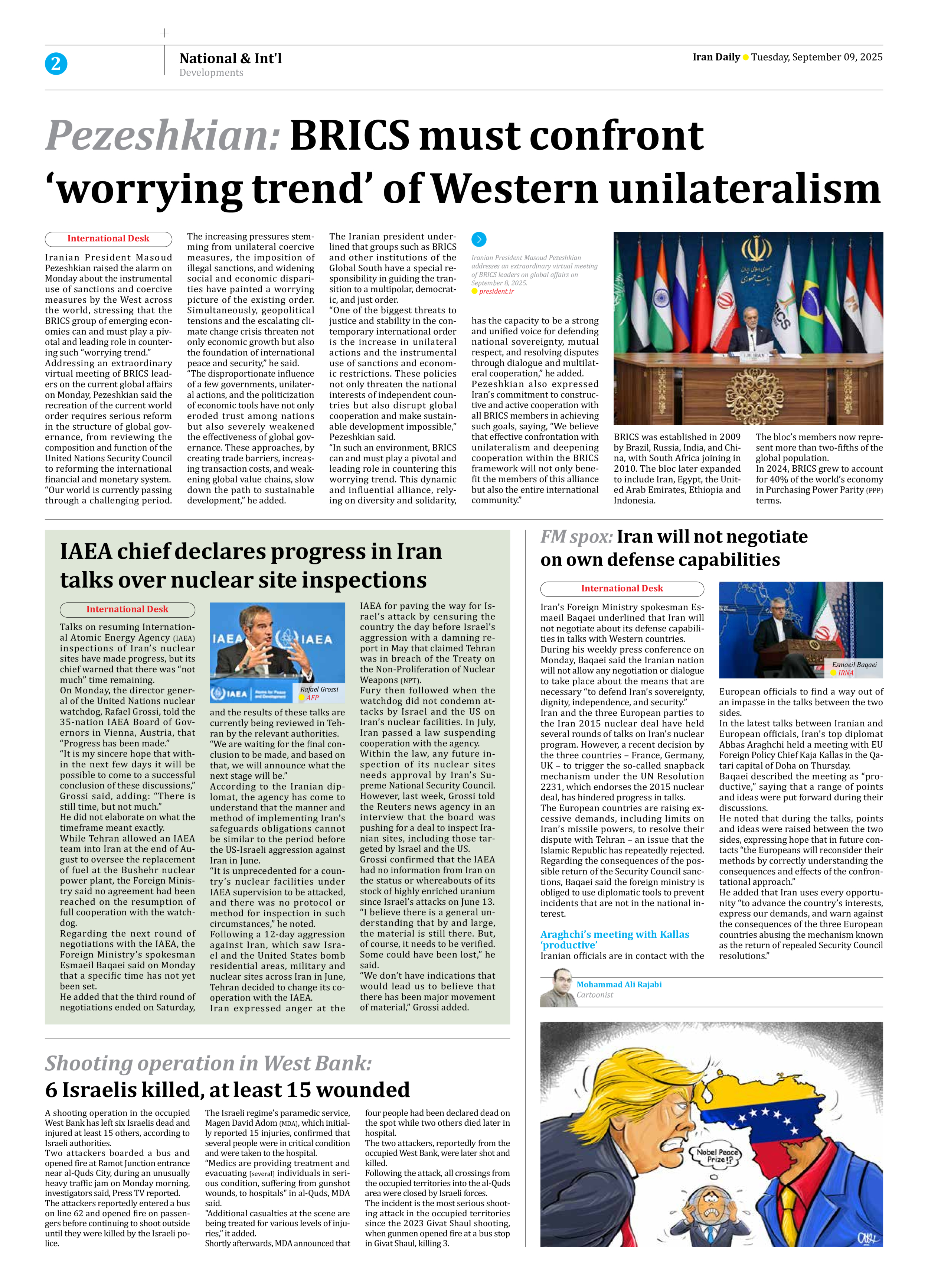
On Monday, the director general of the United Nations nuclear watchdog, Rafael Grossi, told the 35-nation IAEA Board of Governors in Vienna, Austria, that “Progress has been made.”
“It is my sincere hope that within the next few days it will be possible to come to a successful conclusion of these discussions,” Grossi said, adding: “There is still time, but not much.”
He did not elaborate on what the timeframe meant exactly.
While Tehran allowed an IAEA team into Iran at the end of August to oversee the replacement of fuel at the Bushehr nuclear power plant, the Foreign Ministry said no agreement had been reached on the resumption of full cooperation with the watchdog.
Regarding the next round of negotiations with the IAEA, the Foreign Ministry’s spokesman Esmaeil Baqaei said on Monday that a specific time has not yet been set.
He added that the third round of negotiations ended on Saturday, and the results of these talks are currently being reviewed in Tehran by the relevant authorities.
“We are waiting for the final conclusion to be made, and based on that, we will announce what the next stage will be.”
According to the Iranian diplomat, the agency has come to understand that the manner and method of implementing Iran’s safeguards obligations cannot be similar to the period before the US-Israeli aggression against Iran in June.
“It is unprecedented for a country’s nuclear facilities under IAEA supervision to be attacked, and there was no protocol or method for inspection in such circumstances,” he noted.
Following a 12-day aggression against Iran, which saw Israel and the United States bomb residential areas, military and nuclear sites across Iran in June, Tehran decided to change its cooperation with the IAEA.
Iran expressed anger at the IAEA for paving the way for Israel’s attack by censuring the country the day before Israel’s aggression with a damning report in May that claimed Tehran was in breach of the Treaty on the Non-Proliferation of Nuclear Weapons (NPT).
Fury then followed when the watchdog did not condemn attacks by Israel and the US on Iran’s nuclear facilities. In July, Iran passed a law suspending cooperation with the agency.
Within the law, any future inspection of its nuclear sites needs approval by Iran’s Supreme National Security Council.
However, last week, Grossi told the Reuters news agency in an interview that the board was pushing for a deal to inspect Iranian sites, including those targeted by Israel and the US.
Grossi confirmed that the IAEA had no information from Iran on the status or whereabouts of its stock of highly enriched uranium since Israel’s attacks on June 13.
“I believe there is a general understanding that by and large, the material is still there. But, of course, it needs to be verified. Some could have been lost,” he said.
“We don’t have indications that would lead us to believe that there has been major movement of material,” Grossi added.