







Copy in clipboard...
Pezeshkian: BRICS must confront ‘worrying trend’ of Western unilateralism
Iranian President Masoud Pezeshkian raised the alarm on Monday about the instrumental use of sanctions and coercive measures by the West across the world, stressing that the BRICS group of emerging economies can and must play a pivotal and leading role in countering such “worrying trend.”
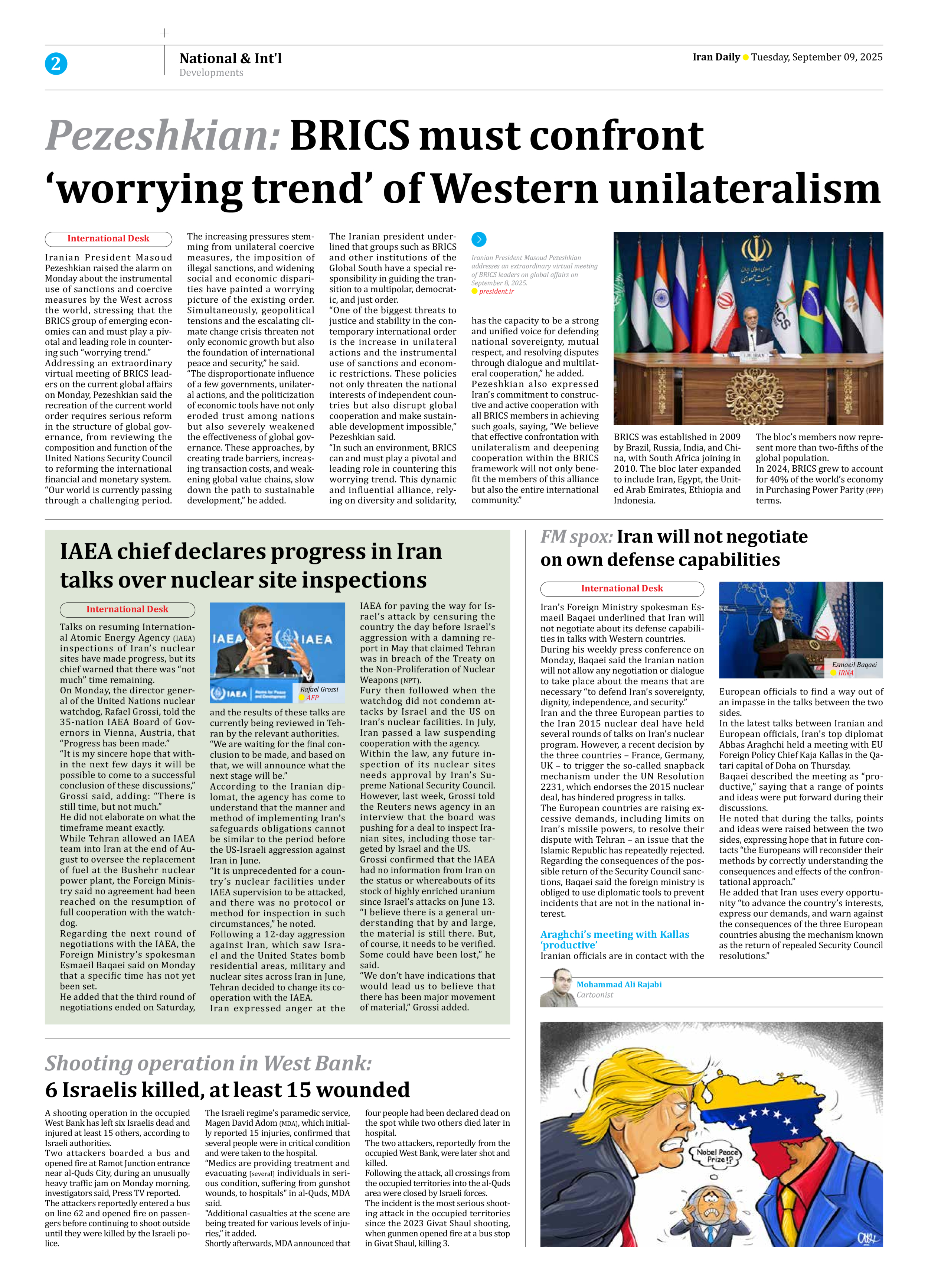
Addressing an extraordinary virtual meeting of BRICS leaders on the current global affairs on Monday, Pezeshkian said the recreation of the current world order requires serious reform in the structure of global governance, from reviewing the composition and function of the United Nations Security Council to reforming the international financial and monetary system.
“Our world is currently passing through a challenging period. The increasing pressures stemming from unilateral coercive measures, the imposition of illegal sanctions, and widening social and economic disparities have painted a worrying picture of the existing order. Simultaneously, geopolitical tensions and the escalating climate change crisis threaten not only economic growth but also the foundation of international peace and security,” he said.
“The disproportionate influence of a few governments, unilateral actions, and the politicization of economic tools have not only eroded trust among nations but also severely weakened the effectiveness of global governance. These approaches, by creating trade barriers, increasing transaction costs, and weakening global value chains, slow down the path to sustainable development,” he added.
The Iranian president underlined that groups such as BRICS and other institutions of the Global South have a special responsibility in guiding the transition to a multipolar, democratic, and just order.
“One of the biggest threats to justice and stability in the contemporary international order is the increase in unilateral actions and the instrumental use of sanctions and economic restrictions. These policies not only threaten the national interests of independent countries but also disrupt global cooperation and make sustainable development impossible,” Pezeshkian said.
“In such an environment, BRICS can and must play a pivotal and leading role in countering this worrying trend. This dynamic and influential alliance, relying on diversity and solidarity, has the capacity to be a strong and unified voice for defending national sovereignty, mutual respect, and resolving disputes through dialogue and multilateral cooperation,” he added.
Pezeshkian also expressed Iran’s commitment to constructive and active cooperation with all BRICS members in achieving such goals, saying, “We believe that effective confrontation with unilateralism and deepening cooperation within the BRICS framework will not only benefit the members of this alliance but also the entire international community.”
BRICS was established in 2009 by Brazil, Russia, India, and China, with South Africa joining in 2010. The bloc later expanded to include Iran, Egypt, the United Arab Emirates, Ethiopia and Indonesia.
The bloc’s members now represent more than two-fifths of the global population.
In 2024, BRICS grew to account for 40% of the world’s economy in Purchasing Power Parity (PPP) terms.