





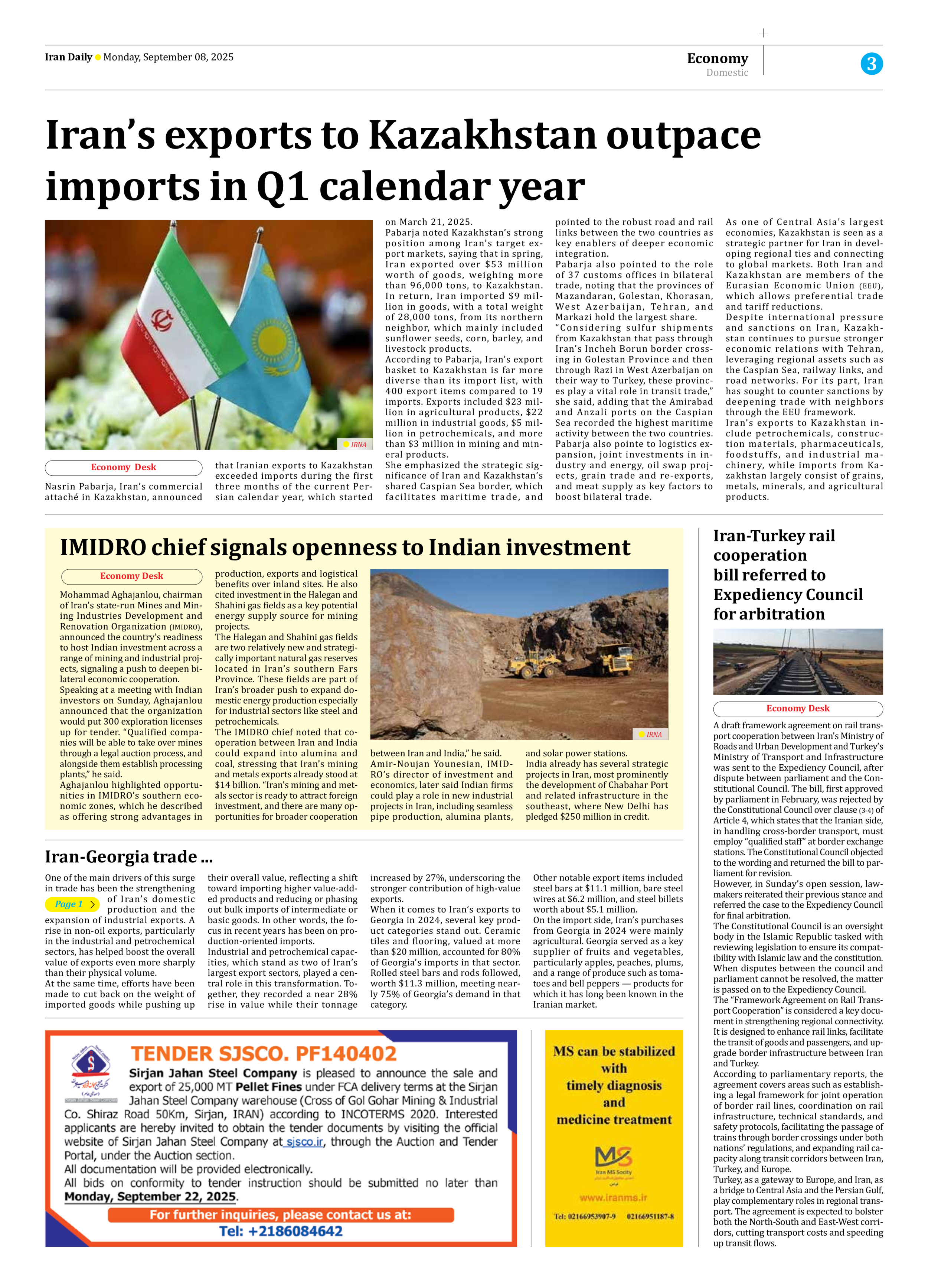


Iran-Turkey rail cooperation bill referred to Expediency Council for arbitration
A draft framework agreement on rail transport cooperation between Iran’s Ministry of Roads and Urban Development and Turkey’s Ministry of Transport and Infrastructure was sent to the Expediency Council, after dispute between parliament and the Constitutional Council. The bill, first approved by parliament in February, was rejected by the Constitutional Council over clause (3-4) of Article 4, which states that the Iranian side, in handling cross-border transport, must employ “qualified staff” at border exchange stations. The Constitutional Council objected to the wording and returned the bill to parliament for revision.
However, in Sunday’s open session, lawmakers reiterated their previous stance and referred the case to the Expediency Council for final arbitration.
The Constitutional Council is an oversight body in the Islamic Republic tasked with reviewing legislation to ensure its compatibility with Islamic law and the constitution. When disputes between the council and parliament cannot be resolved, the matter is passed on to the Expediency Council.
The “Framework Agreement on Rail Transport Cooperation” is considered a key document in strengthening regional connectivity. It is designed to enhance rail links, facilitate the transit of goods and passengers, and upgrade border infrastructure between Iran and Turkey.
According to parliamentary reports, the agreement covers areas such as establishing a legal framework for joint operation of border rail lines, coordination on rail infrastructure, technical standards, and safety protocols, facilitating the passage of trains through border crossings under both nations’ regulations, and expanding rail capacity along transit corridors between Iran, Turkey, and Europe.
Turkey, as a gateway to Europe, and Iran, as a bridge to Central Asia and the Persian Gulf, play complementary roles in regional transport. The agreement is expected to bolster both the North-South and East-West corridors, cutting transport costs and speeding up transit flows.