





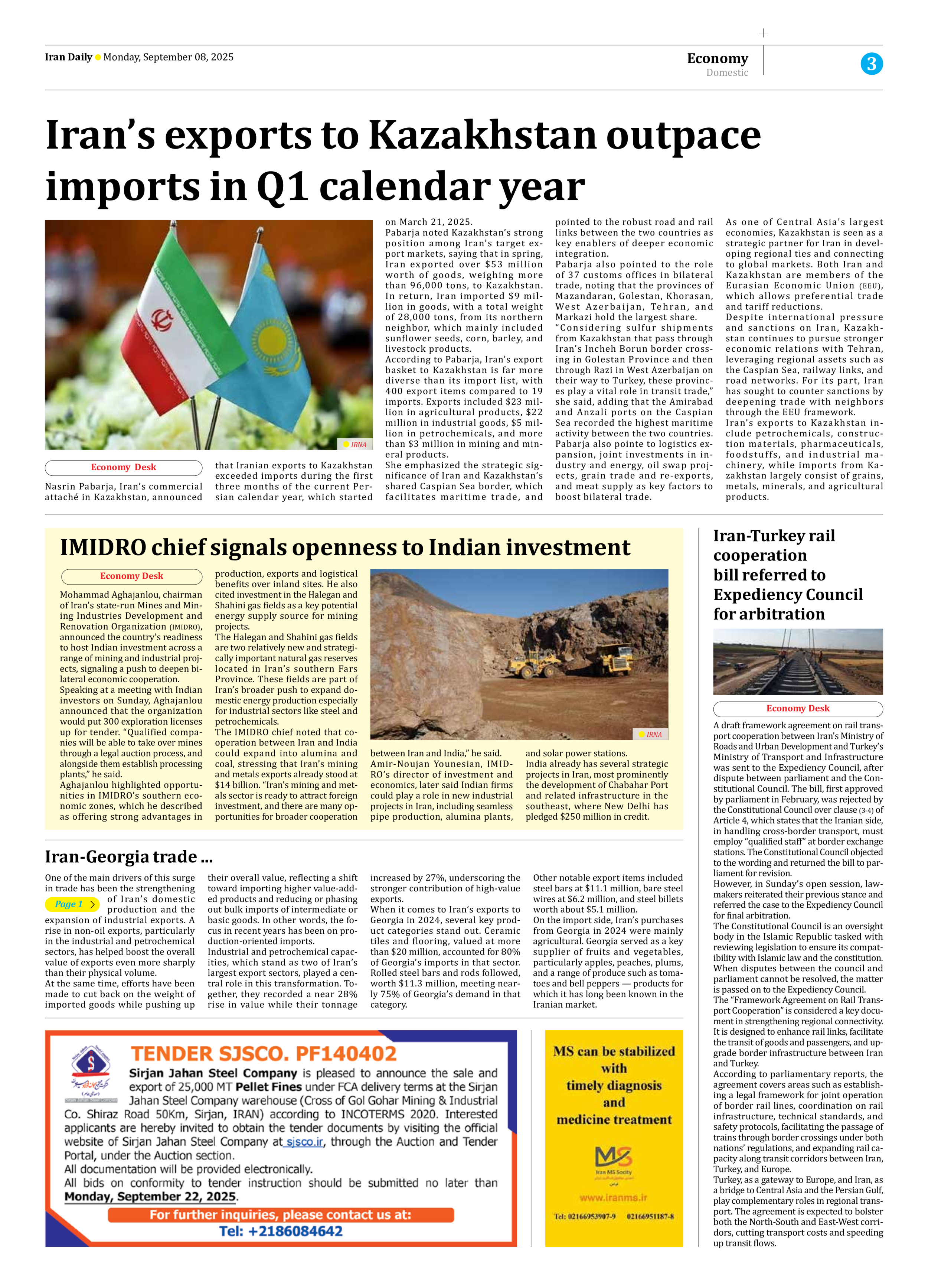


Iran’s exports to Kazakhstan outpace imports in Q1 calendar year
Nasrin Pabarja, Iran’s commercial attaché in Kazakhstan, announced that Iranian exports to Kazakhstan exceeded imports during the first three months of the current Persian calendar year, which started on March 21, 2025.
Pabarja noted Kazakhstan’s strong position among Iran’s target export markets, saying that in spring, Iran exported over $53 million worth of goods, weighing more than 96,000 tons, to Kazakhstan. In return, Iran imported $9 million in goods, with a total weight of 28,000 tons, from its northern neighbor, which mainly included sunflower seeds, corn, barley, and livestock products.
According to Pabarja, Iran’s export basket to Kazakhstan is far more diverse than its import list, with 400 export items compared to 19 imports. Exports included $23 million in agricultural products, $22 million in industrial goods, $5 million in petrochemicals, and more than $3 million in mining and mineral products.
She emphasized the strategic significance of Iran and Kazakhstan’s shared Caspian Sea border, which facilitates maritime trade, and pointed to the robust road and rail links between the two countries as key enablers of deeper economic integration.
Pabarja also pointed to the role of 37 customs offices in bilateral trade, noting that the provinces of Mazandaran, Golestan, Khorasan, West Azerbaijan, Tehran, and Markazi hold the largest share.
“Considering sulfur shipments from Kazakhstan that pass through Iran’s Incheh Borun border crossing in Golestan Province and then through Razi in West Azerbaijan on their way to Turkey, these provinces play a vital role in transit trade,” she said, adding that the Amirabad and Anzali ports on the Caspian Sea recorded the highest maritime activity between the two countries.
Pabarja also pointe to logistics expansion, joint investments in industry and energy, oil swap projects, grain trade and re-exports, and meat supply as key factors to boost bilateral trade.
As one of Central Asia’s largest economies, Kazakhstan is seen as a strategic partner for Iran in developing regional ties and connecting to global markets. Both Iran and Kazakhstan are members of the Eurasian Economic Union (EEU), which allows preferential trade and tariff reductions.
Despite international pressure and sanctions on Iran, Kazakhstan continues to pursue stronger economic relations with Tehran, leveraging regional assets such as the Caspian Sea, railway links, and road networks. For its part, Iran has sought to counter sanctions by deepening trade with neighbors through the EEU framework.
Iran’s exports to Kazakhstan include petrochemicals, construction materials, pharmaceuticals, foodstuffs, and industrial machinery, while imports from Kazakhstan largely consist of grains, metals, minerals, and agricultural products.