







Tracing 12,000 years of human habitation at Chogha Golan
Chogha Golan Archaeological Site, located in Mehran, Ilam Province, is recognized as the oldest agricultural site in both Iran and the broader Middle East, according to an archaeologist Habibollah Mahmoudian.
He emphasized that within the Golan region, a wealth of human settlement remnants from various historical periods have been discovered, painting an extensive timeline of continuous habitation largely supported by the steady flow of the permanent Kanjan Cham river. This water source has been instrumental in sustaining human life and settlement in the area over millennia.
Mahmoudian highlighted that archaeological investigations reveal significant contributions from the late Ali Mohammad Khalilian, who conducted studies in Mehran from the 1980s through the early 2000s. Khalilian successfully identified notable ancient sites within the region, including Chogha Golan 1 and Chogha Golan 2.
Further reinforcing the historical significance of the area, in 2003, additional discoveries were made encompassing the ancient site itself, its historic qanat irrigation system, a caravanserai, an ancient mound, and remains from Islamic-period settlements. These findings have been comprehensively documented, leading to their nomination for inclusion on Iran’s National Heritage List, ISNA wrote.
In the same year, an exploration led by Mohsen Zeidi focused on the eastern area of the site, which naturally separates the Mehran and Dehloran plains. This survey uncovered archaeological sites from a wide temporal span, ranging from the Proto-literate period to the historical era. Mahmoudian went on to state that systematic excavations and surveys began in 2010 to create detailed mappings of the area. These efforts continued through two excavation seasons, and radiocarbon dating of collected samples revealed uninterrupted human habitation at Chogha Golan from roughly the mid-10th millennium BCE through to the end of the 8th millennium BCE.
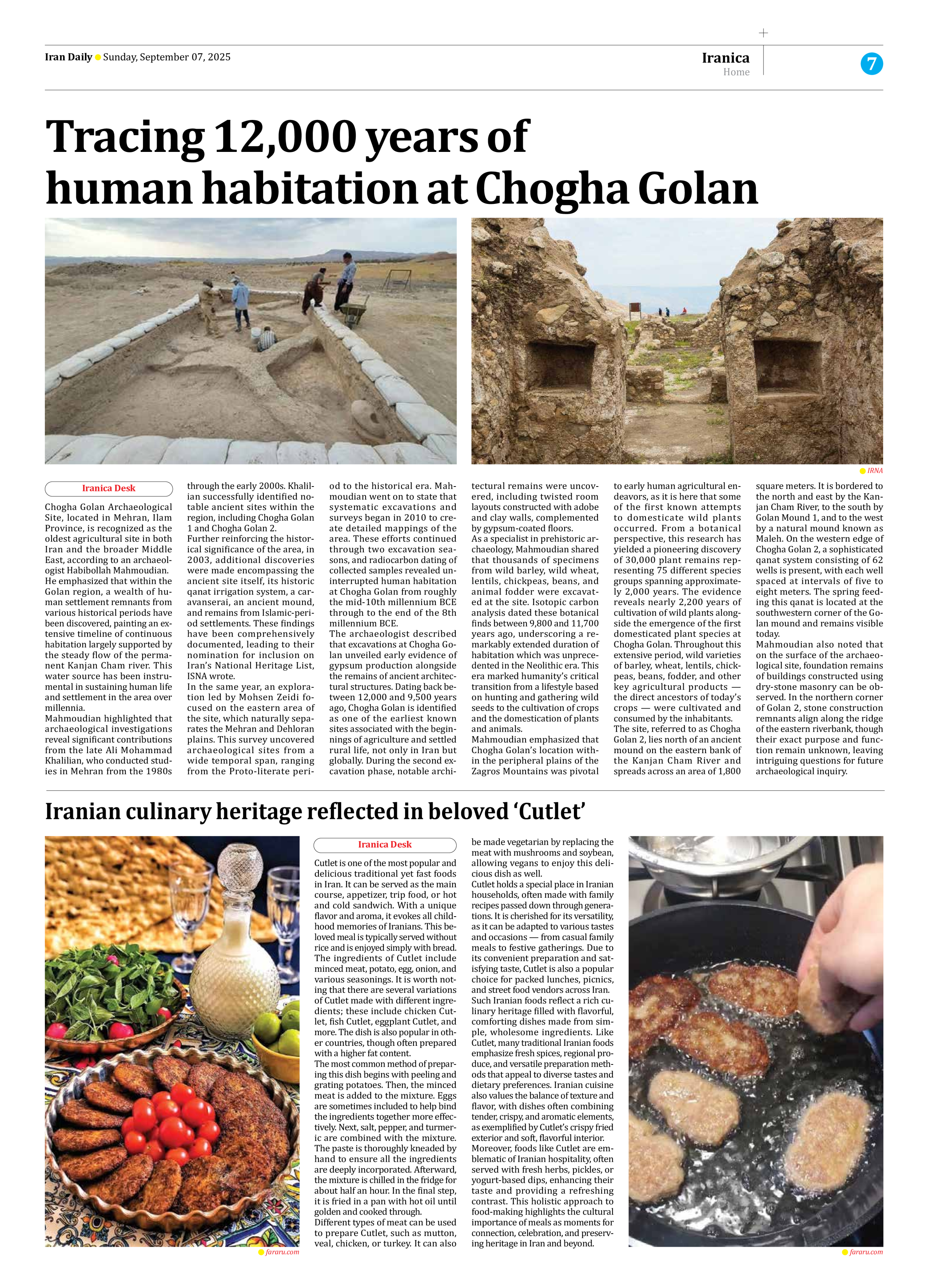
The archaeologist described that excavations at Chogha Golan unveiled early evidence of gypsum production alongside the remains of ancient architectural structures. Dating back between 12,000 and 9,500 years ago, Chogha Golan is identified as one of the earliest known sites associated with the beginnings of agriculture and settled rural life, not only in Iran but globally. During the second excavation phase, notable architectural remains were uncovered, including twisted room layouts constructed with adobe and clay walls, complemented by gypsum-coated floors.
As a specialist in prehistoric archaeology, Mahmoudian shared that thousands of specimens from wild barley, wild wheat, lentils, chickpeas, beans, and animal fodder were excavated at the site. Isotopic carbon analysis dated these botanical finds between 9,800 and 11,700 years ago, underscoring a remarkably extended duration of habitation which was unprecedented in the Neolithic era. This era marked humanity’s critical transition from a lifestyle based on hunting and gathering wild seeds to the cultivation of crops and the domestication of plants and animals.
Mahmoudian emphasized that Chogha Golan’s location within the peripheral plains of the Zagros Mountains was pivotal to early human agricultural endeavors, as it is here that some of the first known attempts to domesticate wild plants occurred. From a botanical perspective, this research has yielded a pioneering discovery of 30,000 plant remains representing 75 different species groups spanning approximately 2,000 years. The evidence reveals nearly 2,200 years of cultivation of wild plants alongside the emergence of the first domesticated plant species at Chogha Golan. Throughout this extensive period, wild varieties of barley, wheat, lentils, chickpeas, beans, fodder, and other key agricultural products — the direct ancestors of today’s crops — were cultivated and consumed by the inhabitants.
The site, referred to as Chogha Golan 2, lies north of an ancient mound on the eastern bank of the Kanjan Cham River and spreads across an area of 1,800 square meters. It is bordered to the north and east by the Kanjan Cham River, to the south by Golan Mound 1, and to the west by a natural mound known as Maleh. On the western edge of Chogha Golan 2, a sophisticated qanat system consisting of 62 wells is present, with each well spaced at intervals of five to eight meters. The spring feeding this qanat is located at the southwestern corner of the Golan mound and remains visible today.
Mahmoudian also noted that on the surface of the archaeological site, foundation remains of buildings constructed using dry-stone masonry can be observed. In the northern corner of Golan 2, stone construction remnants align along the ridge of the eastern riverbank, though their exact purpose and function remain unknown, leaving intriguing questions for future archaeological inquiry.