







Qom‘s Mulla Sadra House catapulting visitors to history
Mulla Sadra House, in Qom Province, is a historical building where Sadr-ol Din Muhammad Shirazi, titled Sadr-ol-Mote’allehin and known as Mulla Sadra, lived for fifteen years. He was born in 1572 during the Safavid dynasty. This Iranian philosopher decided to move to Kahak near Qom to stay away from the Safavid court in Isfahan.
Sadr-ol-Mote’allehin built the Khan School in Shiraz, after which, following the request of Allhverdi Khan Undiladze, the general and commander-in-chief of the Safavid army and ruler of Fars province, he returned to this city.
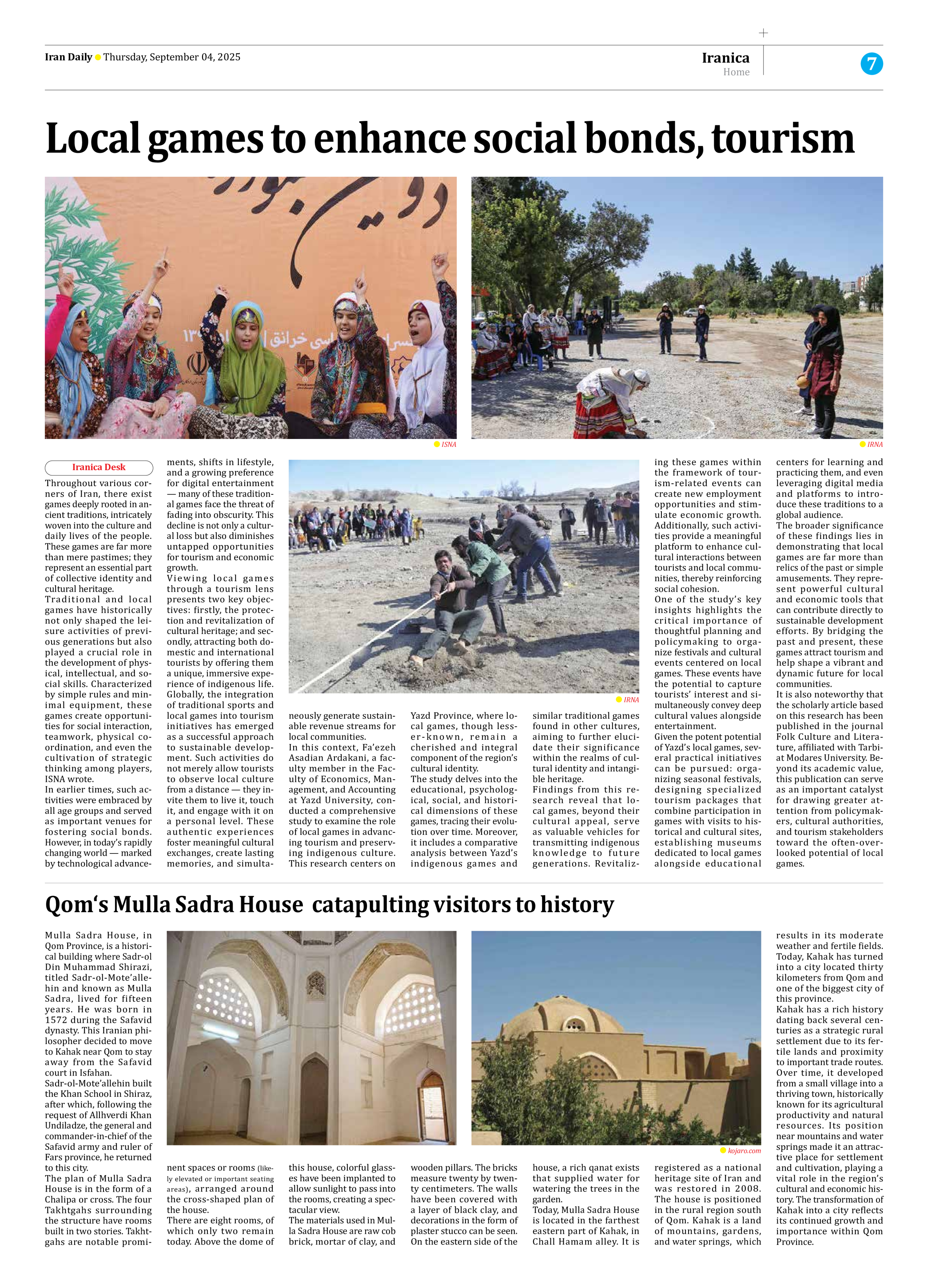
The plan of Mulla Sadra House is in the form of a Chalipa or cross. The four Takhtgahs surrounding the structure have rooms built in two stories. Takhtgahs are notable prominent spaces or rooms (likely elevated or important seating areas), arranged around the cross-shaped plan of the house.
There are eight rooms, of which only two remain today. Above the dome of this house, colorful glasses have been implanted to allow sunlight to pass into the rooms, creating a spectacular view.
The materials used in Mulla Sadra House are raw cob brick, mortar of clay, and wooden pillars. The bricks measure twenty by twenty centimeters. The walls have been covered with a layer of black clay, and decorations in the form of plaster stucco can be seen. On the eastern side of the house, a rich qanat exists that supplied water for watering the trees in the garden.
Today, Mulla Sadra House is located in the farthest eastern part of Kahak, in Chall Hamam alley. It is registered as a national heritage site of Iran and was restored in 2008. The house is positioned in the rural region south of Qom. Kahak is a land of mountains, gardens, and water springs, which results in its moderate weather and fertile fields. Today, Kahak has turned into a city located thirty kilometers from Qom and one of the biggest city of this province.
Kahak has a rich history dating back several centuries as a strategic rural settlement due to its fertile lands and proximity to important trade routes. Over time, it developed from a small village into a thriving town, historically known for its agricultural productivity and natural resources. Its position near mountains and water springs made it an attractive place for settlement and cultivation, playing a vital role in the region’s cultural and economic history. The transformation of Kahak into a city reflects its continued growth and importance within Qom Province.