







Local games to enhance social bonds, tourism
Throughout various corners of Iran, there exist games deeply rooted in ancient traditions, intricately woven into the culture and daily lives of the people. These games are far more than mere pastimes; they represent an essential part of collective identity and cultural heritage.
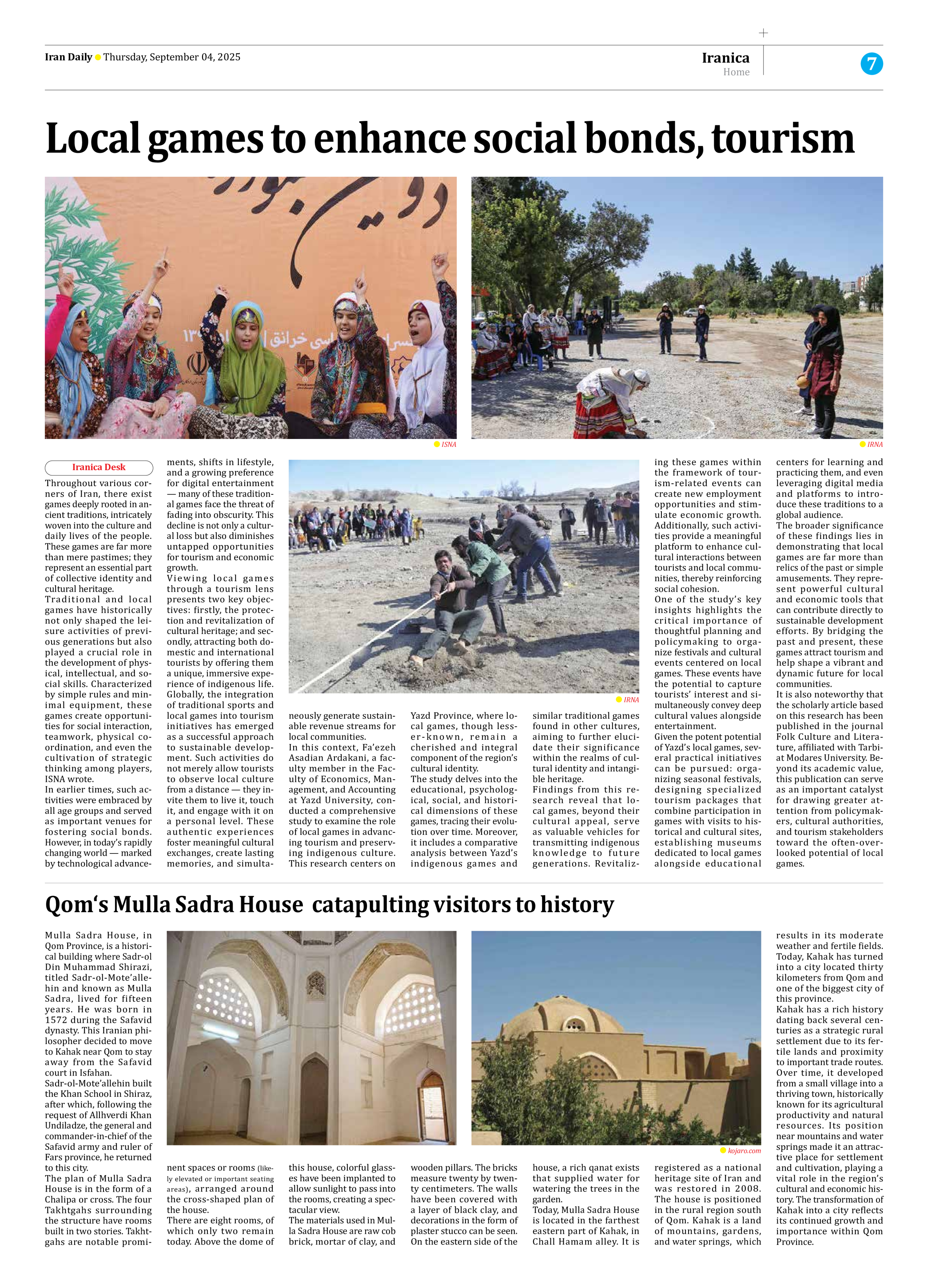
Traditional and local games have historically not only shaped the leisure activities of previous generations but also played a crucial role in the development of physical, intellectual, and social skills. Characterized by simple rules and minimal equipment, these games create opportunities for social interaction, teamwork, physical coordination, and even the cultivation of strategic thinking among players, ISNA wrote.
In earlier times, such activities were embraced by all age groups and served as important venues for fostering social bonds. However, in today’s rapidly changing world — marked by technological advancements, shifts in lifestyle, and a growing preference for digital entertainment — many of these traditional games face the threat of fading into obscurity. This decline is not only a cultural loss but also diminishes untapped opportunities for tourism and economic growth.
Viewing local games through a tourism lens presents two key objectives: firstly, the protection and revitalization of cultural heritage; and secondly, attracting both domestic and international tourists by offering them a unique, immersive experience of indigenous life. Globally, the integration of traditional sports and local games into tourism initiatives has emerged as a successful approach to sustainable development. Such activities do not merely allow tourists to observe local culture from a distance — they invite them to live it, touch it, and engage with it on a personal level. These authentic experiences foster meaningful cultural exchanges, create lasting memories, and simultaneously generate sustainable revenue streams for local communities.
In this context, Fa’ezeh Asadian Ardakani, a faculty member in the Faculty of Economics, Management, and Accounting at Yazd University, conducted a comprehensive study to examine the role of local games in advancing tourism and preserving indigenous culture. This research centers on Yazd Province, where local games, though lesser-known, remain a cherished and integral component of the region’s cultural identity.
The study delves into the educational, psychological, social, and historical dimensions of these games, tracing their evolution over time. Moreover, it includes a comparative analysis between Yazd’s indigenous games and similar traditional games found in other cultures, aiming to further elucidate their significance within the realms of cultural identity and intangible heritage.
Findings from this research reveal that local games, beyond their cultural appeal, serve as valuable vehicles for transmitting indigenous knowledge to future generations. Revitalizing these games within the framework of tourism-related events can create new employment opportunities and stimulate economic growth. Additionally, such activities provide a meaningful platform to enhance cultural interactions between tourists and local communities, thereby reinforcing social cohesion.
One of the study’s key insights highlights the critical importance of thoughtful planning and policymaking to organize festivals and cultural events centered on local games. These events have the potential to capture tourists’ interest and simultaneously convey deep cultural values alongside entertainment.
Given the potent potential of Yazd’s local games, several practical initiatives can be pursued: organizing seasonal festivals, designing specialized tourism packages that combine participation in games with visits to historical and cultural sites, establishing museums dedicated to local games alongside educational centers for learning and practicing them, and even leveraging digital media and platforms to introduce these traditions to a global audience.
The broader significance of these findings lies in demonstrating that local games are far more than relics of the past or simple amusements. They represent powerful cultural and economic tools that can contribute directly to sustainable development efforts. By bridging the past and present, these games attract tourism and help shape a vibrant and dynamic future for local communities.
It is also noteworthy that the scholarly article based on this research has been published in the journal Folk Culture and Literature, affiliated with Tarbiat Modares University. Beyond its academic value, this publication can serve as an important catalyst for drawing greater attention from policymakers, cultural authorities, and tourism stakeholders toward the often-overlooked potential of local games.